
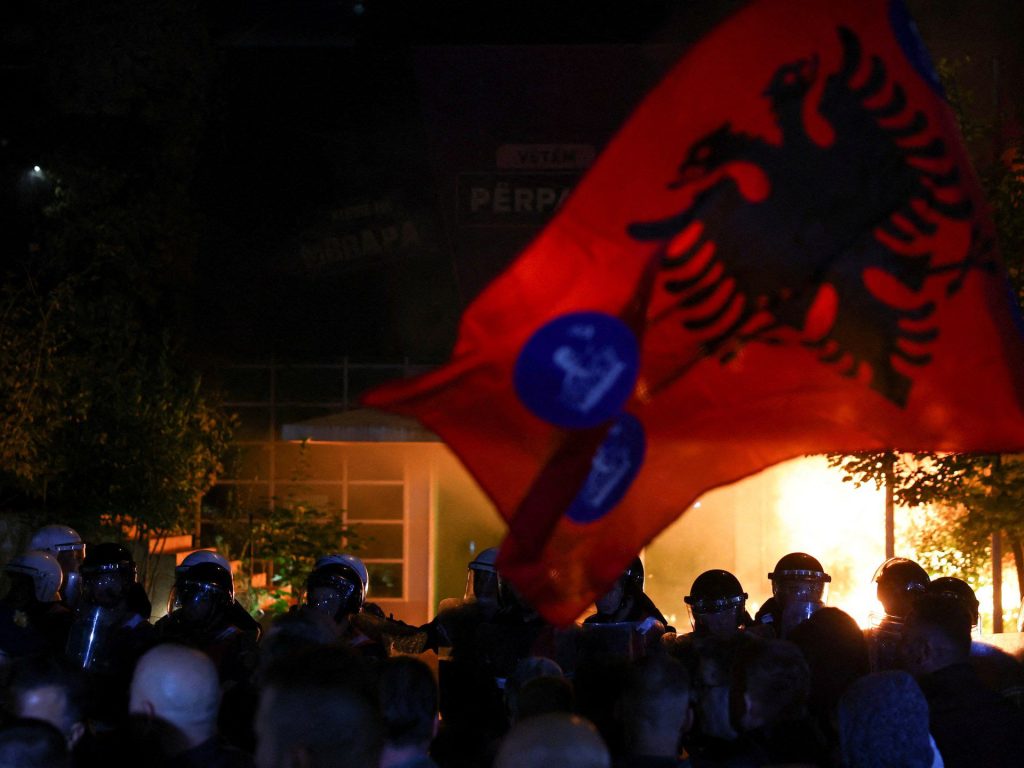
International media outlets extensively covered the Albanian opposition protest held on January 24, 2026, focusing on violent confrontations, the use of Molotov cocktails, and the deployment of tear gas and water cannons by police forces in the center of Tirana.
Thousands of protesters gathered near key government institutions, where tensions quickly escalated into clashes between demonstrators and security forces. The protest, organized by the opposition and led by former Prime Minister Sali Berisha, was framed as part of a broader campaign against the government of Prime Minister Edi Rama, whom opposition leaders accuse of corruption, nepotism, and state capture.
According to Associated Press (AP), large groups of protesters attempted to breach police cordons, throwing “flares and other objects” at law enforcement officers. The agency described chaotic scenes as security forces struggled to contain the crowd amid escalating violence.
Reuters reported that protesters hurled Molotov cocktails and fireworks toward the Prime Minister’s office, highlighting the opposition’s claims that corruption and nepotism within the government were at the core of public anger. The report underlined the symbolic targeting of state institutions as a sign of deep political polarization.
Coverage by Barron’s, based on reporting from Agence France-Presse (AFP), stated that “clashes erupted” between police and protesters, who accuse Prime Minister Rama of corruption and are demanding his resignation. The report also noted that at least ten police officers sustained minor injuries during the confrontations, underscoring the intensity of the violence.
Italy’s national news agency ANSA reported that thousands of protesters gathered in front of the Prime Minister’s office calling for Rama’s resignation. The agency emphasized the масштаб of security measures, including the deployment of approximately 1,600 police officers, reflecting authorities’ concerns over public order and institutional security.
German broadcaster Deutsche Welle (DW) reported that protesters attempted to “occupy parliament,” prompting police to respond with tear gas. The outlet framed the events within a broader narrative of political instability and escalating confrontation between the government and the opposition.
Across international reporting, a common narrative emerged: Albania is experiencing a deepening political crisis marked by mass mobilization, violent street confrontations, and hardening rhetoric. Opposition leaders reiterated their commitment to continue the protests, describing the movement as the “final stretch toward the end of Edi Rama’s regime,” a phrase widely echoed in foreign media coverage.
The events of January 24 place Albania under renewed international scrutiny, raising concerns about political stability, democratic governance, and the normalization of violence in political protest. For global audiences, the images from Tirana presented not only a domestic political struggle, but a broader warning sign of institutional fragility in a region where democratic transitions remain under constant pressure.