
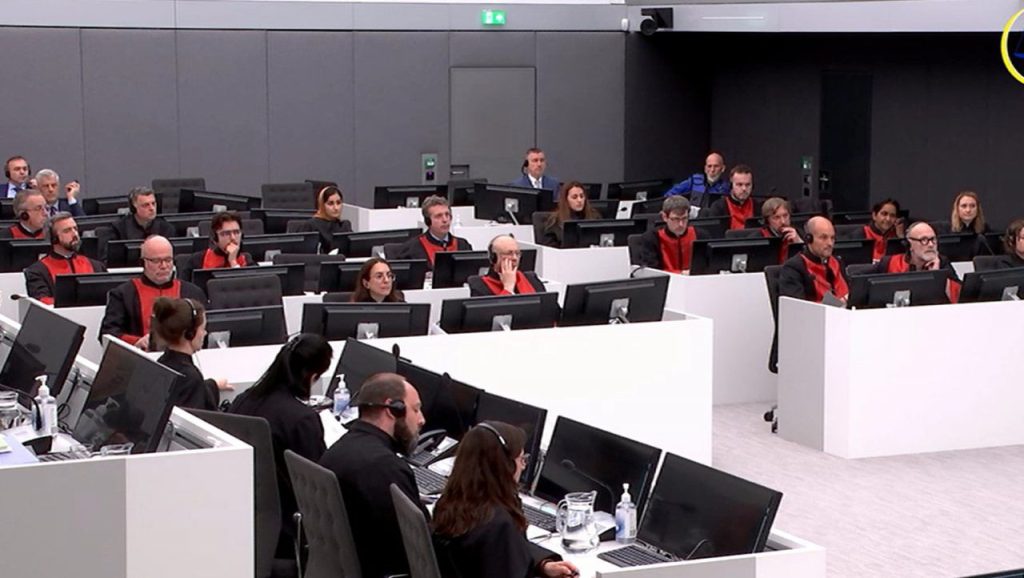
The case against the former leaders of the Kosovo Liberation Army was meant to be the defining moment for the Specialist Chambers—a test of whether international justice could handle history, law, and politics with precision. Instead, the prosecution’s closing act exposed a troubling weakness: punishment was articulated clearly, but individual guilt was not.
Requesting 45 years of imprisonment for each defendant, without publicly articulating concrete, individualized criminal conduct for each one, does not project rigor. It projects haste.
International criminal law is built on a foundational principle: individual criminal responsibility. Rank, symbolism, or historical role cannot substitute for proof of specific acts, intent, and causal contribution. Courts do not sentence movements, causes, or eras; they sentence people. When prosecutors ask for identical, near-life sentences across the board, the burden to demonstrate differentiated responsibility becomes heavier—not lighter.
That burden was not met convincingly.
The prosecution insisted that it was not judging the KLA as a structure, nor criminalizing a liberation struggle. Yet by advancing uniform sentences of extraordinary severity, absent a clearly individualized public narrative of culpability, it blurred precisely that line. The message received—especially in societies shaped by the conflict—is not one of legal nuance, but of collective reproach.
This is not an argument against accountability. War crimes, if proven, must be punished—regardless of the flag under which they were committed. But severity without specificity is not justice. It is assertion.
Comparative jurisprudence makes the imbalance more striking. In multiple international tribunals, perpetrators of systematic, state-organized atrocities have received sentences equal to or lower than those now sought against leaders of a force born in resistance to repression. Such contrasts demand explanation. Silence, in this context, becomes a statement of its own.
The credibility of international justice does not rest on how harshly it can punish, but on how carefully it can distinguish. When prosecutors appear to reach for maximum sentences before convincingly mapping individual actions to individual crimes, the process risks looking less like adjudication and more like a blunt political signal.
Justice must be seen to think before it condemns.
Without a clear, individualized accounting of who did what, when, and with what intent, asking for 45 years per defendant does not read as meticulous prosecution. It reads as careless escalation—and that is a dangerous posture for any court claiming moral and legal authority over history.
If international justice is to endure, it must prove that it can handle complex wars without flattening them into numbers. Otherwise, it will not only judge defendants—it will judge itself.