
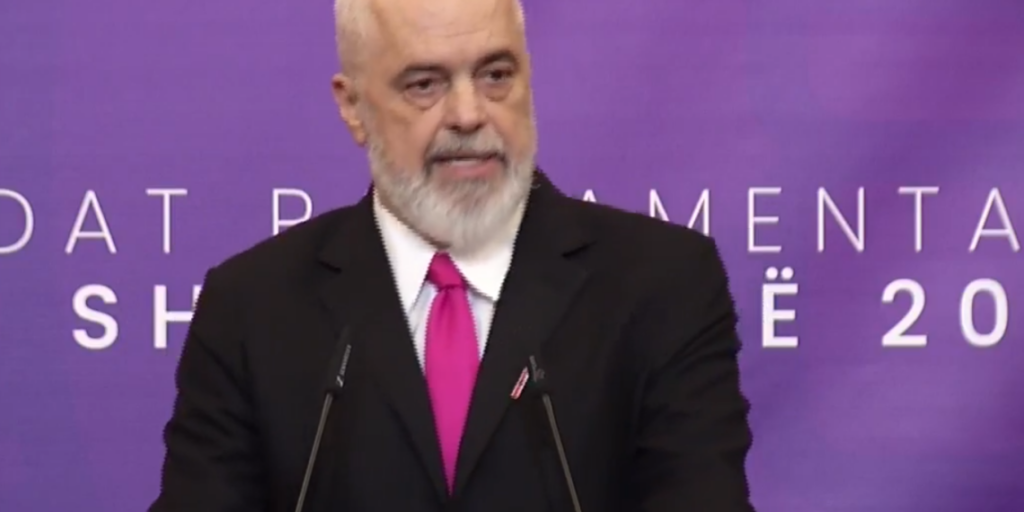
There is a moment in every democracy when a leader’s language reveals more than his policy. Edi Rama’s prolonged address to his parliamentary group was not merely a political defense of a colleague under pressure. It was something more unsettling: a demonstration of how power reacts when institutions begin to act beyond its comfort zone.
For nearly a decade, justice reform has been presented as Albania’s irreversible path toward European standards. The creation and empowerment of anti-corruption structures were framed as proof that the era of untouchable elites was over. The promise was simple: no one would stand above the law.
Today, that promise is being tested at the highest levels of government.
Instead of responding to prosecutorial developments with institutional restraint, the prime minister chose confrontation disguised as concern. He did not reject reform outright. That would have been politically costly. Instead, he reframed it as a system that is overreaching, destabilizing governance, threatening rights, and creating “side effects.” This is a classic strategy of control: undermine the credibility of the referee without openly abolishing the game.
The pattern is familiar in many democracies that slowly drift toward centralization of power. Leaders do not attack institutions head-on. They question their balance, their professionalism, their proportionality. They suggest the need for recalibration. They speak of stability. They frame themselves as protectors of order against chaos.
In this context, Rama’s message becomes more troubling. By portraying himself as the only political figure capable of preserving both reform and stability, he narrows the space between state and leadership. The implicit narrative is this: without him, the system collapses; with him, equilibrium survives.
That is not institutional democracy. That is personalization of the state.
The most concerning aspect is not rhetorical aggression toward critics or smaller political actors. That is routine political theater. The deeper concern lies in the shift from defending reform to managing its limits. When executive power begins to define how far independent institutions are allowed to go, the principle of separation weakens.
Democracy requires discomfort for those in power. It requires leaders to tolerate scrutiny even when it reaches their inner circle. It demands that accountability mechanisms operate without political recalibration. If the response to institutional pressure is to question the legitimacy of that pressure itself, then the system begins to bend toward control.
There is also a broader psychological shift underway. When a prime minister suggests that prosecutors are excessive, that arrests are disproportionate, that rights are endangered, the subtext is powerful: institutions are becoming the problem. Once that narrative takes hold, public trust in independent bodies erodes. And when trust erodes, political authority reclaims ground.
This is how soft authoritarianism advances—not through abrupt coups or overt dismantling of structures, but through gradual delegitimization and concentration of narrative power.
Rama’s extended speech was not just about one official. It was about defining who sets the boundaries of accountability. If those boundaries are increasingly shaped by executive rhetoric rather than legal process, then Albania risks entering a new phase—one where reform survives in name but operates within politically tolerated limits.
A democratic leader trusts institutions even when they are inconvenient. An authoritarian-leaning leader tolerates them only when they are manageable.
Albania now faces a decisive question: Is justice reform an independent pillar of the state, or is it becoming subject to the gravitational pull of a leader unwilling to relinquish control?
The answer will determine whether the country deepens its democratic maturity—or slides quietly toward a system where power speaks of reform while steadily redefining its reach.