
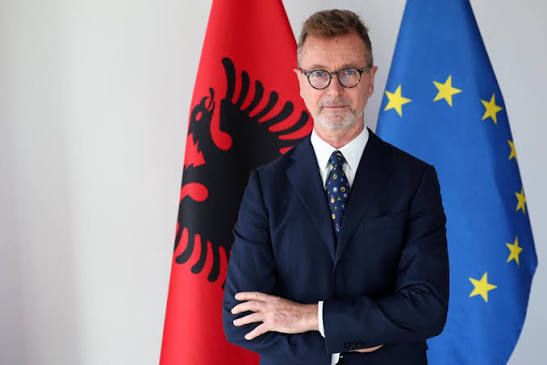
The public clash between Silvio Gonzato and Sali Berisha has exposed something far deeper than another routine political confrontation: the growing perception that international diplomacy in Albania is no longer seen as neutral oversight, but increasingly as an active player inside the country’s political battlefield.
Berisha accused the EU ambassador of being “unified with Rama” and of allegedly transmitting distorted narratives about the opposition to Brussels. The response from European ambassadors was immediate and unusually coordinated, publicly defending Gonzato’s professionalism, integrity and commitment.
But beyond the diplomatic statements, the episode highlights a wider crisis of trust. In Albania, distrust is no longer directed only at domestic politics. It is increasingly extending toward international actors themselves.
For years, Albania’s political class has used international representatives as instruments of legitimacy. When ambassadors praise the government, state-friendly propaganda presents it as international certification of success. When they criticize the opposition, those remarks become political ammunition. The opposition behaves similarly: embracing international voices when useful and attacking them when they are not.
The consequence is dangerous. Diplomacy itself risks losing neutrality in the eyes of the public.
Many Albanians increasingly perceive parts of the international community as excessively comfortable with the ruling establishment. For years, foreign diplomats have spoken about “progress,” “stability,” and “European reforms,” while ordinary citizens continue to face corruption scandals, institutional distrust, economic stagnation and mass emigration.
That is the environment where accusations like Berisha’s find resonance. Not necessarily because the public blindly trusts the opposition, but because many citizens feel there is now a visible disconnect between the optimistic language of international diplomacy and the reality experienced on the ground.
At the same time, personal attacks against diplomats do not strengthen democratic debate either. When every international representative is labeled “captured,” “biased,” or politically aligned, the country risks sliding into a culture where every institution is automatically viewed as propaganda machinery.
Still, European diplomacy should also understand something important: in countries with deep public distrust like Albania, neutrality is not protected merely through statements of solidarity among ambassadors. It is protected through visible distance from political propaganda, equal standards toward all political actors, and the willingness to speak clearly even when the problems originate from those currently in power.
Otherwise, every public defense of a diplomat risks being interpreted not as a defense of European values, but as another symbol of the perceived alliance between political power and the international establishment.