
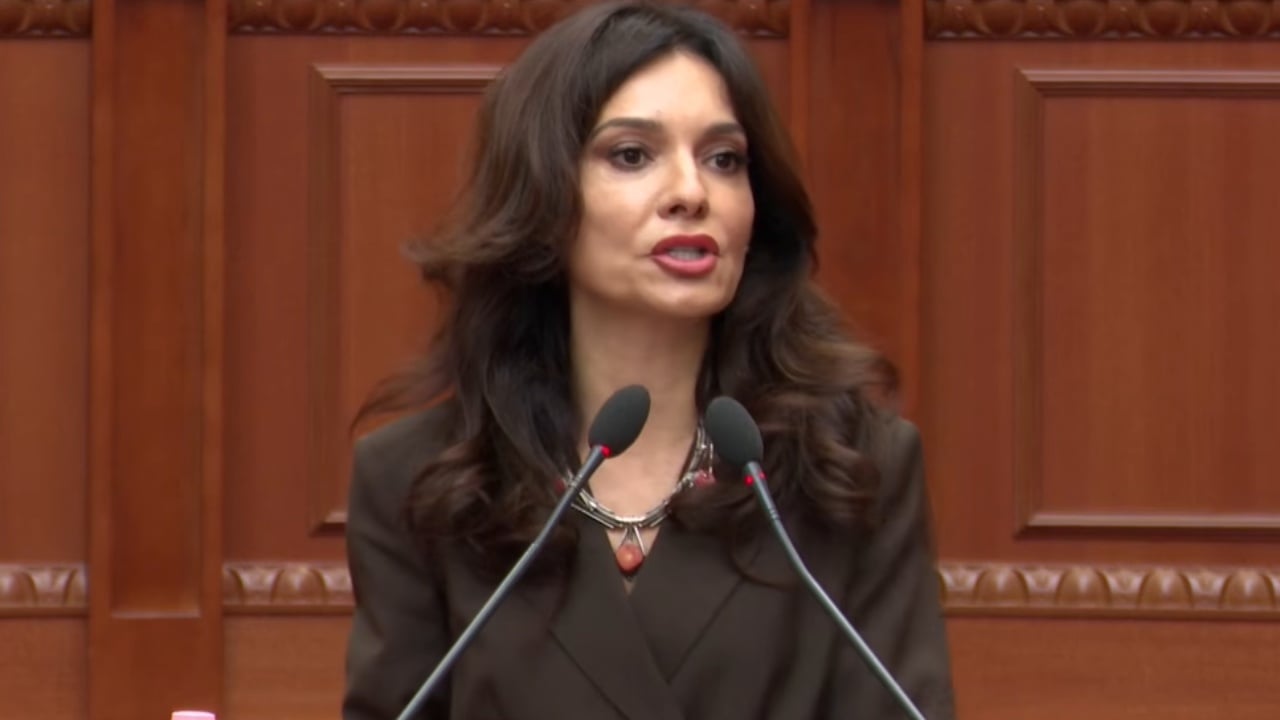
Elisa Spiropali reacted in a plenary session following the decision of the Specialized Chambers in The Hague on the former KLA leaders, describing it as a development with political and historical consequences. In her speech, she called for Albania and Kosovo to come forward with a joint institutional stance, while also raising the need for financial and political support for the defense of Albanians in The Hague.
Strong criticism of the Hague decision
From the parliament podium, Spiropali described the decision as “cruel,” “unjust,” and a dangerous precedent. According to her, the issue is not linked only to the fate of the accused, but also to the way the history of the Kosovo war may be written and read.
She also connected this development to the debate on international justice in the case of Ukraine, arguing that the relationship between victim and aggressor is being presented in reverse in the treatment of the Kosovo war.
Claims of a distortion of the historical narrative
Spiropali said the narrative built around this process risks distorting collective memory and the historical rights of Albanians. According to her, although the judgment, in the version she referred to, does not speak of crimes against humanity, the way it has been formulated remains deeply problematic.
Along the same lines, she challenged the basis on which, according to her, the Specialized Chambers were established, claiming they were created on reports and accusations that were later not proven.
Call for institutional unity between Albania and Kosovo
The strongest political part of her speech was the call for Tirana and Pristina to unite in a coordinated effort. Spiropali said there should be “two hands” both in the government of Albania and in the government of Kosovo, as well as in parliament, to support the defense of Albanians in The Hague.
She spoke openly about the need for engagement not only at the institutional level, but also financially, raising the question of what must happen for the Albanian political class to become a single voice on issues affecting Kosovo and its war.
Comparisons with Ukraine and the toll of the Kosovo war
In her argument, Spiropali cited the war in Ukraine as a comparison and the way the international community reacts to aggression. According to her, it is impossible to speak of justice in one case and not view the context of the Kosovo war by the same standard.
She also recalled the human toll of the war, with thousands killed and civilians massacred, stressing that the perpetrators of many of these crimes remain unpunished. Against this backdrop, according to her, any treatment that places the aggressor and the side that rose up for survival on the same scale carries political consequences beyond the courtroom.
Spiropali’s statement shifted the debate from the strictly judicial aspect to the clash over the political and historical interpretation of the Kosovo war. At its core, her message was clear: the Hague decision is not being read simply as a matter of justice, but as another test of how united or divided the Albanian factor remains when confronting international institutions.