
A setup placed outside the Prime Minister’s Office with chairs and papers bearing the message “dialogue” did not soften the atmosphere of the protest. Students who marched to the building this morning publicly rejected the offer, tearing up the papers and knocking over the chairs, as tensions shifted to a verbal confrontation with the government’s communication representative.
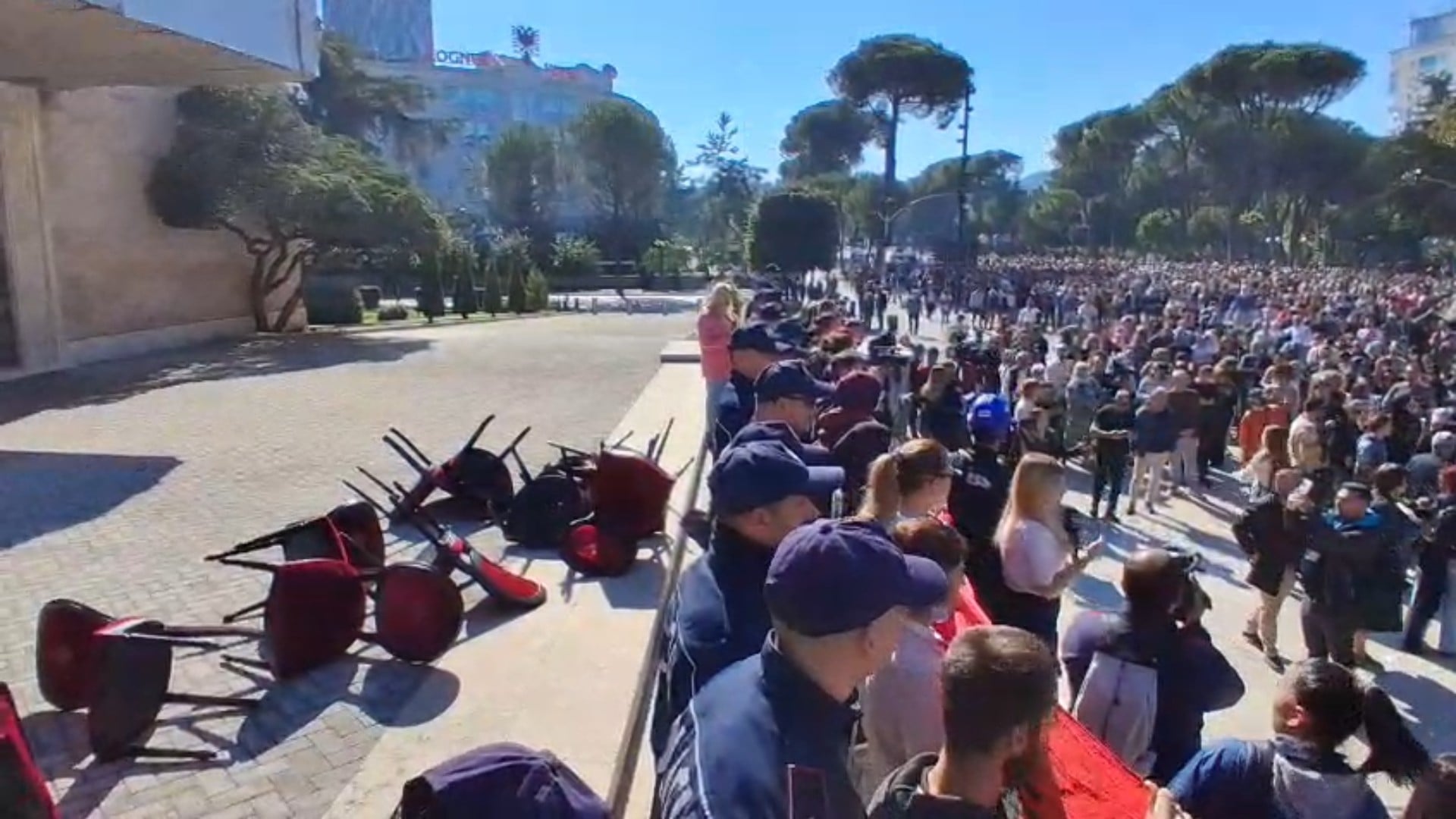
The “dialogue” chairs became a sign of rejection
At the start of the protest, several chairs had been placed outside the Prime Minister’s Office, each with a paper left on it carrying the message “dialogue.” According to the version presented by the government, this was a signal for communication with the protesters.
The students who arrived outside the building did not accept this framework. They tore up the papers placed on the chairs and knocked them over, in a gesture that clearly signaled their rejection of the format offered by the prime minister.
Confrontation with the director of MIA
During the protest, there was also a confrontation between the demonstrators and Manjola Hasa, director of the Agency for Media and Information. She said she was there to convey the request of any student who wished to speak with the prime minister.
According to her, Edi Rama’s position remains the same and anyone seeking dialogue is welcome. The message delivered by the institution’s representative was based on the idea that the prime minister is open to meeting with students.
Protesters demanded answers over the police
The response from the protest was direct and accusatory toward the approach of the institutions. One of the protesters demanded answers over the way, according to him, the police are acting toward students.
“Give an account of why the police are assaulting students without any identification, then ask for dialogue,” was the response voiced to the MIA representative. This moment shifted the focus from the symbolic offer of “dialogue” to doubts and dissatisfaction over the conduct of law enforcement.
The political message collided with distrust on the ground
What was seen outside the Prime Minister’s Office showed that the attempt to impose a communication scene from above was not received by protesters as a solution. On the contrary, it was perceived as a gesture that avoids the core of the discontent expressed in the square.
The students’ refusal to enter this format makes it clear that, for them, the issue is not only the invitation to dialogue, but the demand for responsibility and accountability from institutions.
The scenes and reactions from today’s protest showed a heated atmosphere outside the Prime Minister’s Office, where the symbolism offered by the government was met with open rejection on the ground.
Beyond the official messages about dialogue, the protest highlighted the visible gap between institutional communication and the protesters’ trust in it.