
The debate on the 2027 draft budget brought one of the strongest criticisms from within the majority, as Socialist MP Erion Braçe targeted the way public funds are managed and called for the removal of ministers who, according to him, fail to implement the budget. From the Parliament podium, he raised questions not only about unspent expenditures, but also about the economic model, support for industry and agriculture, and the dependence of local government on the central government.
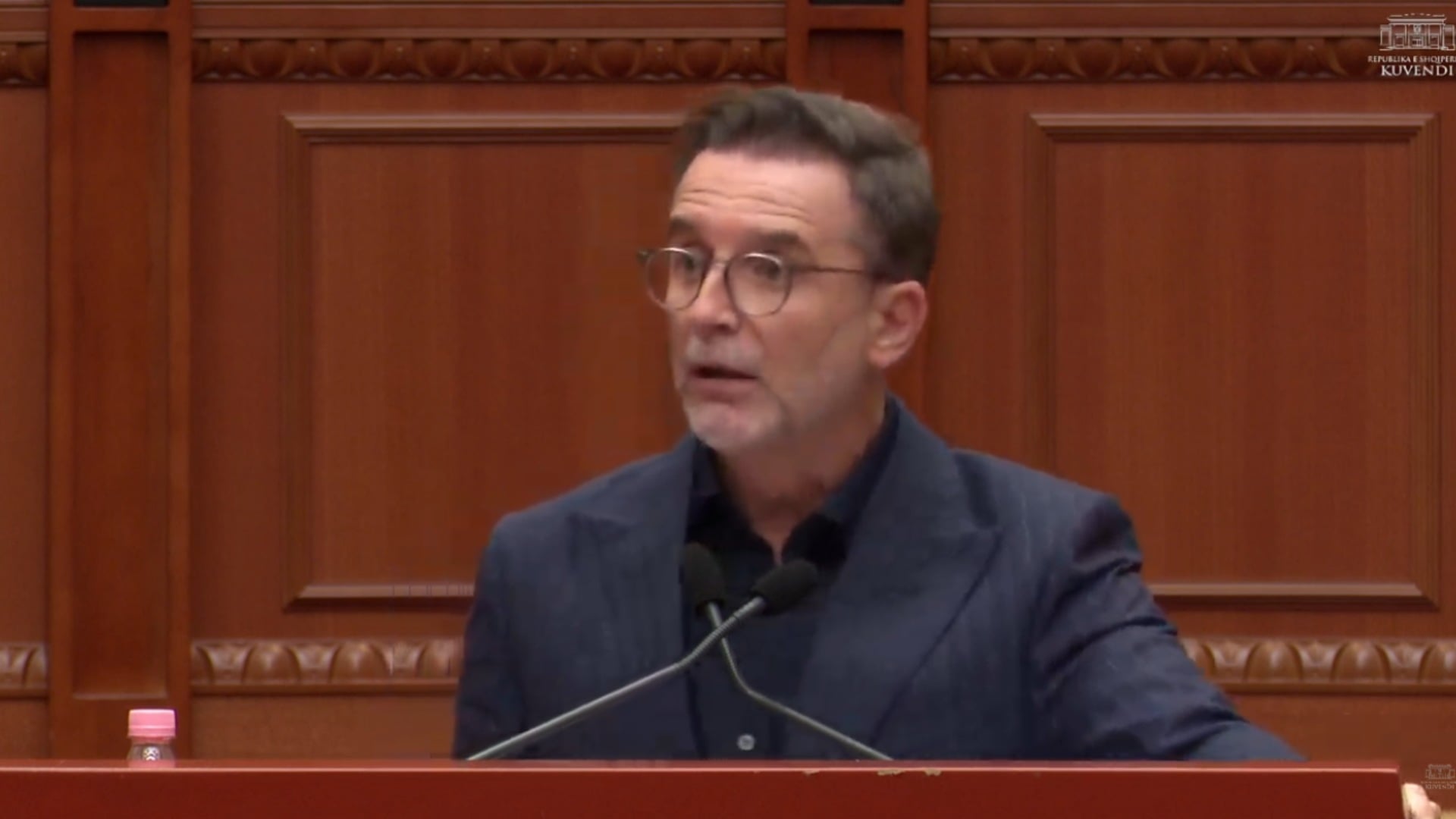
Direct call for the removal of ministers
Braçe said it cannot be accepted that for years the same scenario has been repeated: budget revenues are realized, while planned expenditures fall behind. For the Socialist MP, this is not simply a technical issue, but a political responsibility that should have consequences in government.
He recalled that he had made the same demand a year earlier, insisting that ministers who fail to use approved funds effectively should not remain in office. At the core of his criticism was the administration of public money, for which he said incompetence and mismanagement cannot pass without political cost.
Criticism of industry and the development model
A major part of Braçe’s speech focused on industry, where he called for a complete reform and described the decline in a sector in which the country, according to him, has considerable natural resources as unacceptable. He spoke of a crisis that, in his version, is linked to the current model and to abuses in the sector.
Braçe also raised concern about light industry, especially businesses that produce under outward processing arrangements and export. According to him, the government is asking these enterprises to change their business model, but without providing the support needed for the costs that this transformation brings. As a concrete measure, he proposed removing customs taxes on raw materials.
Agriculture with more funding, but no clear plan
On agriculture, Braçe acknowledged that funding has increased compared with previous years, but assessed that this is not enough. According to him, the main problem remains the lack of a long-term strategy for land and farmers.
This critical line comes at a time when public debate on the sector is also linked to expectations surrounding the agriculture minister and figures mentioned in online searches, such as kush eshte andis salla ministri i ri i bujqesise or melsi koci. However, in the parliamentary chamber, Braçe kept the focus on the lack of planning rather than on specific names.
Warning over the concentration of the economy and its impact on politics
Braçe warned that the concentration of the economy in tourism and construction is creating an ever-greater dependence on a limited number of entrepreneurs. According to him, when growth, income and employment rely on a few operators, the risk does not remain only economic, but also affects the quality of democracy.
He went further, saying that the economic power of large employers can also influence political representation, in a system where, according to him, party leaders carry more weight than the vote. This was one of the strongest political signals of his speech in Parliament.
Pensions, healthcare and the dependence of municipalities
In his intervention, Braçe also touched on the pension scheme, saying that increasing compensation is not enough unless long-term sustainability is secured through reform. He called for support for pensioners not to remain limited to temporary measures.
He also criticized healthcare financing, calling for the budget to fully cover needs, including the list of medicines. He likewise raised concern over the dependence of local government on transfers from the central government and on the infrastructure impact tax, considering this a problem for local autonomy and for democratic functioning itself.
Braçe’s speech took the draft budget debate beyond formal figures and brought it back to the essential question: who bears responsibility when funds are approved, but not spent where they are needed.
Whether these criticisms will bring political consequences within the majority remains to be seen. But the message delivered in Parliament was clear: failure in managing public money cannot be treated as an administrative routine.