
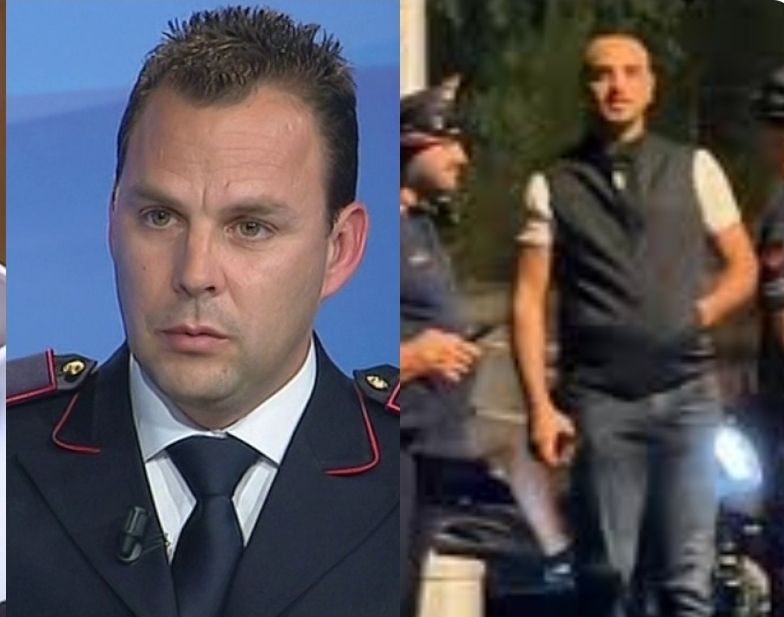
“They kept hitting me, threatened me and forced me to sign that I had no complaints.” The shocking testimony of young Enea Gjodedja raises serious accusations against two police officials, while the institution denies the violence. Who is telling the truth, and why are the security camera recordings not being made public?
A young orphaned man, with a black eye and serious accusations against State Police officials, has gone public to denounce what he describes as brutal violence inside Police Station No. 1 in Tirana.
Enea Gjodedja has identified by name the two people he claims attacked him: Roki Pepa and Ervin Hasrama, the latter being the head of Police Station No. 1.
According to the young man’s testimony, the incident happened after the November 17 protest, when he was waiting for a bus to return to Durrës, near the former Hotel Dajti. Instead of returning home, he was taken in by police and brought to the station, where he claims he was met with blows, insults and threats.
From the protest to the police station, from the police station with a black eye
In an interview for the program “Prime” on News24, Gjodedja said he was first called into an office where Roki Pepa was present.
According to him, Pepa ordered him to remain standing and then began hitting him. After that, the young man claims he was returned to the lower premises of the police station, only to be called back again a few minutes later.
In the second encounter, according to his testimony, it was Ervin Hasrama who hit him even more severely.
Gjodedja said that after the blows he felt dizzy and that he was given cold objects to place on his eye in order to reduce the swelling.
If these allegations are confirmed, this would not simply be a matter of police employees exceeding their authority, but of serious suspected criminal acts committed by people who have a legal duty to protect citizens.
“I have no complaints” — the signature the young man says was taken under pressure
One of the most troubling elements of this case is the statement signed by the protester, according to which he had no complaints against police officers.
Tirana Police has used this document to support its position that the young man was not assaulted at the station.
But Gjodedja gives a completely different version.
He claims he signed the document under pressure and threats, while he was not allowed to have a lawyer present at the moments when, according to him, the violence was inflicted.
This creates a fundamental contradiction that requires an independent investigation: Was the statement given freely, or was it obtained through intimidation?
A signature on a police report cannot automatically serve as proof that there was no violence, especially when the person who signed it claims he was forced to do so.
A young orphan facing those who are supposed to guarantee the law
Behind the denunciation is also the personal story of a young man who says he has lost his father and takes care of his younger brother, who is facing health problems.
Gjodedja has publicly recounted his family difficulties and efforts to secure medical treatment for his brother abroad.
But his family status is not the reason this denunciation is serious.
Even if he were not an orphan, even if he had no economic or family difficulties, he would enjoy the same constitutional rights.
No citizen can be beaten, humiliated or threatened by police because of participation in a protest.
A uniform does not give anyone the right to physically punish a person taken into police custody. On the contrary, it places an even greater responsibility on a police employee to respect the law and human dignity.
Police deny the accusations, but the questions remain unanswered
In its official reaction, Tirana Police denied that Enea Gjodedja was assaulted inside Police Station No. 1.
According to the police version, the injuries to his left eye are linked to an alleged incident with unknown persons near the former Hotel Dajti. The institution also stressed that the young man had signed the report without expressing complaints against police officers.
But facing that position is Gjodedja’s public testimony, in which he not only denies the official version but specifically identifies the people he accuses of violence.
Two versions that directly contradict each other cannot be resolved with a press statement.
What is required is the collection of evidence, review of video footage, forensic documentation of the injuries and questioning of all persons involved.
Particularly serious is the accusation made publicly by MP Agron Shehaj, according to whom police officers exerted pressure on the young man even during his stay at the Trauma Hospital, to change his testimony.
This claim also requires immediate verification.
Where are the cameras from Police Station No. 1?
This is the question that could help clarify the incident.
If Gjodedja was escorted to the police station, if he was called into the offices of senior officials, and if the actions he denounces were carried out there, traces of his movements, custody records and security camera footage may be of decisive importance.
Have all recordings from the evening of November 17 been preserved?
Who entered and left the premises where the young man was held?
Is there footage documenting his physical condition upon entering and leaving the station?
And, above all, have these pieces of evidence been secured by an investigative body independent of the employees against whom the accusations have been raised?
The publication of the footage, to the extent permitted by law and without compromising the investigation, would help clarify the circumstances and institutional transparency.
SPAK, the Prosecution and the Police Oversight Agency facing a serious institutional test
Gjodedja’s denunciation cannot be treated merely as a clash of statements between a protester and the police.
If there are indications of physical violence, threats, arbitrary actions or obstruction of the right to defense, the competent authorities must assess the possible criminal responsibility of the persons involved.
The Police Oversight Agency and the Prosecution must guarantee an effective, impartial and evidence-based investigation. SPAK’s jurisdiction would depend on the circumstances and the legal classification of the possible offenses.
Roki Pepa and Ervin Hasrama are entitled to the presumption of innocence. But that principle does not exclude the obligation to seriously investigate the direct accusations against them.
On the contrary, a transparent investigation is also the only way to determine whether the allegations are true or unfounded.
When a citizen accuses police of violence, the state cannot be satisfied by automatically believing the police version.
In a state governed by the rule of law, the police are not above the law. Their leaders cannot be excluded from investigation simply because of the office they hold.
The case of Enea Gjodedja requires more than an institutional response.
It requires evidence. It requires transparency. It requires accountability.
Because the question is not only what happened to one protester at Police Station No. 1.
The question is whether a citizen can enter a police station and have the guarantee that he will leave without being subjected to violence by those whose duty it is to protect him.
And this is a question that state institutions must answer with facts, not only with statements.