
Two public complaints are casting a shadow of doubt over how border checks at Rinas are being used, at a time when the government has hardened its language and initiatives toward protests. At the center of the claims is the question of whether a police note or identification as a protester can in practice become an obstacle to leaving the country, without a court decision.
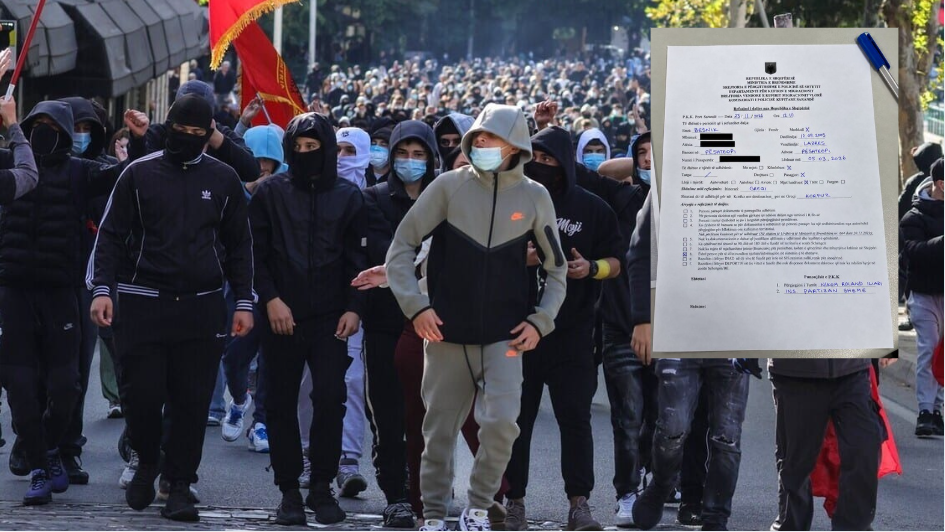
Hasimja: I was separated at passport control
Lecturer Ermal Hasimja said publicly that during passport control at Rinas he was separated and then escorted to the “chief’s” office. According to him, he was told there that the case was linked to the protest, although he was later told there was a possibility of confusion with another person with similar details.
Hasimja indicated that the explanation did not convince him. He raised the suspicion that either protesters are being identified and a form of pressure is being exerted through the threat of restricting movement, or the police are verifying people who may be under an obligation to appear and are trying to leave the country.
Document published by Grimci adds to suspicions
A second complaint came from Eda Grimci, a member of the leadership of the Democratic Party, who published a document in which a citizen is denied exit from the country. According to her, the reason is linked to a note in the police system and may be related to participation in the protest.
Grimci publicly raised the question of whether police information can be used as a basis for restricting freedom of movement, in the absence of a court decision. Her claim directly touches on the line between police verification and administrative arbitrariness.
What is known so far
So far there has been no public institutional clarification for these two cases, nor a full explanation of the criteria used in border control systems when a citizen is separated or prevented from traveling.
This makes the issue more sensitive, because when faced with a procedure affecting a fundamental right such as freedom of movement, transparency is not a matter of form but an obligation. Without a clear legal basis and without an official explanation, suspicions of selective use of the police only increase.
The political context after the protests
For weeks, the government has warned of legal measures against violent protests and people who, according to the official version, undermine public order during gatherings. It is precisely in this climate that complaints about problems at the border carry greater political and civil weight.
If these cases turn out to be more than isolated incidents or confusion in the system, then this would amount to a serious alarm about how state instruments may be used against citizens who take part in protests.
For now, there are serious claims in the public sphere, but still no full response from the responsible institutions. It is precisely this lack of clarification that is keeping open the question of whether security procedures are being applied at the border or whether a dangerous standard of pressure on citizens is being tested.
If a note in the system is enough to block a person’s movement, the debate is no longer simply about one case at Rinas, but about the relationship between the police, the law, and constitutional freedoms.