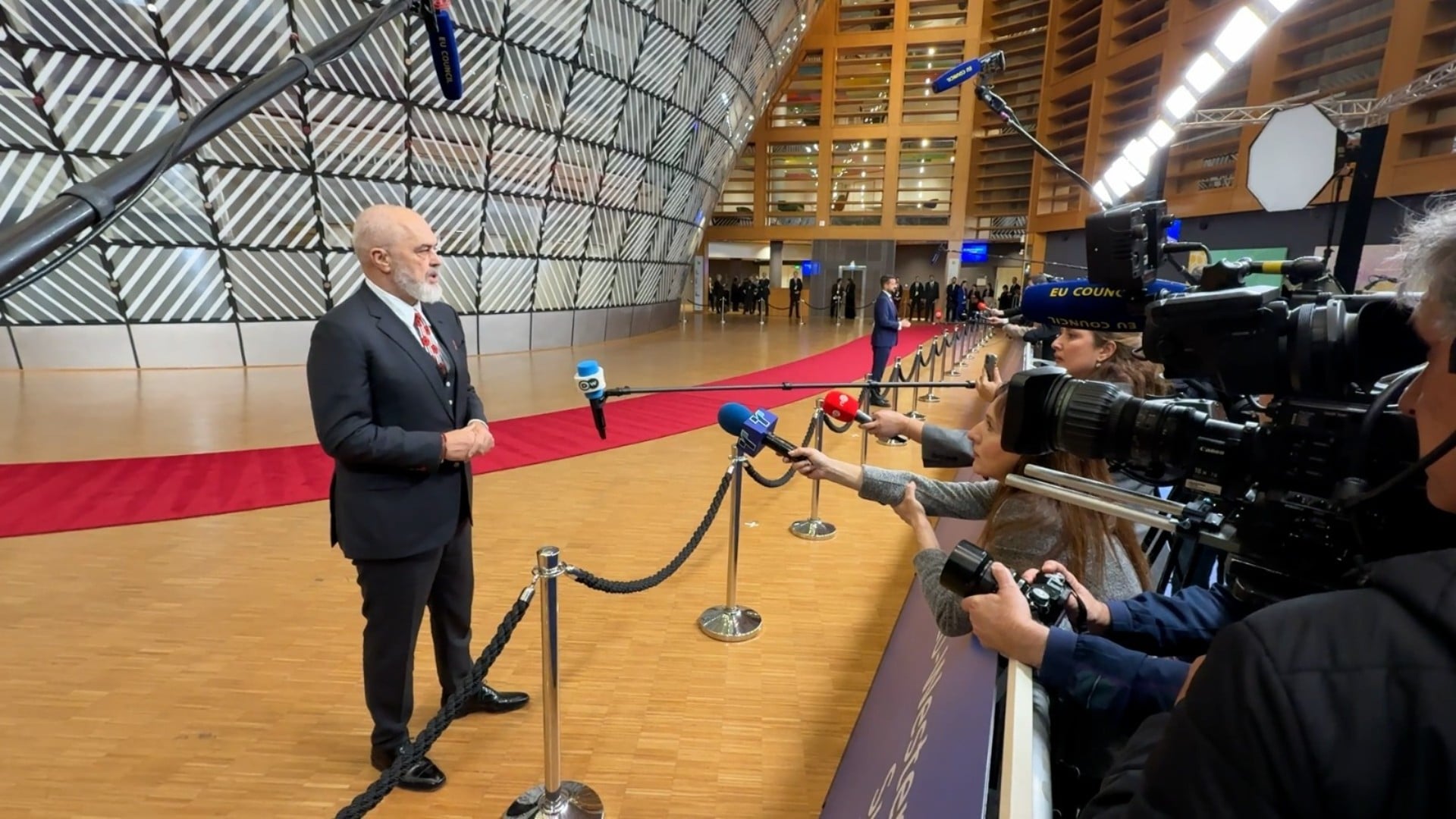
Prime Minister Edi Rama appeared in Brussels with a political request for the European Union: more speed for candidate countries and a stronger signal for the region. But beyond the message on integration, attention was drawn to a question that directly touches the political climate in Tirana: how can Albania speak of readiness for the EU when high-level officials are being investigated by SPAK?
A call for a bolder step from the EU
On the eve of the EU–Western Balkans summit, Rama said the European Union should take a bolder step forward in relation to candidate countries. According to him, all aspiring countries should sit around the same table with the union, without changing the principle of a merit-based process.
The message from the head of government aims to present Albania as part of a new political moment for enlargement. However, the actual pace of integration remains conditioned by decision-making in Brussels and by the standards the EU itself wants to see on the ground, not only in political statements.
Negotiations and chapters still awaiting the Commission’s green light
Asked how many chapters Albania aims to close by the end of the year, Rama said work is continuing with the European Commission and that the process is going according to plan. He acknowledged that this does not depend only on the Albanian side, since on some issues the Commission’s prior approval is still awaited for the prepared texts.
The statement suggests that the government wants to preserve public optimism about the negotiations, but part of the progress remains in the hands of European institutions and their technical and political filter.
The question on Balluku and the test of corruption
The most sensitive moment of the exchange came when Rama was asked whether Albania can claim it is ready for the EU while senior political officials, such as Belinda Balluku, are under criminal investigation by SPAK. The question shifted the focus to one of the strongest tests Brussels has followed for years: whether the fight against corruption truly reaches the highest levels of power.
In response, Rama said that, according to the government, the fight against corruption in Albania is “unprecedented in the region.” He claimed that the country has moved beyond a culture of impunity and that today the system is fighting corruption, adding that no one is above the law anymore.
However, the very fact that the government is using investigations into senior officials as an argument in favor of institutional seriousness remains politically sensitive. A criminal investigation is not proof of the system’s innocence, but proof that suspicions exist and that the justice system’s response still has to pass the test of results.
The German proposal and the comment on Trump
On the German proposal presented earlier at the Tirana Summit, Rama said it should be seen in a broader framework, returning to his idea of a common table between the EU and candidate countries.
As for Donald Trump’s announcements on trade, the prime minister said he was not aware of them and shifted the answer to the European common market, stressing that this is the objective Albania is seeking at this stage.
Rama’s appearance in Brussels once again showed the contrast between the declared ambition for integration and the burden brought by questions about corruption at high levels. On the diplomatic front, the government is seeking more room from the EU; on the domestic front, it remains under pressure to prove that the standard of the rule of law is not only part of the rhetoric.