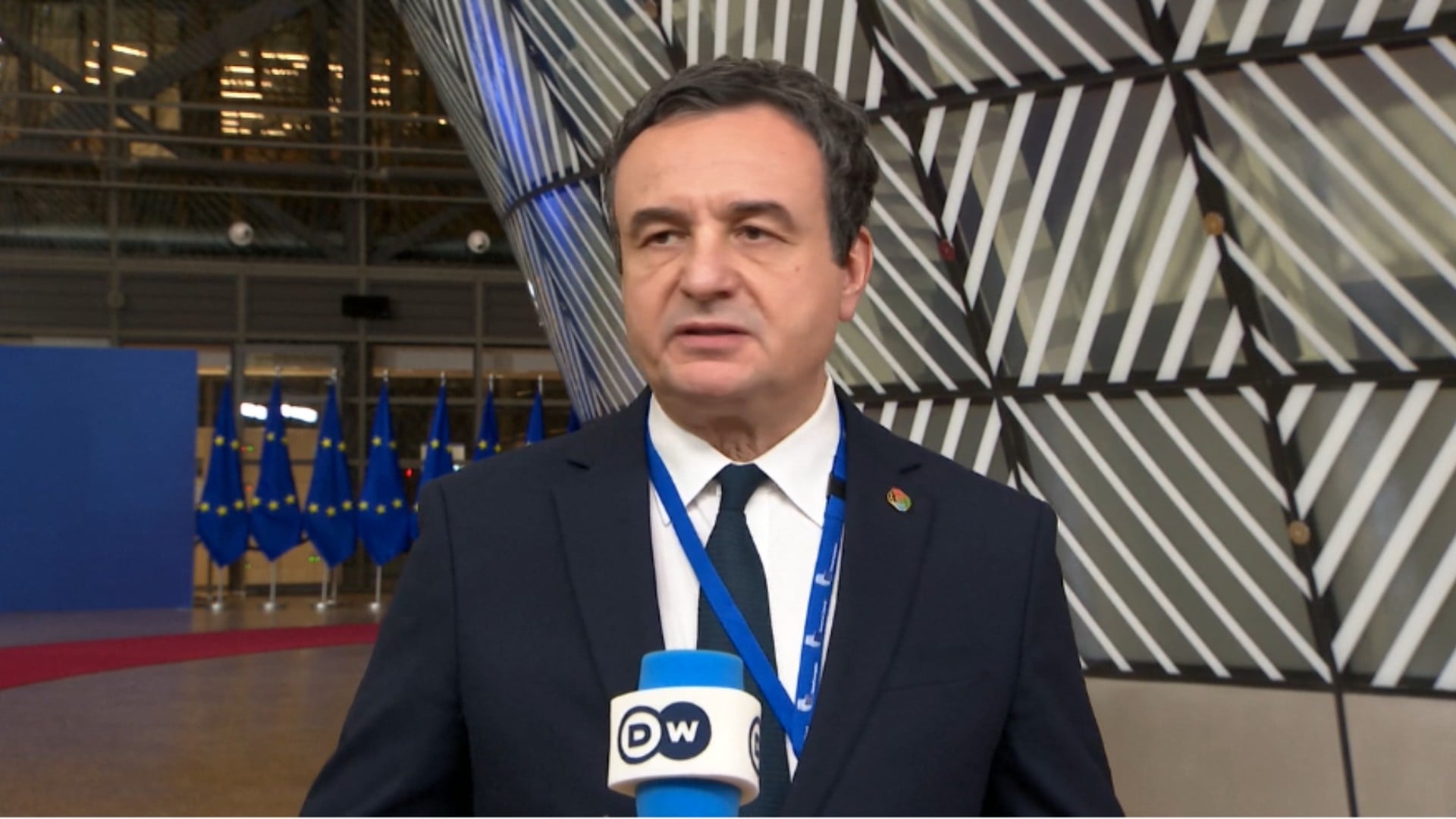
Kosovo Prime Minister Albin Kurti arrived in Brussels with a clear political request: that Kosovo be granted European Union candidate country status. On the eve of the meeting between the EU and the Western Balkan countries, he advanced his government’s narrative that Pristina has met the criteria and that further delay is no longer justified.
The request for candidate status was placed at the center of the visit
Kurti said Kosovo expects to receive candidate country status, while recalling that in mid-December it will be four years since the application for EU membership was submitted.
According to the version he presented, Kosovo remains the only Western Balkan country that has still not received this status, and for that reason the issue is now being treated as urgent by the authorities in Pristina.
He called on the European Council to ask the European Commission to prepare an opinion on Kosovo’s application, as the necessary procedural step to move the process forward.
Kosovo’s government presents the request as a matter of merit
Kurti argued that the country deserves candidate status because of democratic progress, economic growth, the strengthening of the rule of law and the fight against corruption.
He also claimed that Kosovo ranks at or near the top among the six Western Balkan countries in democratic indexes, using this as the basis for seeking political recognition from the EU.
Along the same lines, he said the request should not be seen as a favor or a privilege, but as recognition of developments that his government considers measurable.
Pressure on the EU ahead of the December meeting
Kurti said Pristina’s hope is that the issue will gain momentum at the next European Council meeting on December 14 and 15.
According to him, EU enlargement and the bloc’s internal reforms do not exclude one another, but can proceed in parallel.
He linked this to what he described as a political “window of opportunity” in Europe, suggesting that the moment should be used to more quickly include the six Western Balkan countries in the enlargement process.
Institutional stability, the Berlin Process and accusations against Serbia
In his statement, Kurti said that after the election of the new president, Kosovo has full institutional stability for the next four years.
He also mentioned the need for full implementation of the Berlin Process agreements, especially those related to mobility, the recognition of diplomas and the movement of students and professionals in the region.
On security and the rule of law, Kurti called on Serbia to arrest and hand over Milan Radoicic, whom he accused of organizing the attack in which Sergeant Afrim Bunjaku was killed in September 2023.
Alignment with sanctions on Russia as a political argument
Kurti stressed that Kosovo, according to him, fully adheres to European principles, including accepting and implementing sanctions packages against Russia following the aggression against Ukraine.
He used that position as part of the argument that Kosovo is politically aligned with the EU and that its advancement in the integration process should reflect this alignment.
In the end, Kurti also presented candidate status as an instrument to deepen reforms in public administration, justice and education.
The request made in Brussels once again puts the issue of Kosovo’s status in the EU on the table, but the shift from political statements to a formal step by the bloc remains dependent on the decision-making of member states and on movement by the European Council.
Beyond the optimistic tone of Kosovo’s government, the real test will be whether this request is translated into a concrete procedure, or remains yet another diplomatic appeal without a clear timeline.