Edi Rama appeared in Brussels with a direct political request to the European Union: that candidate countries sit “at the same table” with the union, as a stronger signal for the enlargement process. The statement comes on the eve of the EU-Western Balkans summit, at a moment when the rhetoric on integration remains high, but the concrete pace of the process continues to be measured in chapters, approvals and bureaucratic waiting.
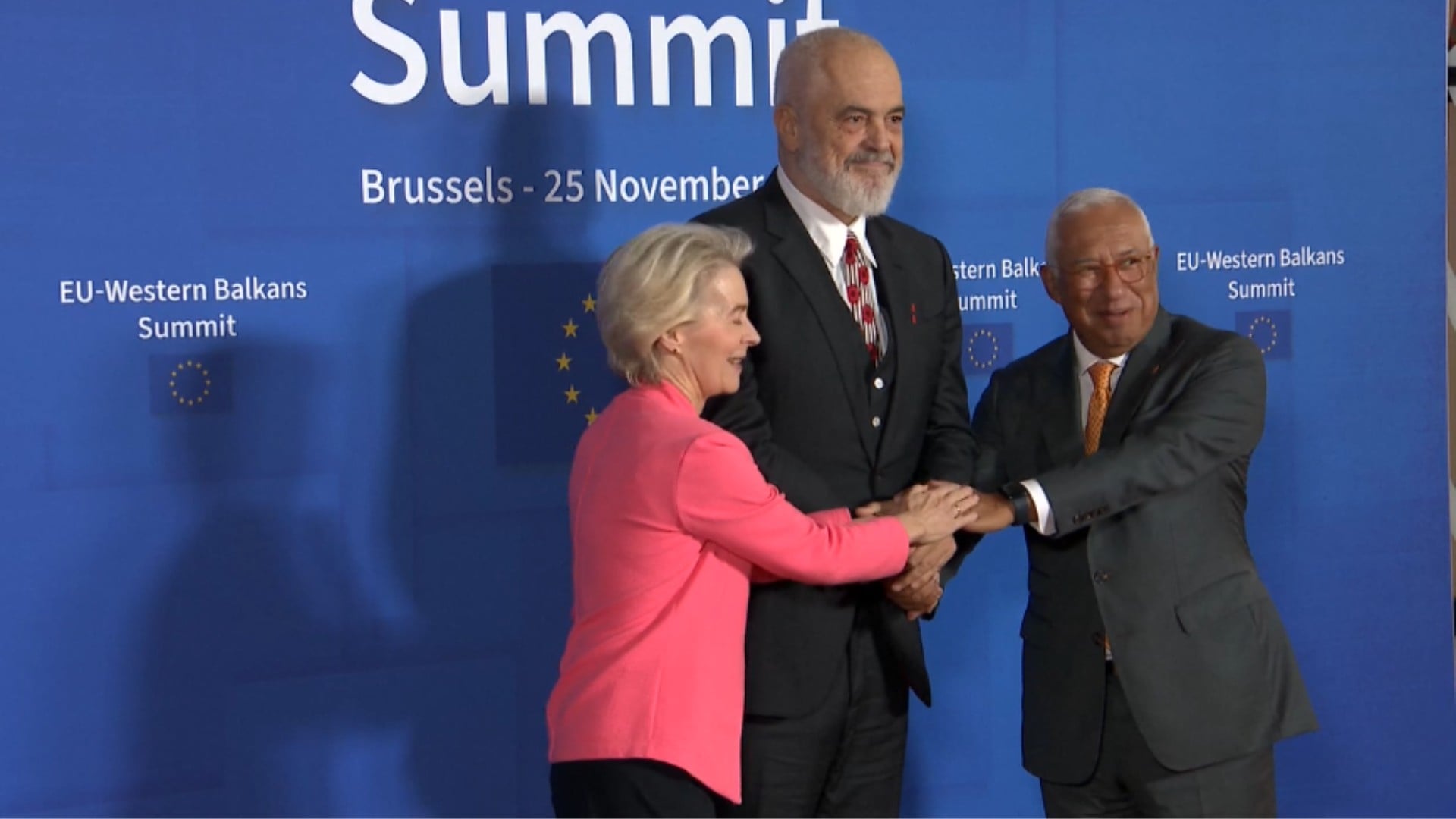
Rama’s call for a political signal from the EU
According to the statement made in Brussels, the prime minister called on the European Union to take a “very bold step forward” by seating all candidate countries around the same table with the European bloc.
He insisted that such an approach should not undermine the merit-based process for each state, but should serve as a political message both for public opinion in the region and for international actors.
The summit as a stage for enlargement rhetoric
Rama described the annual EU-Western Balkans summit as one of the most important events for candidate countries and as a space for dialogue on the year’s developments and ideas for the future.
However, beyond the encouraging tones, the integration process has long remained tied to slow decision-making and political balances within the EU itself, making calls for “courage” more of a diplomatic pressure point than a guarantee of swift movement.
What he said about the German proposal
Asked whether the German proposal presented at the Tirana Summit would be discussed, Rama said it is part of this issue, but in his view it needs a broader framework.
His version remains the same: all of Europe, the European Union and the candidate countries, seated around a common table. In essence, the prime minister is pushing a broader political formula rather than a discussion limited to a single proposal.
Negotiations and chapters still dependent on a green light
On the progress of negotiations, Rama said Albania is working every day with the European Commission and that, in his assessment, the country is “on the right track” and within the planned timeline.
But he also acknowledged the side that usually remains outside optimistic statements: the process does not depend only on the Albanian side. According to him, on some issues Albania is still awaiting prior approval from the European Commission for the prepared texts, showing that the pace of negotiations is also conditioned by decision-making in Brussels.
In essence, Rama’s message from Brussels was political: more symbolic and institutional openness from the EU toward candidate countries, without touching the merit filter.
Whether this will remain only part of summit rhetoric or be translated into concrete movement depends not on ceremonial statements, but on the decisions the EU chooses to make on enlargement.