
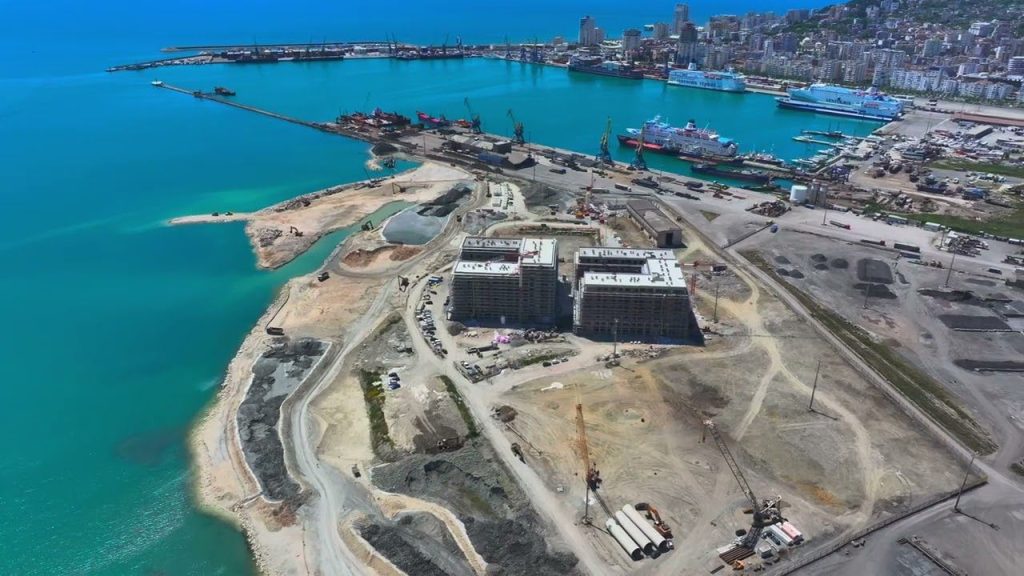
The promise was spectacular: a futuristic marina, luxury towers, private yachts, elite residences and a “new Dubai” rising on Albania’s Adriatic coast. But behind the glossy renderings and aggressive marketing campaign surrounding the Durrës Marina project led by businessman Mohamed Alabbar, serious concerns are emerging about environmental contamination, structural stability and the financial risk being transferred onto ordinary Albanian buyers.
After reports that two buildings within the first construction phase had sunk by up to 30 centimeters — later confirmed by Albania’s National Territorial Inspectorate — the debate is no longer simply about luxury real estate prices or urban transformation. The central question has become far more alarming: what exactly is being built beneath this project, and what are buyers truly purchasing?
The area where the marina is being developed served for decades as the industrial and port heart of Durrës. For years, the zone was exposed to coal storage, fuel operations, industrial waste and untreated sewage discharges. Environmental documentation connected to the project itself has acknowledged contamination concerns affecting both the soil and the surrounding coastline.
Large sections of the territory are believed to contain polluted ground layers caused by decades of heavy port activity. In engineering terms, this creates a highly sensitive construction environment requiring extremely expensive stabilization measures, deep foundational reinforcement and continuous geological monitoring.
Otherwise, the risks are not merely financial — they may become structural and environmental as well.
The problem becomes even more serious considering that these towers are being constructed near the sea, on unstable coastal terrain with a long industrial history. Any geotechnical engineer understands that projects of this scale require exceptional care when built on reclaimed or heavily exploited maritime land.
If structural settlement is already being reported during the earliest stages of development, inevitable questions follow:
What happens after five or ten years?
Can the terrain safely support dozens of luxury towers over time?
Who carries responsibility if deeper structural complications emerge?
But the environmental concerns do not stop underground. The surrounding waters represent another major issue. For years, the port zone has been exposed to sewage discharge, industrial pollution and sediment contamination. Various reports have referred to high concentrations of suspended solids and polluted materials in the water surrounding the development area.
In other words, buyers are not simply purchasing an apartment. They are purchasing a long-term promise tied directly to environmental rehabilitation, land stability and the economic success of an enormous speculative project whose long-term sustainability remains unproven.
Another issue raising concern is the financing structure itself. Financial reports indicate that a substantial portion of the project’s funding has come not from the foreign investor, but from Albanian citizens purchasing apartments before construction completion — and in some cases even before final permits were fully secured.
This means much of the financial burden and practical risk has effectively been transferred onto local buyers themselves.
In practice, many citizens are financing the construction while personally absorbing:
- technical risk,
- environmental risk,
- market risk,
- and institutional risk.
Should the project encounter major delays, engineering failures or future legal and environmental complications, it is ultimately the buyers who may remain exposed.
Meanwhile, political propaganda continues presenting the marina as a historic foreign investment and transformational economic project for Albania. Yet several fundamental questions remain unanswered:
Has the territory truly undergone full environmental rehabilitation?
How safe is large-scale residential construction on historically contaminated coastal land?
Why are ordinary Albanian buyers carrying such a disproportionate share of the risk?
And perhaps most importantly: is this truly a luxury investment — or a speculative real estate bubble built on environmentally compromised terrain?
Behind the luxury branding, dramatic visuals and billion-euro narratives lies a far harsher reality: geology does not respond to political marketing. And when massive towers are built on land carrying decades of industrial contamination and structural uncertainty, risk cannot simply be erased by glossy advertisements and promises of luxury living.