
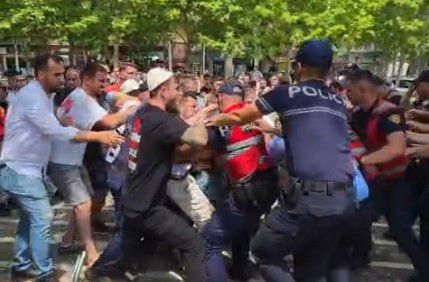
 The use of police officers without identification numbers and the infiltration of civilians into the management of public assemblies is undermining the legitimacy of public order in Albania.
By the Editorial Team | 2 July 2026
Behind the institutional façade of official suits and decorated uniforms, independent experts and political observers are identifying an alarming trend in Albania: the gradual transformation of the State Police into an entity operating with the logic of a private security company, serving the exclusive protection of the executive led by Edi Rama.
What has been unfolding in the squares and streets of the capital during recent civic demonstrations has gone beyond the framework of standard crowd management. Two key phenomena are raising serious questions about respect for the rule of law and human rights.
Legal Anonymity and the Infiltration of “Civilians”
First, the documented cases in which police officers intervene on the ground without visible identification numbers constitute a serious violation of the State Police’s own regulations and international conventions. This deliberate anonymity creates a dangerous environment of impunity, giving free rein to arbitrary conduct without fear of accountability.
Second, operational testimonies and field reports indicate that police operations are increasingly accompanied by civilians without uniforms. According to internal information, a significant number of these individuals function as the personal bodyguards of ministers. Without any clear legal mandate to manage public assemblies or the relevant professional training, these individuals assume the role of using force and detaining citizens, turning public space into a battleground where the distinction between the rule of law and paramilitary structures becomes increasingly blurred.
“When identification numbers disappear and bodyguards without uniforms enter the scene, the line separating the police of a democratic state from a junta controlled by the executive begins to fade.”
The Criminalization of Symbolic Dissent
In the Western political tradition, the use of eggs or flour during protests has historically been a symbolic form of expressing public outrage against corrupt elites or unpopular decisions—an act which, although it may constitute an administrative offence, is rarely prosecuted as a major criminal offense against the state.
However, under the directives of the leadership, the state machinery has chosen an asymmetric approach. The use of force in response to these symbolic acts reflects a profound lack of moral legitimacy. When the police use disproportionate force to guarantee the physical and emotional comfort of ministers, they cease to be protectors of citizens and become a private shield for those in power.
A Challenge for the European Union
This approach is moving Albania further away from the standards of a functioning democracy, bringing it dangerously closer to models of authoritarian regimes where order is based on force rather than on the Constitution. For a country aspiring to European Union membership and negotiating accession under European standards, such scenes represent a step backwards.
The European Union and international human rights organizations can no longer maintain a neutral position in the face of this reality. While Brussels speaks of structural reforms, on the ground a model is being consolidated in which the country’s security institutions are being used for narrow personal agendas. The time for a firm international response is now—before the institutions responsible for maintaining public order permanently lose their public function.