
In a statement with strong political overtones on the war in Gaza, Foreign Minister Ferit Hoxha set out Tirana’s official line: Israel’s security is seen as a priority, while at the same time speaking of a “just and lasting” peace for the region. At the center of his message were also the role the government attributes to Albania in international initiatives and historical references to Albanians’ protection of Jews during the Holocaust.
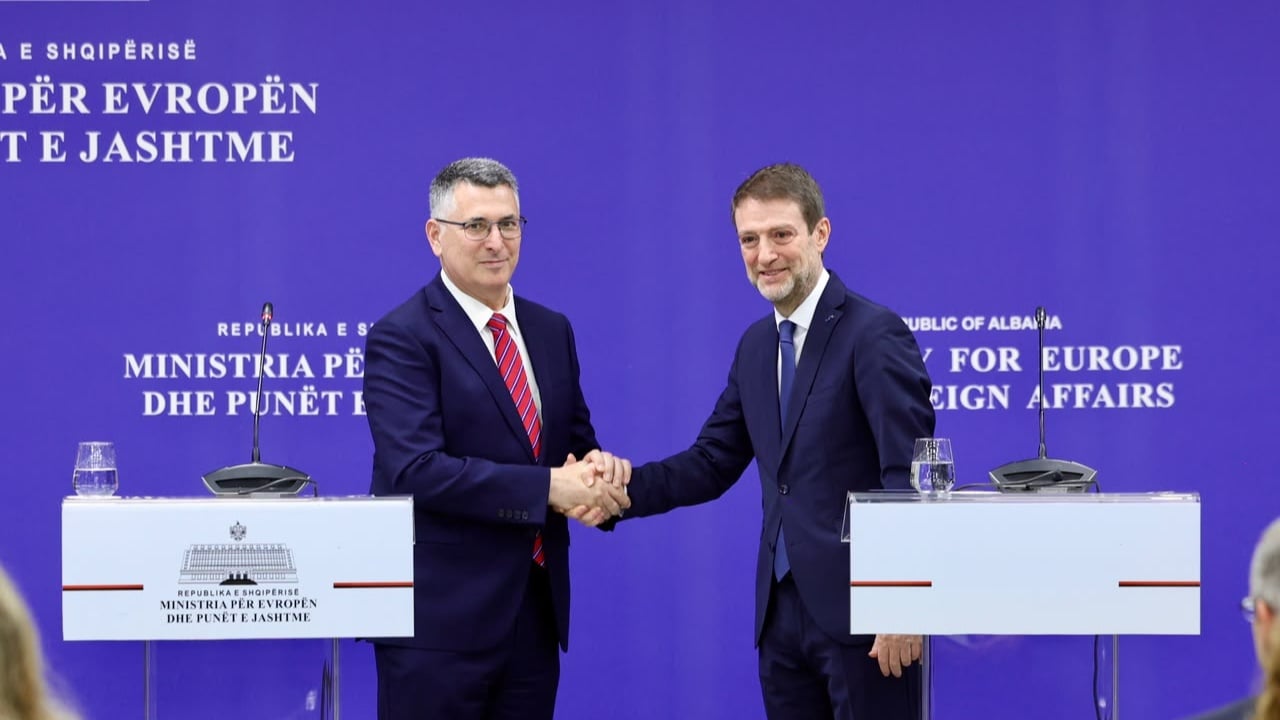
Tirana’s position on the war in Gaza
During a meeting with his Israeli counterpart, Gideon Sa’ar, Ferit Hoxha said that no country can accept the threat of terrorism against its own citizens. According to the official version presented by the minister, guaranteeing Israel’s security and achieving a just peace in the Middle East must move in parallel.
In the same statement, Hoxha also acknowledged the heavy human cost of the war, saying that the violence has claimed many innocent lives and left deep wounds among both Israelis and Palestinians. His wording seeks to maintain diplomatic balance, but places clear emphasis on Israel’s security as the political starting point.
What the minister said about Albania’s role
Hoxha said Albania is a founding member of the Peace Board and has decided to contribute to the International Stabilization Force. According to him, this is presented as evidence of Albania’s commitment to stability, security and humanitarian efforts in Gaza.
The minister also linked this engagement to the government’s political direction, stressing that the steps were taken under the leadership of Prime Minister Edi Rama. Up to this point, the statement remains at the political level and is not accompanied by additional public details on the concrete nature of Albania’s contribution.
Message to the international community
According to Hoxha, the challenge before the international community is to create the conditions for Israelis and Palestinians to live in security, dignity and hope, away from the cycles of violence that have produced the conflict generation after generation.
This is the classic language of multilateral diplomacy, but it comes at a moment when governments’ public statements are weighed not only for their wording, but also for what they choose to place in the foreground: security, responsibilities, the humanitarian crisis or the political solution.
References to the Holocaust and Albanian history
At the end of his statement, the minister drew attention to the historical relationship between Albanians and the Jewish people. He recalled that during the Holocaust, Albanians sheltered and protected Jewish families seeking спасение.
This reference is often used by Albanian diplomacy as an identity element in relation to Israel and issues linked to antisemitism, but in this case it was also used to reinforce the political message of the meeting.
Ferit Hoxha’s statement confirms the Albanian government’s official line on the conflict in Gaza: support for Israel’s security, a call for a just peace, and emphasis on the role Tirana claims it is playing in international initiatives.
What remains to be seen is how much these positions will translate into concrete commitments and how clearly the details of this diplomatic positioning will be made public.