
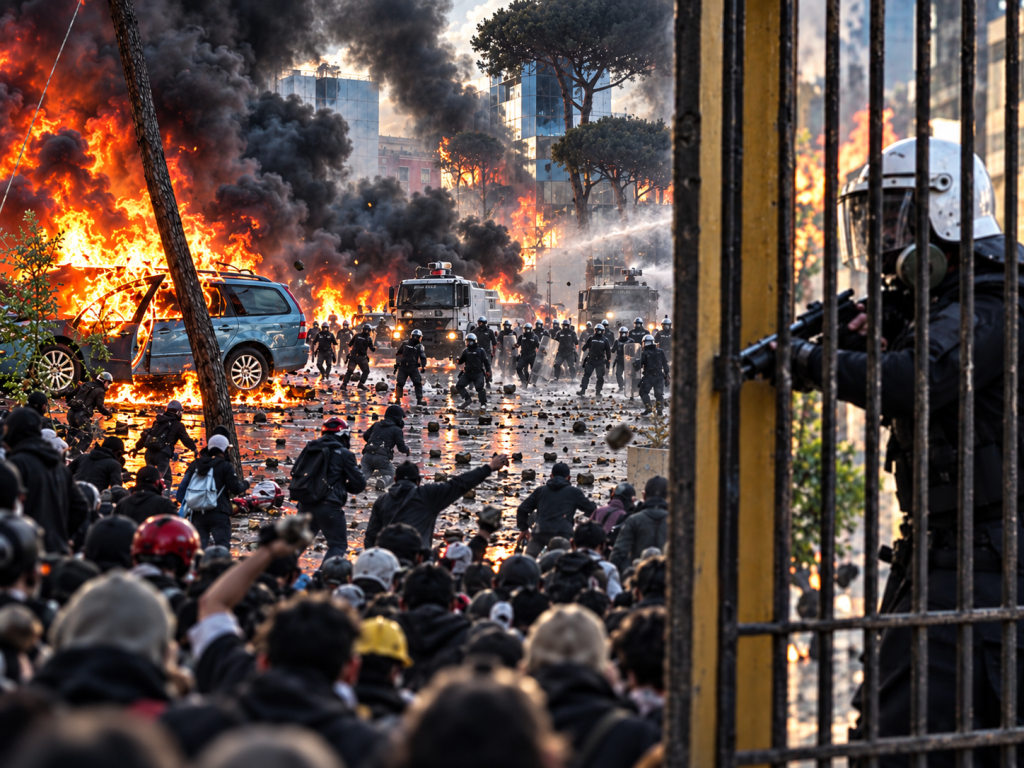
After five days of protests in Tirana, court decisions on the arrests of citizens have opened a debate that goes far beyond the 11 people left in prison. Is justice being exercised independently and proportionately, or are criminal measures creating a chilling effect on protest? In a country where the judiciary is supposed to be the last guarantee against any abuse by the state, suspicions of political patronage cannot be ignored, but neither can they be declared proven without evidence.
From street protests to courtroom decisions
In Albania in October 2026, the debate over the protests has entered a new phase. After clashes between protesters and law enforcement, attention has shifted from the boulevard to the courtrooms, where the fate of dozens of arrested citizens is being decided.
The Tirana Court has set security measures for 51 people. Eleven of them were left in pretrial detention, five under house arrest, 25 under an obligation to appear, and 10 others with restrictions on residence and movement. These decisions were also reported by several media outlets on October 17 and 18.
The figures alone do not show whether the decisions are fair or unfair. But they impose a necessary discussion: on what evidence were the measures based, how necessary were they, and whether the court truly examined less restrictive alternatives.
Because detention is not a preliminary punishment. It is a security measure that must be justified by concrete circumstances.
No one should end up in a cell simply because they went into the street to oppose the prime minister.
Judges or patronage loyalists? An accusation that demands an answer
In today’s tense climate, one question is gaining increasing weight in public debate: how independent are the judges deciding on the freedom of protesters?
A court must not only be independent. Through the reasoning of its decisions and the transparency of its procedures, it must guarantee that its independence is visible to citizens as well.
When a protester faces detention, the public has the right to know whether the measure was based on individual evidence, on the risk of flight, on the possibility of tampering with evidence, or on other circumstances provided for by law.
Otherwise, ground is created for the interpretation that the judiciary is being used to discourage political dissent.
And that perception, even when it does not prove a concrete intervention, can seriously damage trust in justice.
Pretrial detention must not turn into punishment
One of the fundamental distinctions between democratic justice and arbitrary punishment is the presumption of innocence.
The people arrested during the protests have not been declared guilty by a final court decision.
They are citizens under investigation.
Some are suspected of destruction of property, some of resisting police officers, while others face other criminal offenses. These accusations must be investigated seriously, especially when violence against individuals or damage to property is involved.
But between criminal suspicion and punishment there is a judicial process that cannot be bypassed.
The measure of detention must rest on concrete security needs. It cannot serve to create the impression that the state is teaching a lesson to everyone who comes out to protest.
Even when there are reasonable suspicions of a criminal offense, the court must explain why lighter measures are not sufficient.
If that analysis is missing, the problem is not simply procedural.
It is a problem that directly affects individual freedom.
Restricting protest: What happens to the constitutional right of assembly?
A particularly important element of the decision is the restriction imposed on 10 people, who are forbidden from approaching within 500 meters of public institutions and from remaining in places where gatherings are held without court authorization.
This measure also requires careful scrutiny.
The right to peaceful assembly is one of the fundamental rights of a democratic society. It is not a privilege the government grants a citizen when it agrees with their message.
Of course, that right does not include violence, destruction of property, or attacks on individuals.
But restrictions on it must be lawful, necessary, and proportionate.
A broad ban on taking part in demonstrations may have consequences that go beyond the purpose of a security measure.
This is why courts must justify not only the need for the restriction, but also its scope and duration.
Otherwise, there is a risk that a procedural measure will be perceived as a practical ban on protest activity.
Violence against police and violence by police must be investigated by the same standard
The protests of recent days have also involved serious acts of violence, physical clashes, and damage to public and private property.
Attacks on police officers cannot be justified by dissatisfaction with the government.
At the same time, the police cannot be exempt from responsibility when they use force unlawfully or disproportionately.
International reporting has documented both violence by some protesters and allegations of excessive use of force by police. According to reports on October 18, seven police officers were suspended while they are investigated for excessive use of force.
This makes the demand for the same investigative standard even more important.
If a citizen is accused of striking the police, the circumstances must be investigated and responsibility must be individual.
If a police officer is accused of striking an unarmed protester, that accusation too must be investigated with the same seriousness.
A uniform does not create immunity.
Nor does participation in a protest create immunity for criminal offenses.
Justice must apply the law on the basis of evidence, without favoritism and without selective punishment.
The danger of a justice system perceived as an extension of those in power
When the executive uses harsh language against protesters and the courts issue decisions that limit their freedom, an even greater need arises for institutional transparency.
This does not prove that the courts are taking political orders.
But it does require them to show clearly that decisions are based only on the law and on the evidence in each case.
The independence of justice is not a declaration written into reform documents.
It is proven in practice, especially when a court must decide on the rights of citizens who oppose the government.
If a person is kept in prison, the judge must provide individualized reasoning that can be reviewed.
If the prosecution seeks a severe measure, the court must examine that request critically.
And if the evidence does not justify restricting liberty, the court must make the corresponding decision, regardless of public or political pressure.
Only in this way can the perception be avoided that the decisions are part of a coordinated response against the protests.
European Albania cannot be built by weakening citizens’ guarantees
Prime Minister Edi Rama has linked the current confrontation to Albania’s goal of European integration.
But a successful integration process is not measured only by progress in negotiations.
It requires independent institutions, impartial administration of justice, and protection of fundamental rights.
A European state must be able to protect public order without unnecessarily infringing civic freedoms.
It must punish criminal offenses, but not political dissent as such.
It must protect police officers from violence and citizens from abuse of force.
And above all, it must have courts that do not feel obliged to align their decisions with the narrative of the government or the opposition.
These are not demands of one political side. They are standards of the rule of law.
Eleven citizens in jail and a test for the institutions
Today, 11 people remain in pretrial detention in the cases reviewed by the Tirana Court.
But the matter does not end with the announcement of the measures.
The decisions must be subject to legal review through avenues of appeal. The prosecution must continue the investigation on the basis of evidence. The defense must have the opportunity to challenge the accusations and the need to keep the measures in place.
Meanwhile, institutions must provide answers for every credible claim of police violence and for every concrete suspicion of political interference in judicial proceedings.
The debate over “patronage judges” must not remain at the level of political labels.
If there is evidence of improper ties, conflicts of interest, or partisan influence, it must become the object of verification by the competent bodies.
If there is no such evidence, judges cannot be declared guilty in public opinion simply because of the decisions they make.
But their decisions can and should be criticized, analyzed, and legally reviewed.
Because the authority of the court does not stem from being untouchable by criticism. It stems from legality, impartiality, and the reasoning of the decision.
Justice cannot have a party color
In the end, the decisive question is not whether a judge sympathizes with one political force or another.
The question is whether he or she is capable of deciding independently even when that decision runs counter to the interests of those in power.
If a government must face protest, the institutional response must be limited by law.
If a citizen is suspected of a criminal offense, that person must face an impartial court.
And if the court decides to restrict that person’s liberty, it must show with concrete arguments why this is necessary.
Justice must be neither patronage-based nor oppositional. It must be independent.
Because the day a citizen becomes convinced that the decision about their freedom is determined by a judge’s relationship with those in power, and not by the law, is the day trust in the rule of law suffers a serious blow.
Eleven pretrial detention measures do not in themselves prove the political capture of justice.
But neither those in power nor judicial institutions should consider unimportant the demand to prove that decisions were made without political influence.
In a democratic republic, the court is not there to protect the government from the citizens. It is there to apply the law and to protect the rights of everyone, including the citizen who protests against the government.
And that is the standard by which today’s decisions should be judged.