
Tensions between the government and protesters resurfaced outside the Prime Minister’s Office, where the chairs placed by Edi Rama as a sign of dialogue once again ended up on the ground. The gesture was read as an open rejection of the prime minister’s invitation, while his public response came in an ironic tone.
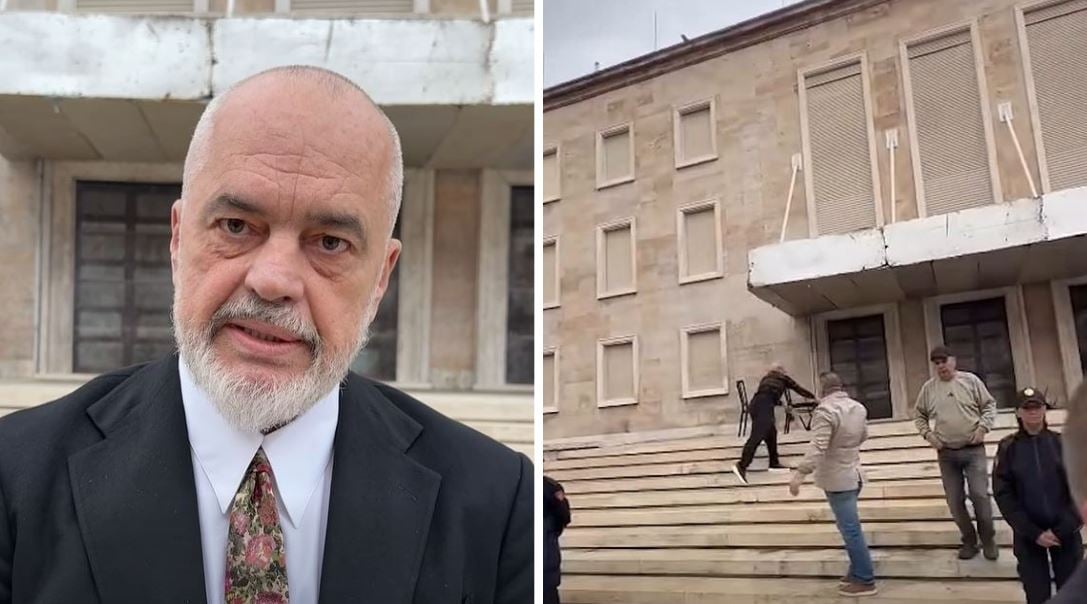
The confrontation was repeated outside the prime minister’s office
From the early morning hours, protesters gathered in front of the Prime Minister’s Office building, where the chairs had been placed that Rama had presented as an invitation to dialogue with the lecturers and students protesting.
Images from the scene showed that the chairs were broken and thrown near the institution’s door, in an action that signals rejection of this form of communication offered by the government.
A symbolism that is not producing dialogue
The placing of the chairs has been used by the prime minister as a public gesture to convey the idea of talks, but the protesters’ reaction shows that this political staging is not being accepted as a real solution.
Instead of bringing the sides closer, the situation is turning into a clash of symbols, with the protest responding with rejection to what the government presents as a step toward dialogue.
Rama chooses irony in his public reaction
After today’s episode, Edi Rama reacted on social media with an ironic comment, placing the word “lecturers” in quotation marks.
“‘Lecturers’ came again today…,” he wrote alongside a video showing footage of the protesters’ action outside the Prime Minister’s Office.
The weight of political language amid the protest
The use of irony and quotation marks toward the protesters shifts the debate even further away from the substance of the demands and toward political confrontation and public communication.
In this climate, what the government presents as an invitation to dialogue is being seen by the other side as a cosmetic gesture, not as a step that guarantees real listening or concrete solutions.
Today’s event further deepens the gap between the government and the protesters, showing that the confrontation is not easing even on the symbolic level.
Beyond the images and public irony, it remains clear that contact between the sides continues to pass through rejection rather than through a dialogue accepted by both sides.