
The victory of the student movement in Serbia has also sparked discussions in Albania about a new political organization for young people. At the center of this effort is the idea of a national student movement, presented as non-partisan and inclusive. But when enthusiasm is translated into real representation, an obstacle emerges that is not new: the electoral rules are built to protect the big parties, not new entrants to the scene.
Inspired by the Serbian model, but not the same political terrain
The Serbian example is being used as a reference point by students and activists seeking a new political alternative in Albania. The message being repeated is the departure of the old political class and the rise of new representation with students, lecturers and professionals.
In this climate, some of the voices that have appeared publicly present the movement as a reaction to a system that, according to them, has closed off space for honest figures not captured by party interests. The ambition is clear: not only protest in the square, but also political confrontation.
Calls for a new front among students and academics
Alongside the students, some lecturers have also come out in support of the idea of a new political force. The line uniting these positions is opposition to both the majority and the traditional opposition, both perceived as part of the same political class.
In public statements, the emphasis is on excluding old figures and on the need for an organization with people considered unspent by the system. The rhetoric is strong and goes beyond the usual criticism of the government, taking aim at the entire political structure that has dominated the country for decades.
The Electoral Code, the real obstacle to any new entry
The point where rhetoric collides with reality is the Electoral Code. The initiators themselves admit that the current system leaves little room for models like the one in Serbia and forces new groupings to choose between creating a political party or running with independent candidates.
This is the core of the problem: in Albania, the rules of the contest are such that they favor the big parties and make it very difficult for a student movement to become a real force of representation. Beyond the slogan of change, it remains to be seen whether this initiative will find an organizational formula that survives the institutional filter.
Mobilization on social networks and parallel groupings
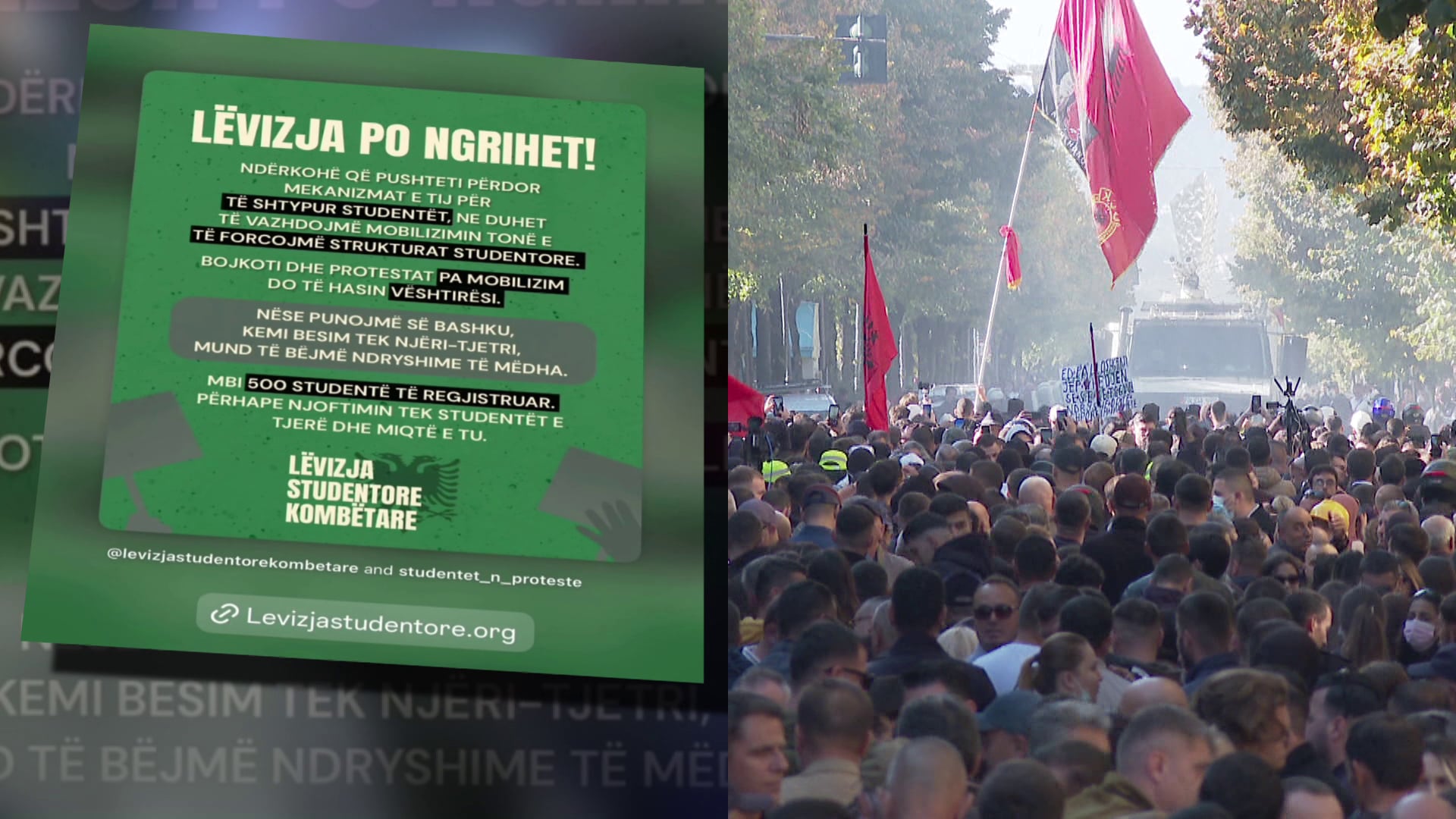
Meanwhile, on social networks a profile for the new movement has been opened, calling for registration and mobilization of student structures through the student card. In parallel, another grouping is also circulating under the slogan “nationalist youth,” showing that the youth landscape is producing several lines of organization, not necessarily unified.
This early phase shows interest, but also uncertainty. There is still no clear political architecture, no detailed platform, or a proven way to turn online support into electoral weight. In a system where formal mechanisms are tightly controlled by the existing parties, this remains the main test.
Between the hope created by the Serbian precedent and the walls raised by Albania’s political system, the student initiative is entering terrain far more difficult than its public rhetoric suggests.
Whether this will remain a symbolic youth revolt or take shape as a political alternative depends not only on its organization, but also on its ability to break through an electoral framework that for years has left little breathing room for new entrants.