
The tension from the protests outside institutions was also reflected inside the Economy Committee, where the opposition and the majority offered two opposing readings of what is happening on the ground: on one side, accusations of violence against young people; on the other, the majority’s insistence that the problem lies in violent acts and not in the protest itself.
Opposition turns attention to the protest
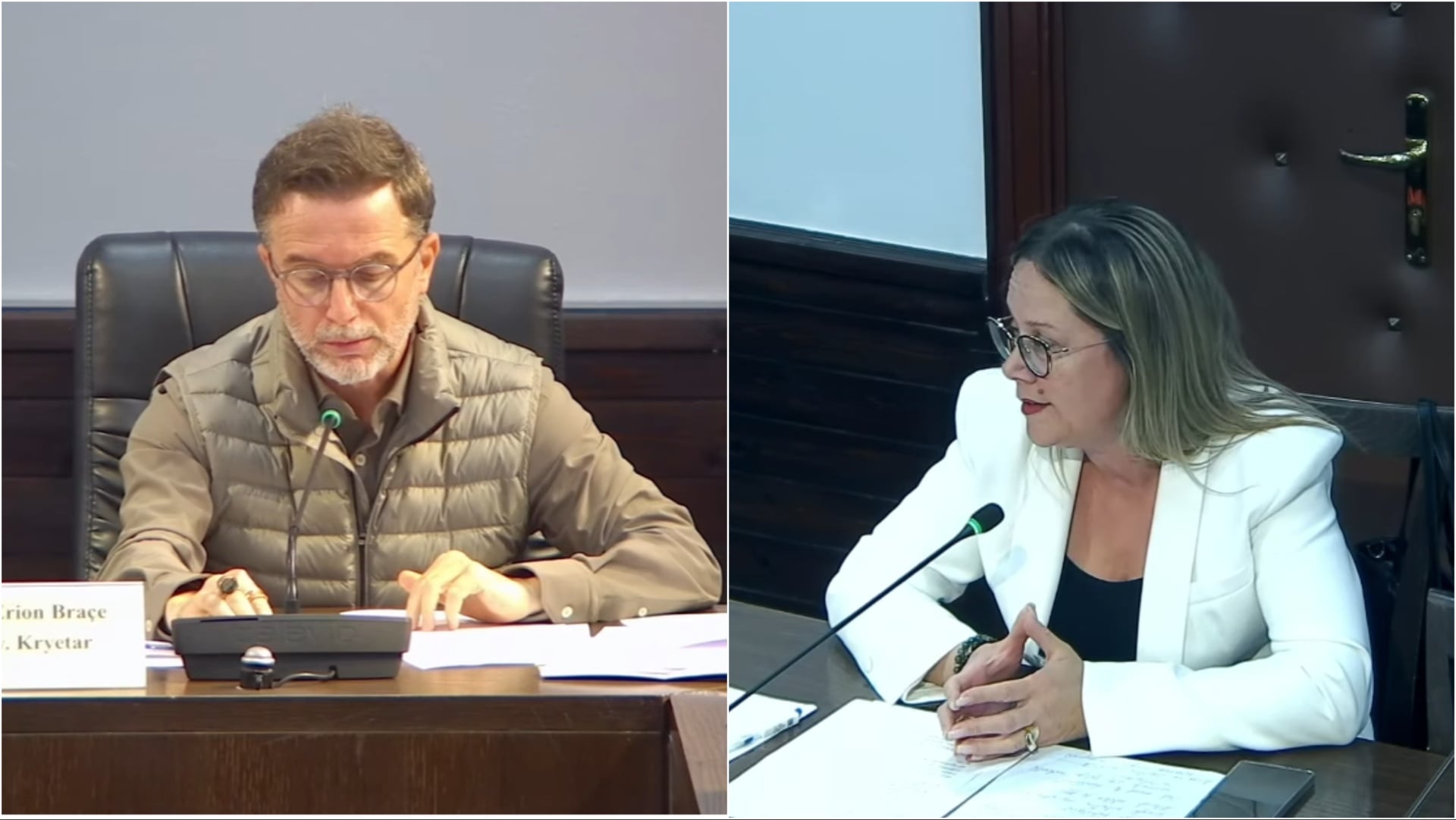
At the committee meeting, Democratic Party MP Ledina Aliolli said the situation outside the chamber did not allow for a normal agenda, linking the discussion to the protests and the condition of the young people in the square.
She said the Democratic Party would stand alongside the students, also speaking of violence against protesters and mentioning the case of a young man from Elbasan who, she said, risks losing his sight. At its core, her political message was clear: the opposition is trying to position itself publicly on the side of the protest.
Aliolli leaves, Braçe responds from the chamber
After her statement, Aliolli left the meeting. The response came immediately from Erion Braçe, who defended the majority’s position and said the Socialist Party remains open to dialogue.
According to Braçe, the protests in Tirana have continued for more than 15 days, but he insisted that, in the majority’s version, the problem lies in acts of violence that have gone beyond the law and public order.
Two narratives for the same protest
Braçe expressed regret both for those injured in the protest and for police officers, seeking to maintain the official line of equal distance between the sides involved in the clashes.
However, the core of his response was political: according to him, the difference is not whether the protesters are students, but the conduct of those who use violence. With this formulation, the majority is attempting to shift the debate from the reasons for the protest to order and security.
The political clash enters every committee
The clash in the Economy Committee confirms that the protest climate has penetrated every institutional space, making the normal course of parliamentary debates almost impossible.
On one side, the opposition is seeking to use the floor to denounce what it describes as repression against protesters; on the other, the majority is maintaining language that accepts protest only up to the point where it does not challenge the order established by institutions.
In today’s confrontation, there was neither any rapprochement between the sides nor any signal of de-escalation. What was clearly visible was the deepening political divide over the protests, with each side seeking to impose its own reading of the events in the streets.