
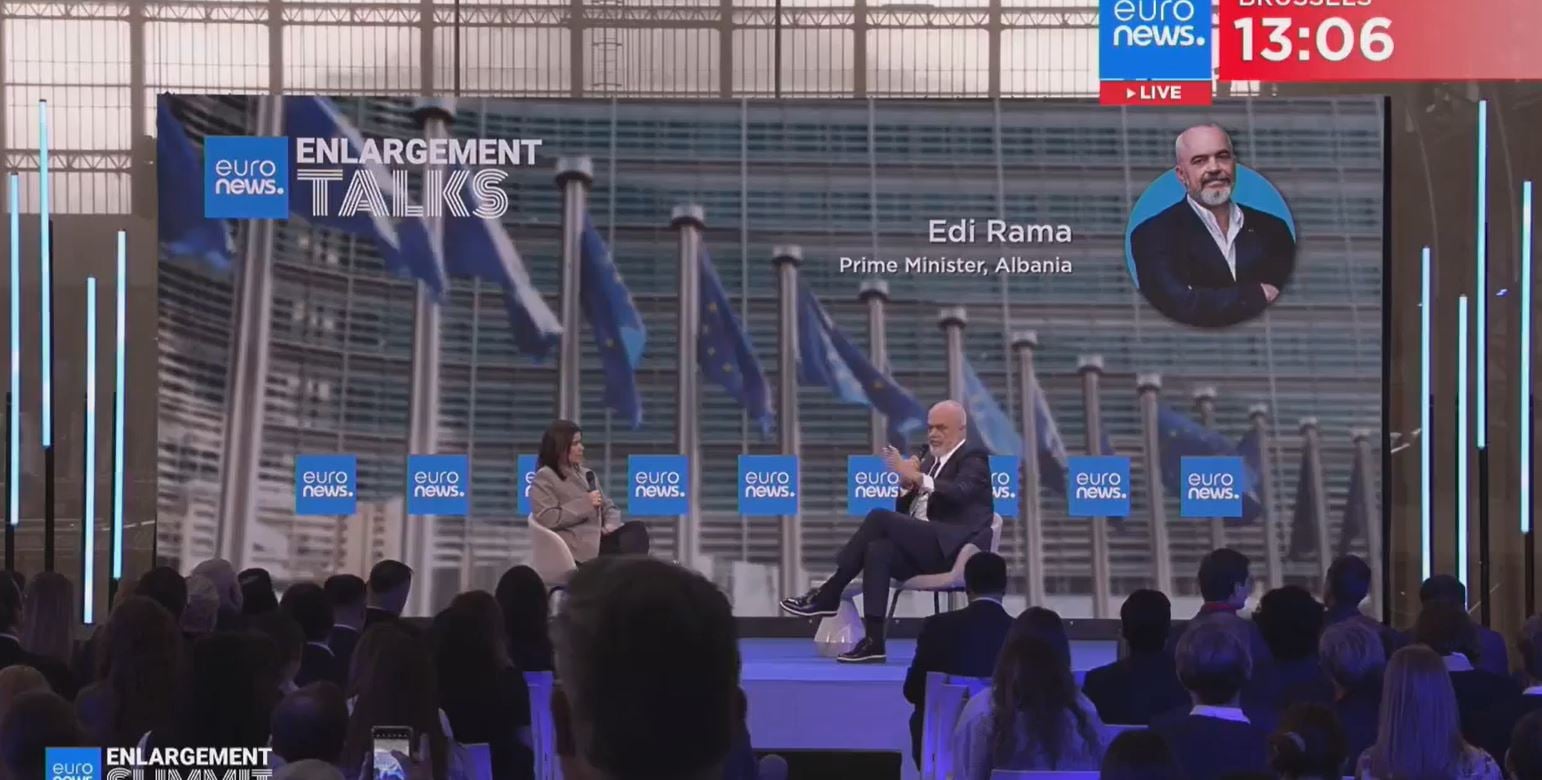
Prime Minister Edi Rama became involved in a tense exchange with the moderator during a forum in Brussels after being asked about the protests in Albania and how the clash between police and demonstrators is being portrayed. In response, Rama used irony, defended the government’s official version of events and shifted the debate toward political legitimacy and the broader social climate.
The forum in Brussels and the government’s message
Speaking at the Euronews Enlargement Summit, Rama said Albania still has problems, but according to him the government is working to solve them within the framework of the European integration process. He presented relations with the European Union as a difficult but useful process for the administration and for reforms.
In the same appearance, the head of government also used mocking language about Brussels bureaucracy, saying it knows how “to torture you and bring out the best in you.” The comment was made on a panel focused on EU enlargement and expectations for aspiring countries.
The protests, the police and Rama’s version
When the debate turned to the protests of recent months, Rama returned to an argument he has made before: according to him, more police officers than protesters have been injured in clashes on the ground. He used that balance to challenge the narrative that, according to him, circulates differently on social media.
Rama said Albania is in a phase where it is dealing more with high expectations than with basic needs, while he presented the protests as part of a “clash of realities.” However, he did not provide any full explanation for the specific cases denounced in the latest protests, leaving the analysis at the level of general politics.
The journalist’s question and the ironic response
The moderator intervened by pointing out that protesters could argue that the confrontation is not equal, since the police are armed while they are not. This prompted an immediate reaction from Rama, who addressed her with the question: “Are you provoking me or are you serious?”
He then said he would leave office only on the day he thought there was no longer any need to change. In the same answer, he also mentioned changes in the government’s actions, including the use of artificial intelligence, without going into detail on how this is connected to the management of protests or to the criticism raised against institutions.
“You did not give it to me, the Albanian people did”
In the closing part of his response, Rama said he is ready to confront and to engage in dialogue, but according to his version, some protesters refuse talks and demand only his departure. He stressed that the mandate was not given to him by the protesters, but by “the Albanian people.”
This is a familiar political line from the prime minister, often used to delegitimize protests as representative of noisy minorities rather than the majority. In Brussels, he repeated that position by claiming that those in the street are not “the Albanian people,” but a small number of people calling for him to go.
Rama’s appearance in Brussels produced more than one message about integration: it also brought back the way the government reads protests, public criticism and its relationship with the media.
Beyond the irony and the one-liners, it remains essential that claims of violence, injuries and the relationship between police and citizens do not remain only in the official version of those in power, but are verified with transparency and institutional standards.