
The European Commission has published its annual enlargement report, and Brussels has delivered a positive assessment of Albania’s progress in the membership process. But behind the encouraging tone, the political message is more cautious: the opening of chapter clusters is seen as progress, while the real test remains whether reforms will continue at the same pace.
Albania among the four most advanced countries
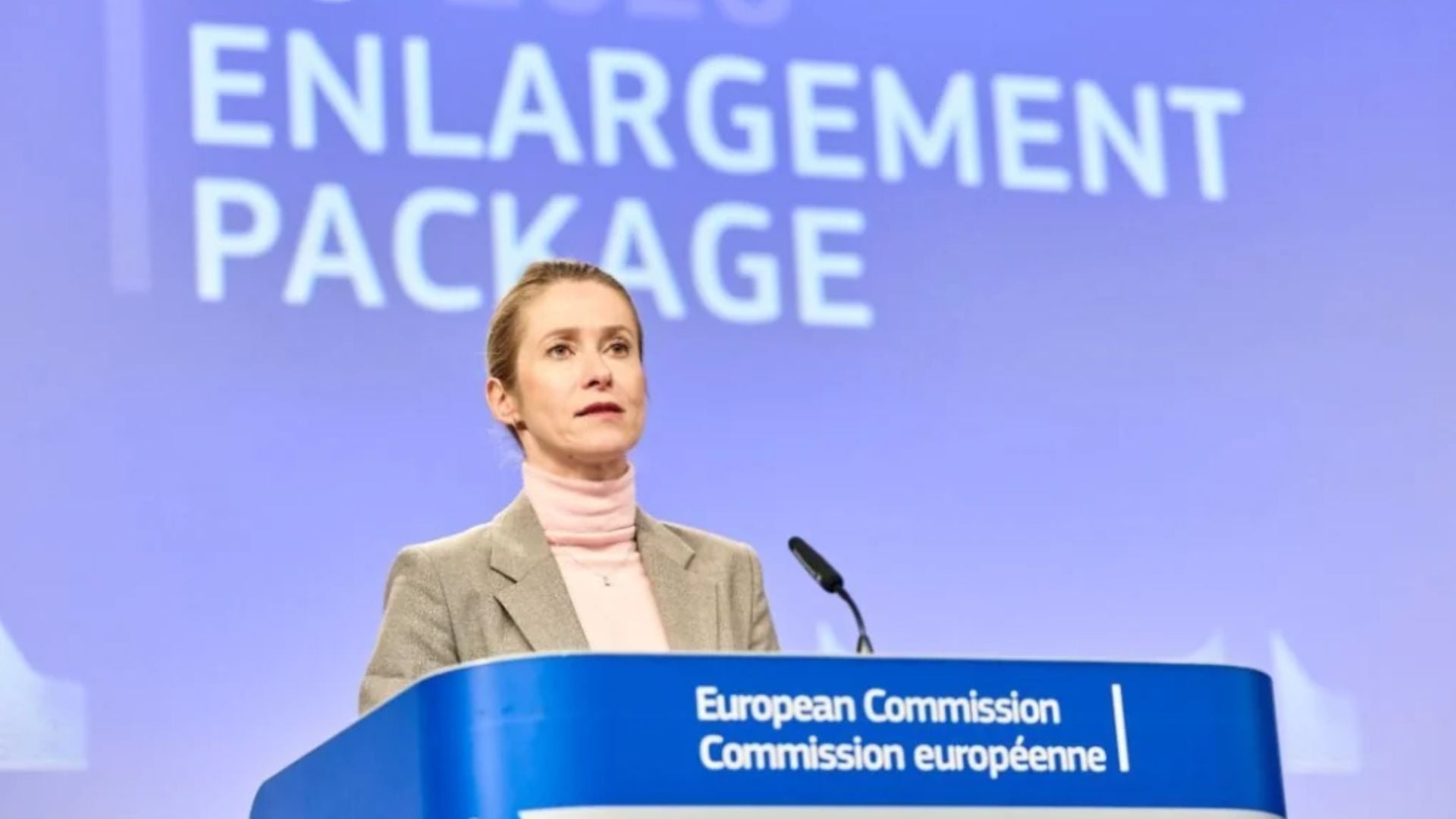
The European Union’s High Representative for Foreign Affairs and Security Policy, Kaja Kallas, mentioned Albania among the four countries that, according to the Commission, are the most advanced on the path toward EU membership.
According to her remarks, Albania has managed to open all negotiation chapter clusters in just over a year, a pace that Brussels described as an important development in the process.
Praise with a condition: now the pace must be maintained
However, Kallas’s message did not stop at the formal assessment. She stressed that the challenge now is to maintain the pace by accelerating reforms, indicating that from the EU’s perspective, opening chapters is not enough without measurable results going forward.
This is also the main filter Brussels is applying to candidate countries: progress is not measured only by the political calendar, but by meeting obligations, the rule of law and fundamental rights.
The enlargement report and the new weight of security
This year’s report assesses the progress of 10 countries in the accession process and, according to the Commission, places the security dimension more clearly at the center. For the first time, the document also includes a dedicated section on Security and Defence.
According to the EU’s official line, the worsening security situation in Europe, the war in Ukraine, strategic competition and economic uncertainty have increased the urgency of enlarging the union.
Brussels ties enlargement to the EU’s strategic interests
In presenting the report, Kallas explicitly linked the enlargement process to the European Union’s security and geopolitical weight. According to her, a larger EU would be stronger politically, economically and militarily.
In this context, the Commission also presented for the first time roadmaps for accession negotiations with Montenegro, Albania, Moldova and Ukraine, four countries currently seen as ahead of the others in this process.
For Albania, the signal from Brussels is politically favorable, but not without reservations. The assessment of the pace so far is accompanied by a clear demand: reforms must accelerate and be maintained at the standard required by the EU.
This means that, despite the enthusiasm generated by the diplomatic language of the report, the burden of proof still lies with concrete implementation and not with declarations of success.