
Albania’s Socialist Party is expected to convene its National Assembly on Saturday at a resort in Lalzi Bay, at a time when the ruling majority is facing political costs from protests and open questions over the local electoral race. According to sources at the party headquarters, the meeting is scheduled for 10:30 a.m. and is expected to be dominated by Edi Rama’s electoral calculations, as well as internal issues affecting relations at the top of the Socialist Party.
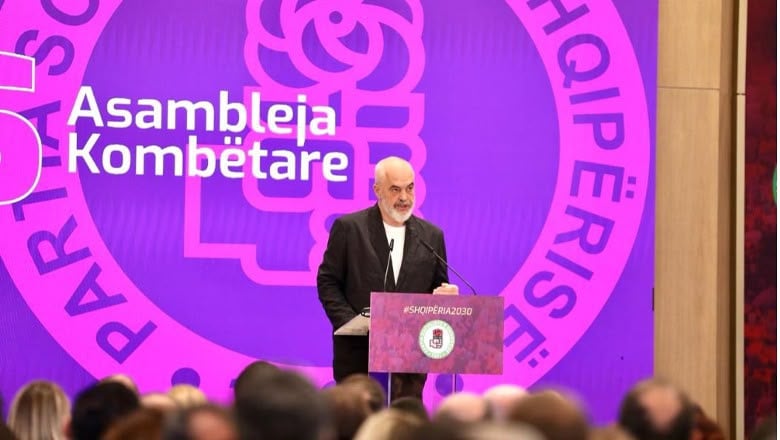
Focus on the May 9 local elections
Preparations for the May 9 local elections are expected to be at the center of discussions. According to published information, Rama is expected to call for the mobilization of Socialist Party structures for a race that the ruling majority intends to treat as a direct political test.
Alongside the goal of victory, one of the key issues remains how Socialist candidates for mayor will be selected. This is no minor matter, as the choice of names in the Socialist Party usually passes through the chairman’s filter and not necessarily through an open political process.
Tirana and the shadow of a clash with Veliaj
Special attention is expected to be paid to the Municipality of Tirana, as the country’s largest and most important political unit. It remains unclear whether Rama will give concrete signals about the profile of the candidate he wants for the capital, or whether he will keep the decision-making closed until a more favorable political stage.
At the same time, Socialists are waiting to hear Rama’s public position on Erion Veliaj, who according to reports has now entered into a sharp course of confrontation with the prime minister after his transfer to Fier prison. Silence or a cautious statement on this relationship would be read politically just as much as an open stance.
Protests and discontent in the background
The situation with the protests is also expected to weigh on the political agenda of this assembly, as they continue, albeit with lower participation than in the initial stages. For the government, this is an issue that cannot simply pass as temporary noise, especially when discontent is emerging simultaneously on social ground and in electoral cost.
The prime minister’s official version has been that the concerns raised have been noted and are being addressed. However, it remains to be seen whether there will be more at the Assembly than a routine political reading of the situation and whether the weight these developments have created for the government will truly be acknowledged.
Spiropali’s motion and the scenario of cabinet moves
Another point that could generate debate is whether Elisa Spiropali’s motion on opening up the Socialist Party and what she has called the need for a “New Deal for Albania” will be included on the agenda. If this issue is overlooked, it would be seen as another signal that internal debate in the Socialist Party remains tightly controlled from above.
Likewise, it cannot be ruled out that Rama will use this forum for cabinet moves. In September 2023, he chose this very Assembly to announce the replacement of half the government. If something similar happens this time as well, it will once again be a decision centered on the prime minister’s will, at a moment when the government is facing political and public pressure.
Saturday’s Assembly is expected to send signals not only about the Socialist Party’s electoral strategy, but also about how Rama intends to manage internal tensions and the costs coming to him from outside power.
Beyond organizational formulas, the essence remains in the political decisions: how candidates will be chosen, what will be done with Tirana, how the protests will be handled, and whether the prime minister will once again use the Assembly to reformat the government.