
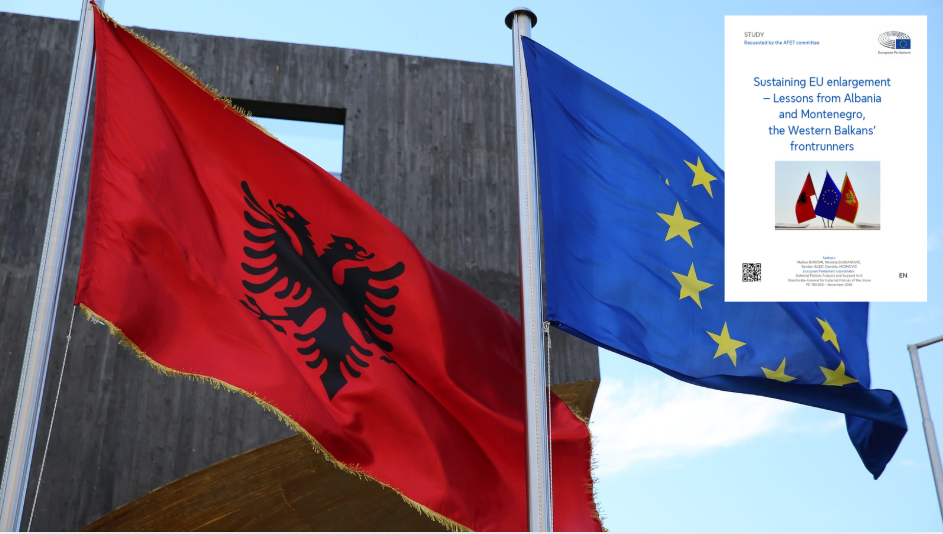
Albania is moving quickly at the negotiating table with the European Union, but not all of its old problems are moving at the same pace. An analytical study by the European Parliament praises the country for its formal progress in the accession process, while raising a series of alarms over corruption, the politicization of the administration, the concentration of power and the weakness of oversight mechanisms.
Negotiations at a fast pace, but standards remain the real test
According to the analysis, Albania is considered one of the two frontrunner countries in the Western Balkans on the path toward the EU. The document praises the political commitment to integration and the fast pace of negotiations, but stresses that procedural acceleration should not be confused with the actual fulfilment of membership standards.
Albania opened negotiations in July 2022 and during 2024-2025 managed to open all six negotiating clusters. In May 2026, the interim benchmarks for Cluster 1, “Fundamentals,” were met, while in July 2026 the first three chapters were provisionally closed. The objective of completing technical negotiations by the end of 2027 is presented as ambitious and dependent on the continuity of reforms and their implementation on the ground.
SPAK and justice reform receive praise, but not a blank check
The 2016 justice reform is listed among the most important developments in the integration process. According to the document, the vetting process and changes in the system have been seen by European institutions as a sign of political will to address the structural problems of the justice system, even though implementation of the reform has produced difficulties and institutional tensions.
The role of SPAK and the National Bureau of Investigation is assessed positively, especially for investigations into high-level corruption and politically exposed persons. But the analysis does not see this as a closed story: it calls for consolidated results, especially final convictions in high-profile cases, as well as greater effectiveness in the seizure and recovery of criminal assets. The document also raises concerns about possible political influence over other law enforcement institutions.
Polarization, media and administration under question
One of the most critical parts of the analysis concerns the functioning of Albanian democracy. According to the European Parliament’s assessment, strong political polarization, conflictual relations between the sides and the concentration of power have called into question checks and balances, political pluralism and media independence.
The problems also extend to public administration. Despite legal changes and new mechanisms, the document identifies a lack of capacity, politicization, high staff turnover and inconsistent implementation of meritocracy. In this regard, it calls for merit-based recruitment, limiting political interference in senior-level appointments and stronger coordination among the institutions leading the integration process.
Strong support for the EU, but dissatisfaction with governance
In foreign policy, Albania is praised for its high level of alignment with EU positions, including sanctions against Russia after the aggression in Ukraine. NATO membership and the country’s Euro-Atlantic orientation are presented as factors that increase its credibility as a strategic partner.
The analysis also underlines strong public support for EU membership, at levels above 80-90 percent according to data cited from the Balkan Barometer. However, this support is not seen as approval of the way the country is governed. The document mentions dissatisfaction with transparency, the quality of democracy and governance, also citing the June 2026 protests in Tirana against the development project in the Zvërnec area, known as the “Flamingo Revolution,” which later took on a broader political and civic dimension.
EU money is tied to reforms, not only rhetoric
On the economic front, Albania has advanced in aligning with the European market through the Stabilisation and Association Agreement, regional cooperation and participation in EU programs. An important development mentioned in the analysis is inclusion in SEPA, which aims to reduce the costs of euro transfers for citizens and businesses.
At the same time, the country benefits from the Growth Plan for the Western Balkans, where European funding is conditional on concrete reforms. According to the figures included in the document, Albania has fulfilled 21 of the 41 planned reforms and has received just over 200 million euros from a potential fund of 922 million euros over three years. The message emerging from the analysis is clear: the pace of negotiations and the funds are not enough if the state does not prove through results that institutions truly function and not only on paper.
The conclusion of the analysis is that Albania has made significant progress on the road toward the EU, but the decisive test remains implementation. According to the document, closing negotiations by the end of 2027 will require not only the opening and closing of chapters, but sustainable results against corruption and organized crime, independent institutions, a more professional administration and a democratic environment in which the media and civil society function without pressure.