
The use of screens in classrooms is becoming a fierce debate in the United Kingdom, as parents and health professionals question the safety and real benefits of technology in learning. At the center of the criticism are the possible effects on children’s eyesight, sleep and physical development, while the British government is maintaining its pro-technology line.
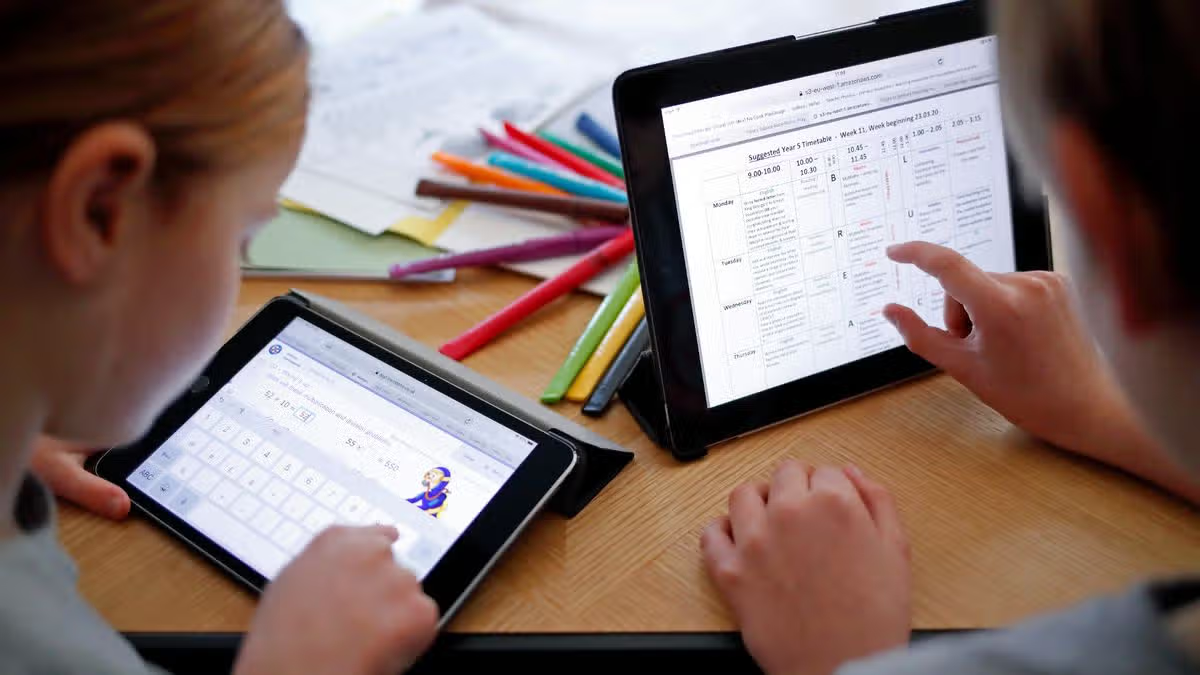
Parents express fears about the impact on health
A survey published by the organization SafeScreens shows that 47% of parents fear that the use of digital devices in classrooms could negatively affect their children’s eyesight and posture.
Likewise, 36% of respondents are concerned about the effect prolonged screen time could have on sleep quality. The data takes the debate beyond technological convenience and shifts it toward the concrete health consequences for pupils.
Warning letter from more than 150 health professionals
More than 150 health professionals, including general practitioners, pediatricians and speech therapists, have sent a letter to British Education Secretary Lucy Powell and Health Secretary Yvette Cooper.
The letter speaks of a “crisis” in children’s physical and developmental health which, they say, is linked to the use of technology in the learning process. The signatories also question the lack of sufficient evidence for the safety and educational value of the technological tools being used in schools.
Concerns also over the expansion of artificial intelligence tools
Another point of concern is linked to plans to introduce artificial intelligence-based teaching tools starting next year for up to 450,000 children from low-income families.
Critics are calling for more evidence and less institutional enthusiasm at a time when schools in the United Kingdom spend around £900 million a year on education technology, with that bill expected to rise further.
The government rejects broad restrictions
According to the official position, the British government does not intend to impose broad restrictions on the use of technology in schools. Its argument is that technology is already part of children’s lives and can bring benefits in learning, creativity and support for pupils with special educational needs.
However, the Department for Education is preparing guidance on the amount of time children over the age of five should spend in front of screens, with publication expected before Christmas. This suggests that the institutions themselves recognize that the issue is not as clear-cut as it is presented in official discourse.
Stronger rules for phones in schools
At the same time, ministers have introduced tougher measures for the use of mobile phones in schools. Under the new plans, pupils may be required to place their phones in special lockers or hand them over to teachers during school hours.
The move is justified by the aim of creating distraction-free classrooms, at a time when only 16% of secondary school pupils say phone rules are enforced at all times.
The debate over technology in education is thus moving beyond promises of modernization and into fundamental questions about safety, scientific evidence and how public funds are spent.
If screens are being presented as an automatic solution for schools, the reaction from parents and doctors shows that this narrative is facing serious resistance.