
Prime Minister Edi Rama presented the 2027 draft budget in Parliament, marketing it as a package aimed at lowering the cost of living and redistributing part of economic growth. According to the government’s version, the document is backed by a budget that for the first time reaches the level of 10 billion euros, while the opposition and the parliamentary debate focused on the credibility of these promises and how they will be implemented in practice.
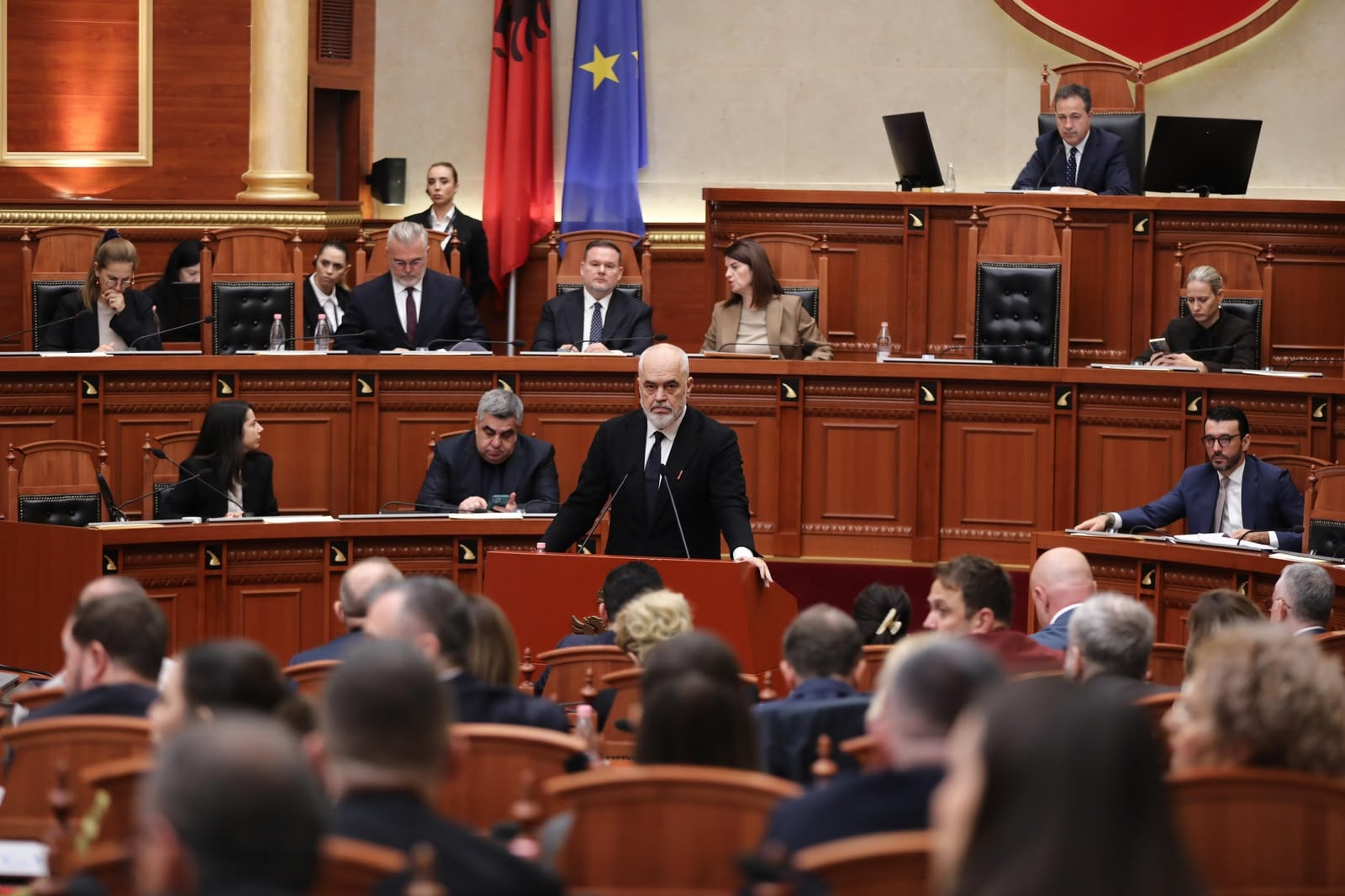
Government speaks of a record budget and relief for families
In his presentation, Rama said the 2027 draft budget reaches a ceiling of 10 billion euros. He linked this to what he described as a tripling of the economy compared with the time when the Socialists took office.
One of the main points of the package is a cut in VAT to 6% for 54 products in the food basket. According to the prime minister, this measure will leave around 150 million euros a year with Albanian families through lower prices. However, it remains to be seen whether the tax cut will actually be reflected in consumer prices, or whether part of it will be absorbed by the market.
Fuel and taxes: a promise of a lower price at the pump
The government also plans to remove the circulation tax from the fuel price and shift it to the vehicle. According to Rama, this would bring a reduction of 32 lek per litre at the pump and bring fuel prices in Albania closer to those in the region.
Under the declared plan, payment of the tax will be linked to the characteristics of the vehicle and to the system of the General Directorate of Public Transport. What remains unclear is the final effect for citizens: if the tax burden is simply being shifted from the pump to vehicle ownership, the real savings will depend on how the scheme is designed and how much each vehicle category will pay.
Pensions, dividends and the promise to narrow inequality
Rama said the philosophy of the draft budget is to narrow the gap between high-income groups and those with lower incomes. Along these lines, the government is keeping unchanged the 15% tax on business profits, but proposes increasing the dividend tax from 8% to 15%.
For pensioners, according to the prime minister, from January 1 there will be a doubling of the increase compared with the year now ending. For this, 20 billion lek, or around 200 million euros, have been earmarked, while for the April indexation an additional fund of 4 billion lek was mentioned. Here too, the real weight of the increase will be measured not by the figures presented from the podium, but by their impact on purchasing power in the face of prices.
Housing and students, two other promises in the package
In the field of housing, Rama said 1,000 families will be included in subsidised lending schemes, another 2,000 will be supported through rent subsidies in the free market, while another 7,000 families will benefit from the new approach to housing. In total, according to the government, this amounts to 10,000 beneficiary families.
For students from families in need, the draft budget provides for an increase in the scholarship from 10,000 to 25,000 new lek per month and its extension to the master’s cycle as well. The government presents this as relief for young people facing living and rental costs, especially in Tirana.
200 billion lek in public investment
Another pillar of the draft budget is the plan for 200 billion lek in public investment. The prime minister presented this not as consumption of revenue, but as reinvestment to stimulate further economic growth.
However, beyond the large figure, the essential question remains the quality of these investments, the concrete priorities and the control mechanisms over the use of public money. These are precisely the points that tend to remain the most contentious whenever the government presents budgets with high political and financial ambitions.
The 2027 draft budget was presented as a package with tax cuts, social support and high public investment. But as with any budget, the difference between promise and real effect is not measured in the Parliament hall, but in citizens’ prices, bills and purchasing power.
The political debate is expected to focus precisely on this point: how much of the announced measures will translate into concrete relief and how much will remain part of the government’s optimistic narrative for 2027.