
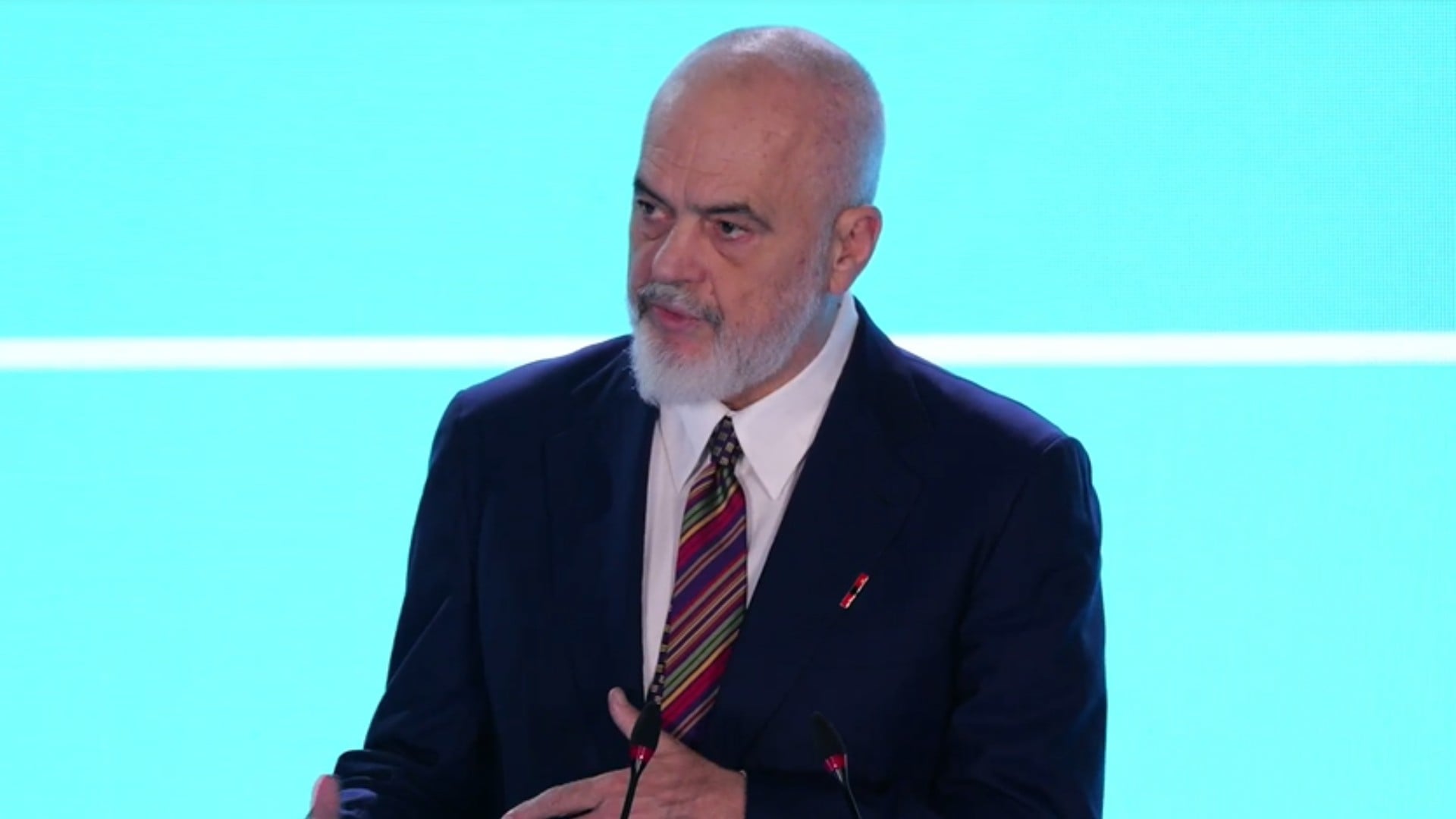
Prime Minister Edi Rama used the EU-Western Balkans Investment Conference to push forward the government’s narrative of a more attractive Albania for foreign capital, declaring that the country will benefit from greater support from the European Union’s Growth Plan. In his speech, the head of government called on European investors to look “beyond outdated perceptions” of the region.
The government presents Albania as an economic success story
According to the version presented by Rama, Albania is entering a stronger economic phase, with more consolidated institutions and a more sustainable outlook for the future.
He said the country’s progress has been recognized “on every front” and linked this to expectations that Albania will receive more support from the EU’s new growth plan. In the same vein, the prime minister also pointed to the increase in the budget, stating that for the first time it reaches 10 billion euros.
Focus on energy, infrastructure and technology
In an effort to attract new investors, Rama listed the sectors the government considers to have the highest potential: energy, infrastructure and digital technology.
He mentioned the country’s natural resources, such as sun, wind and water, as advantages for energy production, while arguing that interconnected systems and digital infrastructure are the basis for economic competitiveness.
Fiscal promises and a call for European capital
In his remarks, Rama also emphasized fiscal policy for small business, stating that Albania is “perhaps the only country in Europe” with zero tax for this category.
The political message of the conference was clear: the government is trying to present the country not as a market that requires prior trust, but as an economy that, in its view, already has results to showcase to European investors.
A call for investment in young people’s skills as well
Beyond physical projects, Rama also spoke about the need for investors to become involved in developing human capital. He said schools and universities must respond to market demands and that some of the projects being promoted are linked to young people and skills development.
According to him, success should not be measured only by announcements or plans, but by completed projects, businesses that grow and jobs that are sustained over time. In the end, he closed his appeal with the idea that the Western Balkans should be seen as part of Europe’s present, not its periphery.
The prime minister’s statements at this forum come at a time when the government is intensifying its promotional tone on the investment climate and Albania’s connection to new European funds.
What remains to be seen is whether the expectations declared at conferences will translate into concrete investments, measurable projects and a real impact on the economy.