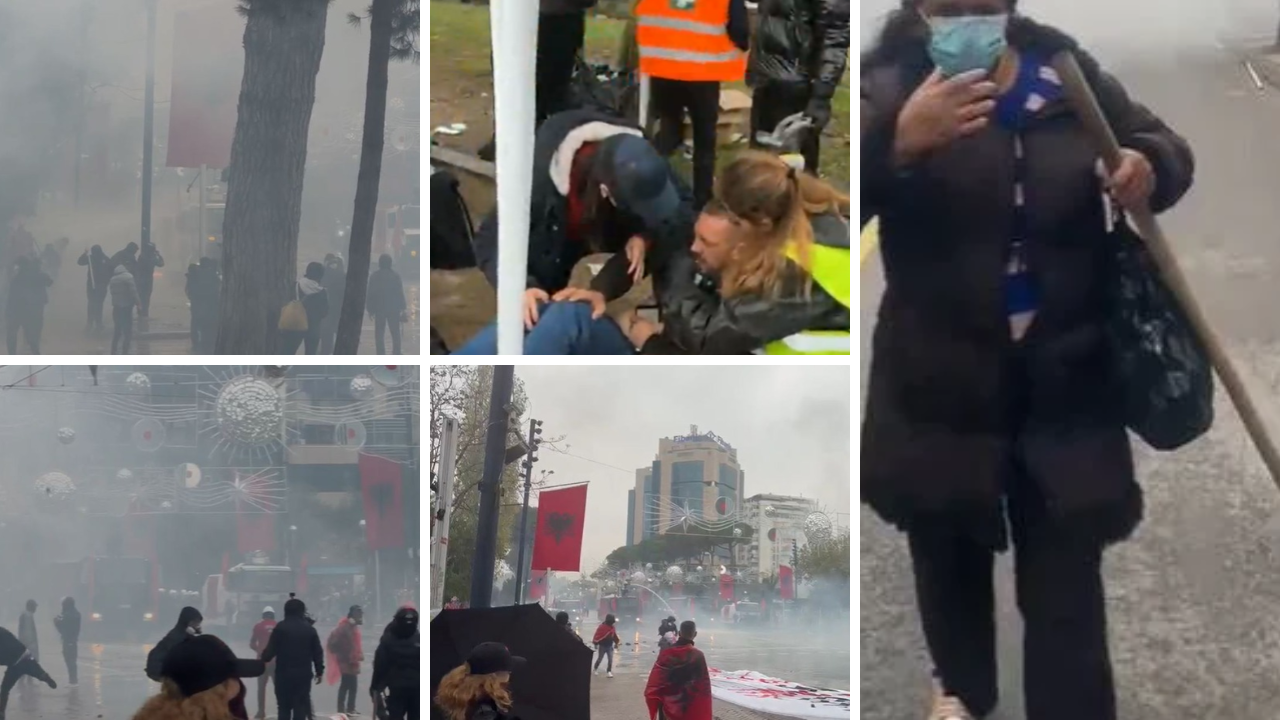
The opposition protest in Tirana quickly escalated into fierce clashes with police, as the gathering in Skanderbeg Square moved from firecrackers to stones and Molotov cocktails. In the area around the Prime Minister’s Office, smoke, water cannons and explosions dominated the scene, while the preliminary number of injured was published by health institutions.
From the square to the clash outside the Prime Minister’s Office
Tensions began in Skanderbeg Square, where the gathered protesters threw the first firecrackers. The crowd then marched toward the Prime Minister’s Office, where the situation spiraled out of control and protesters took up positions facing the police cordon.
Footage from the scene shows stones and a series of Molotov cocktails being thrown at police forces, while the police response came with water cannons and tear gas. The area was engulfed in smoke and explosions, turning central Tirana into a scene of open confrontation.
Preliminary injury toll
According to the Ministry of Health and Social Welfare, by 2:00 p.m. one police officer, two media representatives, one of them a foreign national, as well as five protesters had arrived at the University Trauma Hospital.
The official version says all of the injured were conscious, in stable condition and receiving treatment in the emergency department. According to the same official data, teams from the National Center for Medical Emergency also treated three other protesters at the scene, whose condition is reported to be good.
Injuries also reported at the scene
During the protest, there were also reports of one person injured in the leg in Skanderbeg Square, who was given first aid at the scene before the wound was bandaged.
In another serious episode, a police officer was engulfed in flames after Molotov cocktails were thrown toward the cordon. The extent of his injuries has not been disclosed beyond the preliminary notifications.
A protest with a high public cost
The clash outside central institutions, including the Prime Minister’s Office and the Bank of Albania, once again highlighted the failure of the structures to keep a previously announced gathering under control. Instead of management that would prevent escalation, the center of the capital ended up amid gas, fire and injuries.
So far, official information is limited to the preliminary number of people who received medical assistance, while important questions remain unanswered about the level of preparedness, the chain of responsibility and how the situation was allowed to deteriorate to this point.
Images and reporting from the scene show a protest that quickly turned into violent clashes in the heart of Tirana.
The full number of injured and responsibility for the escalation remain unclear.