
A Chinese national has been pulled out alive from a tunnel in Nepal after being trapped for 10 days, in one of the rare survival episodes amid the disaster that has struck areas near the border with Tibet. While authorities are presenting the operation as a rescue success, the death toll and the number of missing people show the true scale of the tragedy.
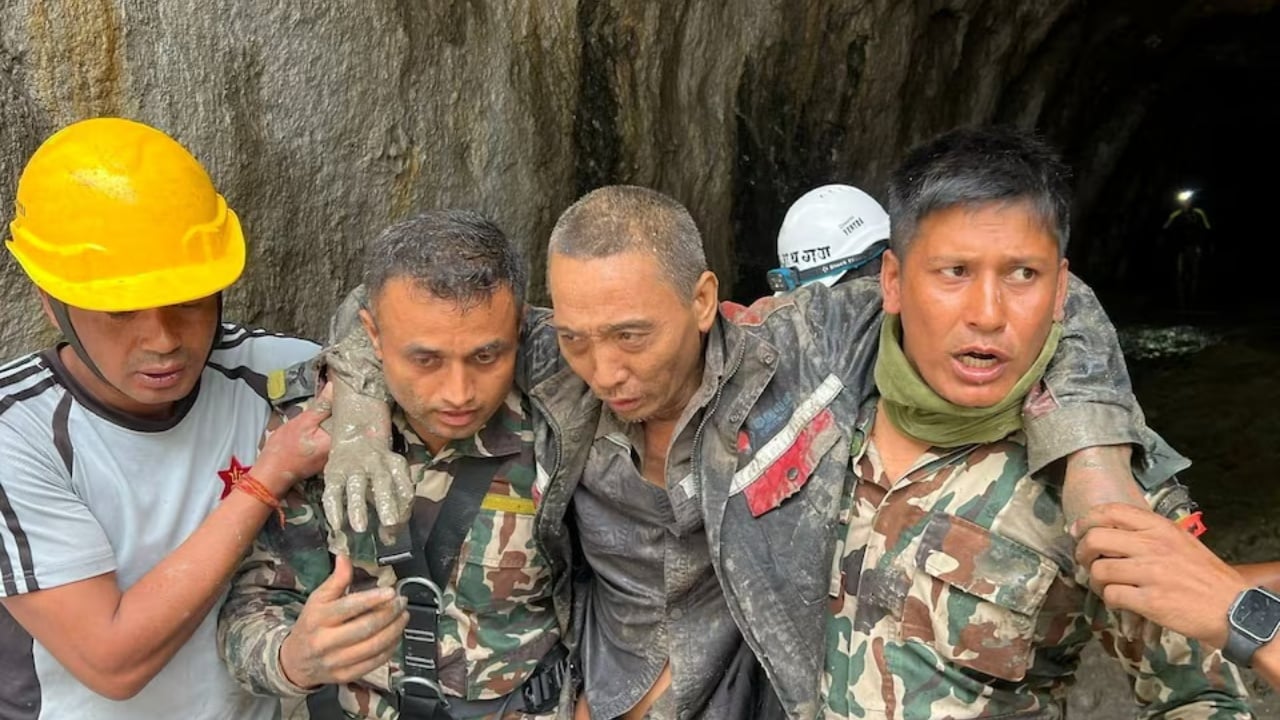
Rescue after 10 days underground
The Nepalese army announced on Saturday that Lu Haitao was pulled out alive from a tunnel about 225 meters long, part of the Upper Trishuli-1 hydropower project. He is the third person to be rescued alive from the tunnels affected by the disaster.
According to the official account, Lu had no visible injuries and his condition was stable, although he showed signs of mild hypothermia. Footage released by the army shows him exhausted and disoriented as he receives first aid in a helicopter before being transported to a military hospital.
The disaster that struck the Himalayan valley
On August 26, a mass of ice, rocks and mud broke loose in the upper part of the Himalayan valley, causing major flooding in several areas near the border with China’s Tibet.
The waters swept away homes, roads and other structures, while the mountain areas turned into a scene of difficult search operations. The scale of the damage makes it clear that this is not an isolated incident, but a disaster with broad human and infrastructure consequences.
Heavy toll and many questions over the missing
Nepalese authorities report at least 1,344 deaths from the floods, while 4,887 people are still listed as missing. Among them are 583 foreign nationals, many of them pilgrims and tourists who were in the mountainous area.
On the other side of the border, China has reported 31 deaths in Tibet and 531 missing. According to data published by the state agency Xinhua, 261 of them are foreign nationals.
Meanwhile, according to authorities, around 900 people may still be trapped in the tunnels affected by the disaster, a figure that makes the contrast even starker between the rare rescue cases and the still unclear toll on the ground.
Families wait for news near the search areas
At a military barracks in Nuwakot district, relatives of the missing have put up photographs and posters of loved ones believed to still be inside the tunnels. Images from the area show a long wait and continuing anxiety.
Among them is the family of Ishwor Poudel, who had worked for three years in the tunnel of the Hakubesi hydropower project. His brother, Krishna Poudel, said the last contact was on August 26, shortly after the flood swept through the valley.
According to accounts he received from other survivors, Ishwor was seen inside the tunnel and from within, the voices of hundreds of people could be heard. These accounts keep families’ hopes alive, but also raise serious questions about the real number of people who may still be trapped.
Another survivor found under mud
Also on Saturday, the Nepalese army announced the rescue of Chandika Kumari Shrestha from her home in Betrawati. She was found covered in mud inside a flooded underground structure.
Rescue teams gave her water and assistance in a narrow space filled with sludge, another indication of the extreme conditions facing both survivors and teams on the ground.
Between rescue operations and the rising death toll, the disaster in Nepal remains an open humanitarian crisis, with thousands of fates still unclear.
The rescue of several trapped people has brought hope, but official figures and testimony from relatives show that the ordeal in the tunnels and flooded areas is far from over.