
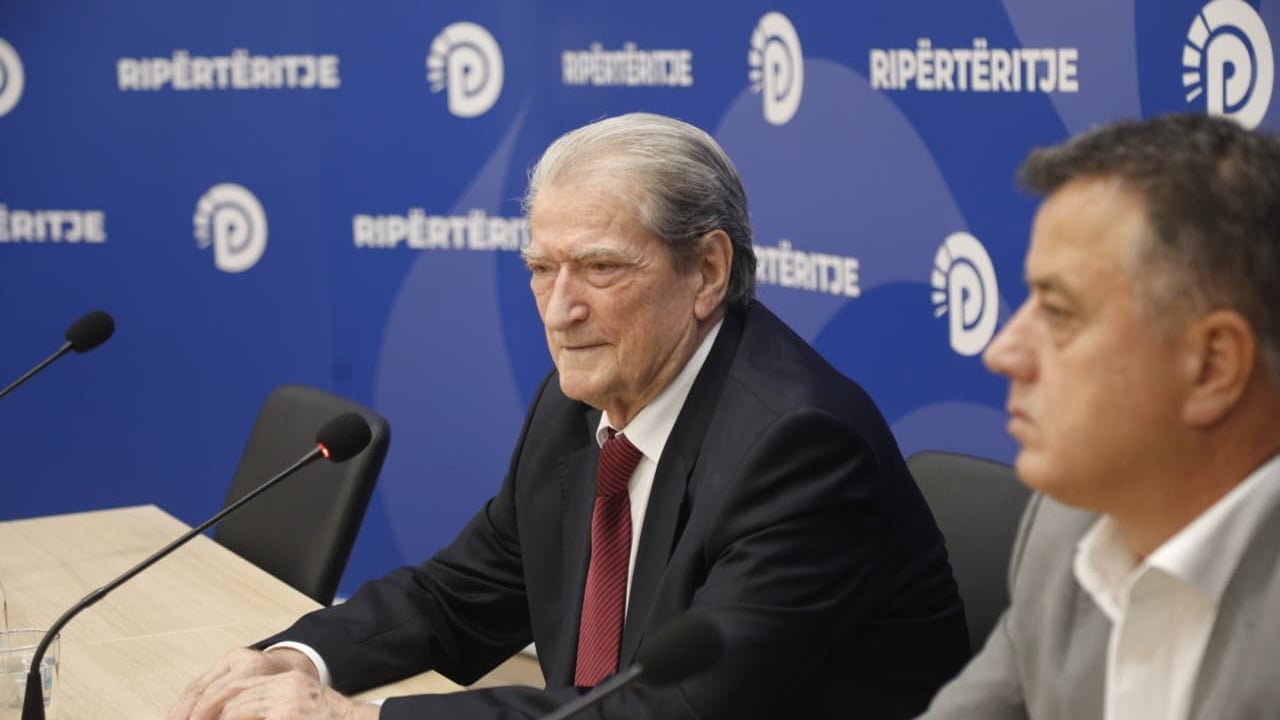
Sali Berisha convened the leadership of the Democratic Party this afternoon, in an appearance where, beyond his usual rhetoric against the government, he also raised serious political accusations regarding AKSHI and national security. At the same meeting, he asked PD structures and supporters to line up behind the protest on the boulevard.
Political accusations against the government
During his remarks, Berisha said Edi Rama’s government has lost the legitimacy to govern the country. According to the PD leader’s version, the majority is in a phase of deep discrediting and is facing heavy political blows.
He described the government with extreme accusations, calling it a tainted regime and repeating the opposition’s narrative that the rule of law has been replaced by criminal interests. These are political claims articulated at the leadership meeting, without being accompanied in this appearance by new public evidence.
Attack on AKSHI and references to national security
A significant part of Berisha’s statement focused on the issue of national security and on AKSHI. He also mentioned the arrest warrant against Vlora Hyseni, claiming that what he described as the state’s most valuable asset — national security — had been undermined.
Berisha went further, calling AKSHI, in his view, “the most dangerous mafia group in Europe,” and directly accused Edi Rama of placing the internet and communications across Albanian territory under full control. These too remain strong political accusations made by the opposition in a party forum.
Message for the protest in Tirana
At the end of the meeting, the PD leader placed the emphasis on the protest on the boulevard, for which he called for full engagement from Democrats. He called support for this gathering a “major duty” for the opposition.
The political message was clear: PD aims to use the protest as an instrument of pressure on the ground against the government, turning street mobilization into a central part of its political strategy.
Harsh rhetoric, but no new factual elements
Berisha’s appearance was characterized by strong language and serious accusations against institutions, but no new factual elements were presented in the public content of the meeting to independently support the claims made.
Politically, the leadership meeting served more as a signal of a rise in the opposition’s tone and of strengthening participation in the protest than as the presentation of a new public case against the government or the institutions involved in Berisha’s accusations.
The PD leadership meeting once again confirmed the opposition’s hard line toward the government and the institutions it considers politically captured.
Beyond the rhetoric, the real weight of these accusations remains tied to facts that can be publicly proven and to how they will translate into political action on the ground.