
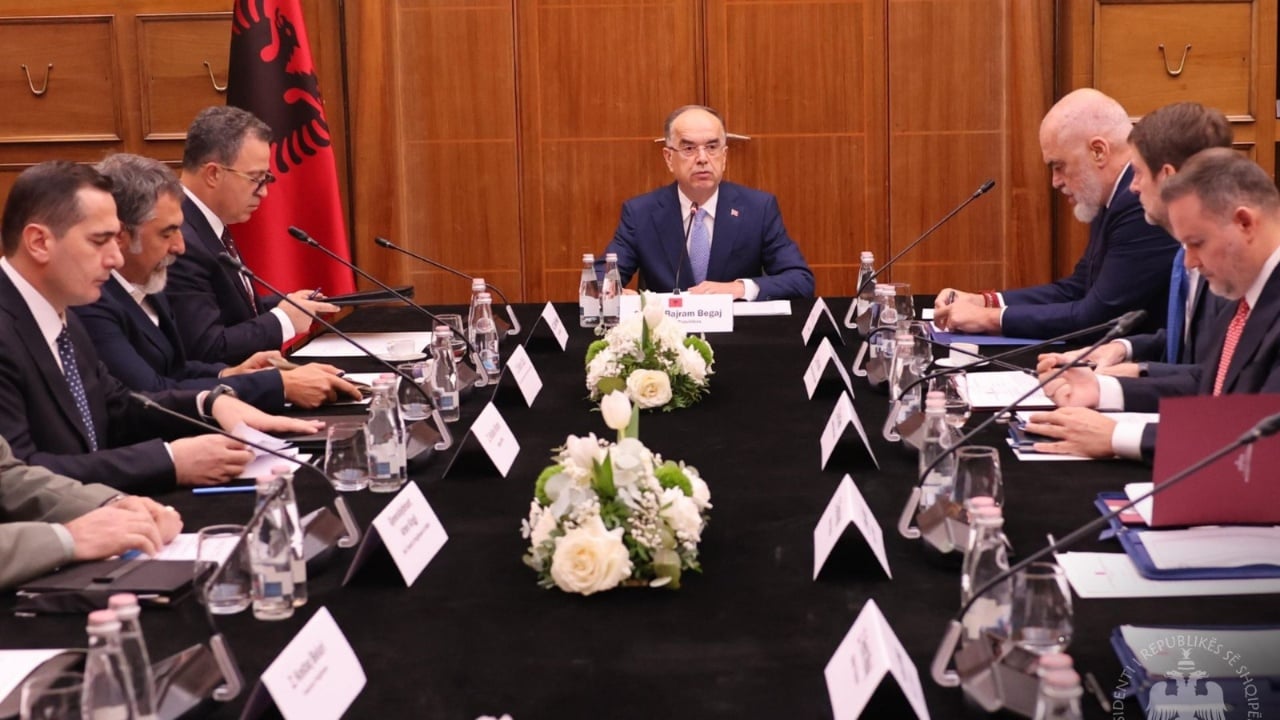
President Bajram Begaj convened the National Security Council this Saturday, at a time when the public debate has also shifted to the credibility of the security institutions. In the Presidency’s official version, the focus of the meeting was the current security situation, coordination between institutions and preserving public trust, while on the Vlora Hyseni case it was requested that the investigations be left in the hands of justice.
What the Presidency said after the meeting
In its media statement, the Presidency stressed that issues of current concern and their impact on the work of the security institutions were discussed at the meeting. According to this version, emphasis was placed on strengthening inter-institutional cooperation, coordination with partners and allies, as well as restoring citizens’ trust.
The members provided for by law took part in the meeting, while representatives of the General Prosecution Office and SPAK were also invited. Their presence was presented by the Presidency as part of the need for communication and institutional coordination on issues affecting security.
The message on the Vlora Hyseni case
The most sensitive part of the statement concerned the case of Vlora Hyseni. The Presidency said the investigations must be conducted entirely independently and respected by الجميع, adding that individual cases should not be turned into a crisis of confidence in the state and the security institutions.
This wording shows the Presidency’s effort to keep the debate within an institutional framework and to avoid a particular case producing a broader political or institutional shock. However, the very need for such a clarification shows that the issue has created public pressure and questions about how the links of security and accountability function.
A call for cooperation, not competition, between institutions
According to the Presidency, it was stressed during the meeting that the security institutions should not compete with one another, but cooperate for the same interest, that of the security of the Republic of Albania. The statement called for institutional mistrust to be replaced by coordination, professional communication and clearly divided responsibilities.
It also underlined the need for stronger standards, oversight, transparency and accountability. These are familiar formulations in official statements, but it remains to be seen whether they will be accompanied by concrete steps from the responsible institutions.
The Council’s role and the limits of the meeting
The Presidency clarified that the National Security Council does not make decisions, but is an advisory body to the President of the Republic. Its meetings are held behind closed doors and are intended to support the head of state in exercising constitutional and legal powers.
This means the weight of the meeting remains mainly political and institutional, not executive. As a result, the public message emerging from it has more guiding and signaling value than a direct decision-making effect.
In essence, the Presidency chose to deliver a calming message for the security institutions while at the same time distancing itself from any open interference in the investigations. But when it is publicly requested that an individual issue not be turned into a crisis of confidence, this shows that the problem of credibility is already on the table.