
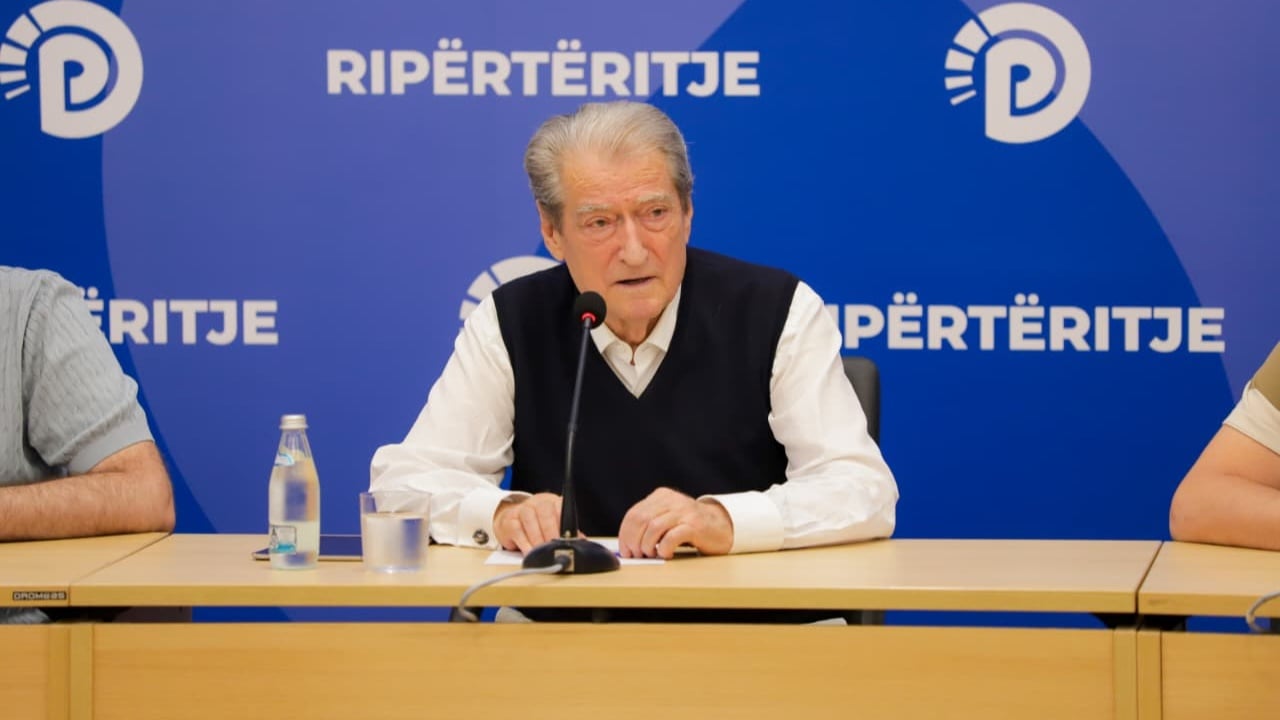
The debate over the new territorial map has returned with sharp political overtones. From the Democratic Party headquarters, Sali Berisha presented the government’s project as a move to strengthen control over local government, while claiming that opposition to the dissolution of municipalities has begun in some areas.
Direct accusations against the government of concentrating power
At a meeting with allies from the United Opposition Federation, Berisha said the parliamentary majority is being used by Edi Rama to push forward a territorial reform which, according to him, is aimed at an even greater concentration of power.
According to the head of the Democratic Party, the opposition became involved in the process not because it believed the government would carry out a real reform, but because of citizens’ demands that this issue not be left entirely in the hands of the Socialists, and because territorial reform, according to him, has also been mentioned in European Commission reporting.
The government draft and the claim that consultations were halted
Berisha claimed that consultations were abruptly interrupted while the process had still not been completed. According to his version, a draft with 46 municipalities was then presented, eliminating 15 more.
He interpreted this move as the government’s electoral calculation, not as an administrative reform built on consensus or on the needs of local communities.
PD speaks of 100 municipalities and a clash over procedure
Berisha said the opposition has submitted to Parliament an alternative draft with 100 municipalities, while also leaving open the possibility of creating other units depending on whether the criteria are met.
He argued that such changes run counter to the Constitution and to the Charter of the Congress of Regional and Local Authorities of the Council of Europe, insisting that issues of this weight require consultation and a referendum. These remain the political positions of the opposition, while there has been no reaction from the government included in this development.
Claims of protests and opposition on the ground as well
On his way out, Berisha declared that in a number of municipalities, a reaction has begun against the abolition of local units. According to him, in some cases even councillors whom he considers linked to the majority have refused to vote for the closure of municipalities.
This turns territorial reform into a clash that does not remain only in Tirana and in party halls, but directly affects local representation and the way communities will be administered.
For now, the debate is moving forward through political accusations and conflicting versions of a process that affects the structure of local government.
The main question remains whether the new territorial map will be built on real consultation with communities or will pass as a decision driven by the majority’s numbers.