
Spain’s housing crisis has once again brought crowds into the streets. A day after parliament rejected the government’s housing package, tens of thousands of people protested in Madrid and dozens of other cities, demanding concrete measures on rents, evictions and access to affordable housing.
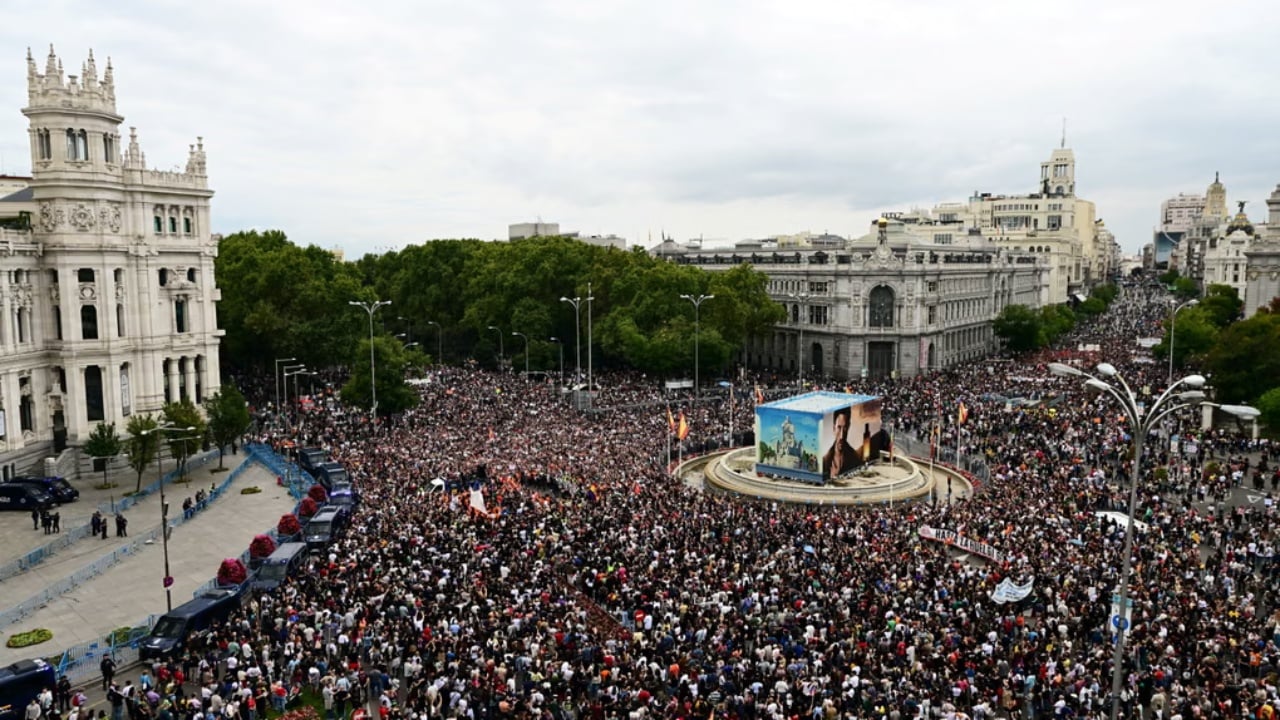
Protests in around 50 cities, but turnout figures remain disputed
Saturday’s demonstrations took place in around 50 cities and were organized by groups calling for action against rising rents and the difficulty of securing affordable housing.
Here too, participation figures vary sharply. According to authorities in Madrid, around 70,000 people took part in the protest, while organizers put the number at about 500,000, a gap that shows how contested the real scale of the mobilization remains.
Government package rejected in parliament
The protests came immediately after the governing coalition led by Pedro Sánchez presented two decrees with measures to address the housing crisis, but failed to secure the necessary votes in parliament.
According to the official version, the package included, among other measures, a ban on evictions until 2030, as well as regulation of short-term rentals and homes rented out by room.
The two decrees were voted down by the Popular Party, Vox and the pro-independence Catalan party Junts. The Popular Party argued that the solution is to build more homes rather than intervene through decrees.
Housing as a right, not a luxury
At the protests, banners were displayed and calls for a general strike were heard, while the central demand was that housing be treated as a fundamental right rather than a burden pushing citizens out of the housing market.
One protester in Madrid said she spends half her salary on a small room, summing up a reality that appears to be affecting broad sections of the population. In the capital there were also chants against the growing profits of companies linked to the housing market and demands for stronger intervention on rents.
The case of an 87-year-old woman became a symbol of the anger
Public anger escalated after the case of Maricarmen Abascal, 87, disabled, who was evicted from the home where she had lived for around 70 years.
According to reports, the investment fund that had bought the apartment demanded a 230% rent increase, an amount the elderly woman said she could not afford. Her case has become a symbol of the protests against rising housing costs.
Clashes in Valencia and political pressure on the government
Most protests were reported as peaceful, but in Valencia there were clashes between demonstrators and police. Police used rubber bullets and tear gas to disperse the crowd, while around 30 people briefly entered the City of Arts and Sciences complex before being removed by police.
This wave of protests comes at a difficult moment for Sánchez’s government. Spanish media have reported that, after the failure of the housing package, the scenario of early elections in November may also be on the table.
The housing crisis is becoming a direct test for Spanish politics, where the clash between government promises, market interests and social pressure is growing ever sharper.
Beyond the parliamentary battle, the message from the streets appears clear: a large share of citizens are no longer waiting for statements, but for solutions that address rents, evictions and the minimum security needed to live.