
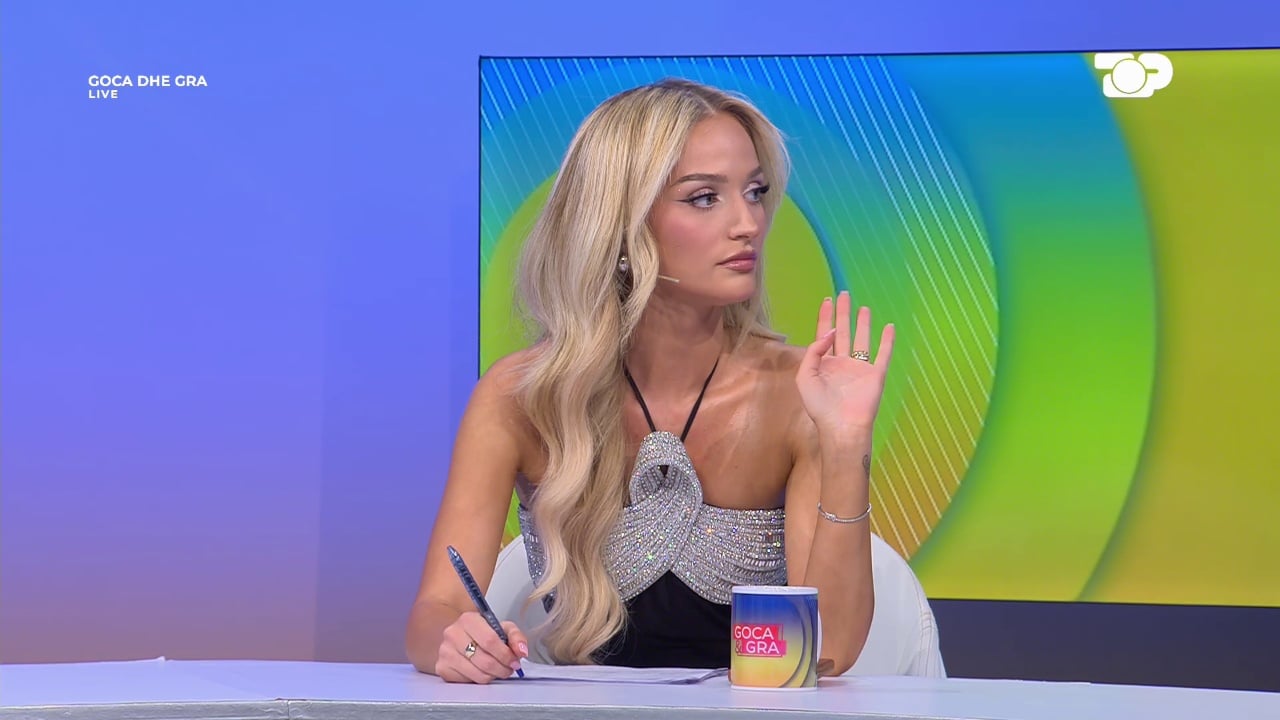
The new season of “Goca dhe Gra” opened with a topic that has stirred public reaction: the release of intimate videos involving well-known screen figures. At the table, the debate took on a direct tone, especially after Selin Bollati’s position that responsibility cannot be placed on only one side.
Season opens with heated debate
Tonight, the program brought back four co-hosts to the panel: Ori Nebijaj, Ema Andrea, Selin Bollati and Orinda Huta.
The first part of the program focused on intimate videos involving well-known figures, an issue that has generated considerable public noise and selective judgment across social media and television studios.
Selin Bollati drew attention to the case of Beatrix Ramosaj
In her argument, Selin Bollati recalled the way Beatrix Ramosaj had, in her view, been “crucified” during the first edition of “Big Brother VIP” over the love story formed inside the house.
She said society reacts with a double standard and that the same situations are not treated equally. Along these lines, Bollati raised the claim that some figures face harsh public punishment, while in other cases there is restraint in judgment.
Clash with Orinda Huta over comparing the cases
Her position was challenged by Orinda Huta, who said the two cases cannot be placed on the same line. According to her, the fact that one person was publicly attacked in the past does not justify repeating the same pattern toward the women involved in the intimate videos.
In the studio, the divide between two approaches became clear: one that calls for shared responsibility for everyone involved, and the other that opposes public lynching as a moralizing mechanism.
Statement on responsibility and references to the Hila family
Selin Bollati said she was not speaking about “crucifixion,” but about shared responsibility, saying that women involved as third parties in a relationship should also bear the weight of their actions.
She also added that, according to information she claimed to have heard, Mr. Hila’s wife is standing by him at this time. In the same conversation, Bollati said that, according to Hila’s wife, the family had been in order and not separated.
For her part, Orinda Huta objected to delving into family dynamics, stressing that no one can speak with certainty about how a relationship has been built within a home.
The debate in the studio once again highlighted a familiar tendency on Albanian screens: strong moralizing, shifting standards, and very few boundaries between public interest and private life.
That is precisely where the core of the issue remains: where personal responsibility ends and where collective judgment begins, which often strikes harder than the facts made public themselves.