
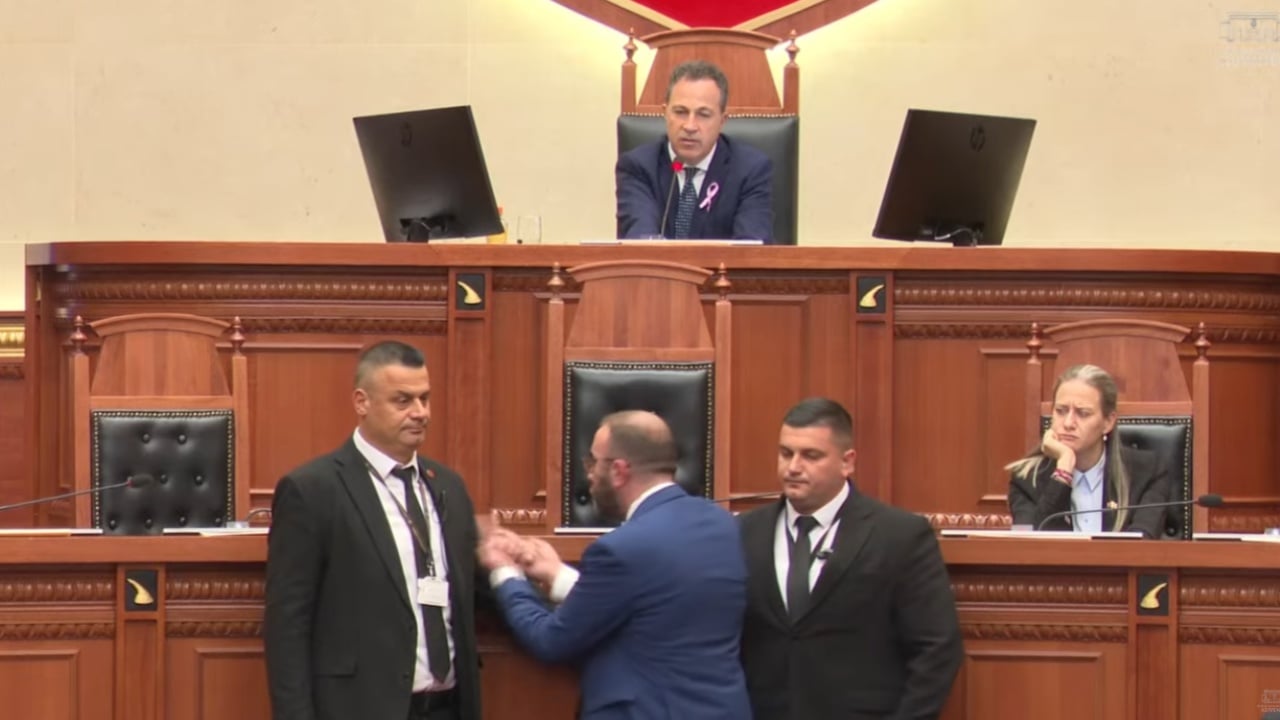
Thursday’s parliamentary session once again produced tension, this time between the head of the PD parliamentary group, Gazment Bardhi, and the session chair, Niko Peleshi. The clash erupted over a familiar point of political conflict in Parliament: limiting the opposition’s speaking time and the interpretation of the rules by those chairing the session.
The debate began over question time
According to reported episodes from the session, Bardhi objected to the time set for questions, claiming he would use the amount of time he considered necessary. At that point, Peleshi reminded him of Parliament’s rules and asked him to conclude his remarks within the allotted minute.
This kind of clash is not unusual in the parliamentary chamber, where the rules are often used as a tool of formal discipline, while the opposition reads them as a political restriction on speech. This time as well, the tension quickly moved from procedure to harsh language.
What was said in the chamber
During the debate, Bardhi addressed Peleshi in strong terms: “Who are you to block the podium for me? I have 40 questions and I will take as much of my time as I want, and I won’t ask you or your guard.”
For his part, Peleshi replied that the podium was free and that there was no order for the guard, insisting that the MP had only one minute at his disposal. Later, when the gong sounded in the chamber, Bardhi asked not to be provoked.
Peleshi continued by referring to the rules, declaring that the microphone was open and that he would show them the rules “so that you don’t take it badly.”
The rules at the center, but also control of the session
At first glance, the debate was about time limits. But at its core, the clash once again exposes the conflict over control of speech in Parliament: who decides the line between enforcing procedure and political intervention in debate.
When the conduct of a session relies on the immediate interpretation of the rules, the opposition often sees this as a selective filter. On the other hand, those chairing the session present it as enforcement of parliamentary order. In the absence of a standard perceived in the same way by both sides, every such incident turns into a personal and political clash.
Another episode in the tense parliamentary climate
The clash between Bardhi and Peleshi adds to the series of tense episodes in Parliament, where procedural debate often overlaps with political substance. Instead of clarifying the questions or ensuring institutional accountability, the session shifted to a conflict over minutes and authority over the podium.
This once again makes visible the crisis in the normal functioning of parliamentary debate, where rules are often cited, but trust that they are applied equally remains contested.
In the end, the episode left behind more procedural noise than political clarification, confirming that Parliament remains an arena where rules and frayed nerves often run in parallel.