
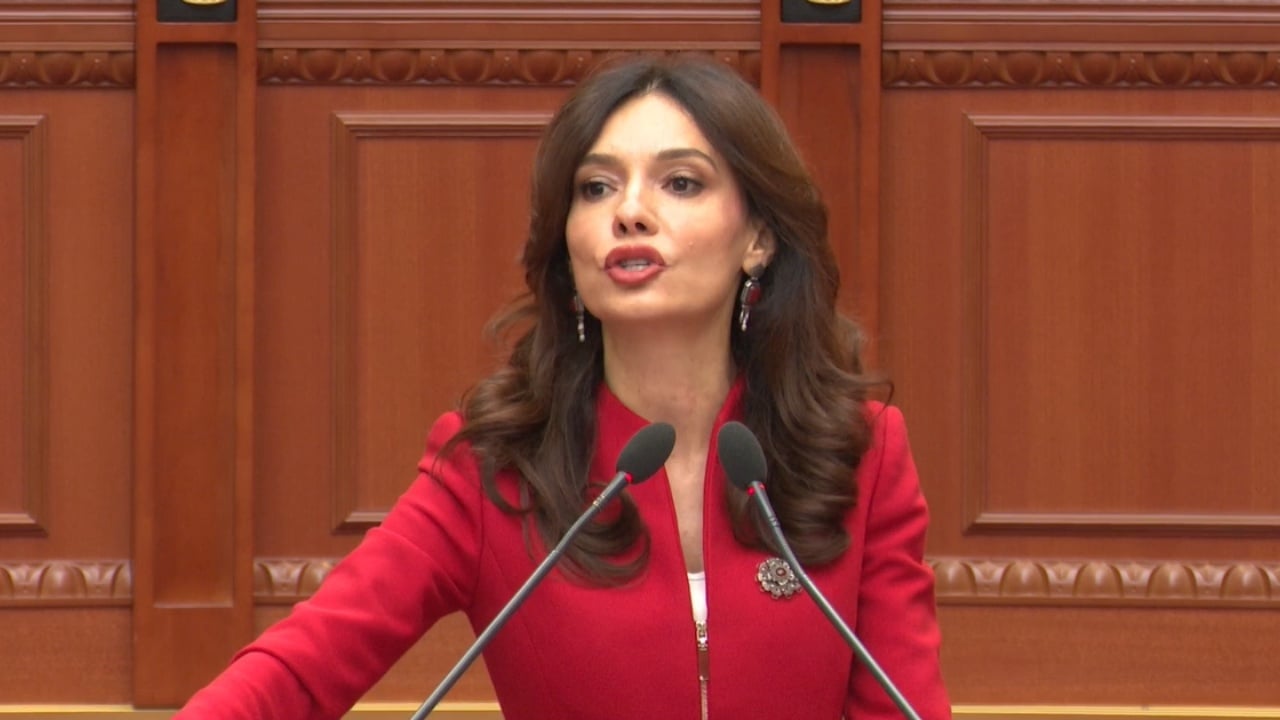
In an intervention that exposed cracks within the majority, Socialist MP Elisa Spiropali declared in Parliament that she will vote against the new territorial reform, openly challenging the official line. According to her, the problem is not simply the number of municipalities or the administrative map, but the concentration of power and the lack of real decentralization.
Criticism from within the majority
During the session where the reform was expected to be put to a vote, Spiropali spoke of a crisis of trust toward institutions, political parties, and Parliament itself. She described the political climate as filled with theater, a lack of cohesion, and a failure in normal communication between the government and citizens.
Her position stood out not only for its critical tone, but also because it came from an MP from the ruling majority, at a moment when the government is presenting the reform as an important intervention in local governance.
“It is not reform if only the map changes”
Spiropali argued that territorial reform cannot be considered such if it is limited to revising the administrative map. According to her, the essential question is how much real power municipalities have and how close citizens feel to decision-making.
She raised doubts about a process that speaks about local government, but avoids debate on the autonomy of institutions and the concentration of power at other levels of governance. At its core, her criticism targets the model of political control over local units.
A direct message about how mayors are treated
One of the strongest points of her speech was the relationship between central government and municipalities. Spiropali said that mayors should not be used as prefects or as links in the ruling party chain, but should be treated as representatives with institutional weight.
She opposed the approach under which mayors are summoned to meetings and treated as subordinates. This is a clear critical signal toward the way power is exercised, even when official rhetoric speaks of decentralization.
A blow also to the electoral system and party discipline
The Socialist MP extended her criticism beyond territorial reform, saying that the electoral system also remains a problem. According to her, citizens should clearly know whom they are voting for, while the current model with partially closed lists does not produce healthy representation.
Along the same lines, she attacked the culture of blind obedience within politics. Her phrase, “we are not cardboard cutouts either,” was a direct rejection of the formal role of the MP who only raises a hand on the chairman’s order.
At the end of her speech, Spiropali stressed that reform should not be demanded only by political opponents, but also by the majority itself. She called for courage to reform parties, municipalities, and the way representatives are selected.
Her statement places the debate on territorial reform beyond the administrative map and brings it back to the most sensitive issue: who really holds power and how much space institutions are given to function outside political subordination.