
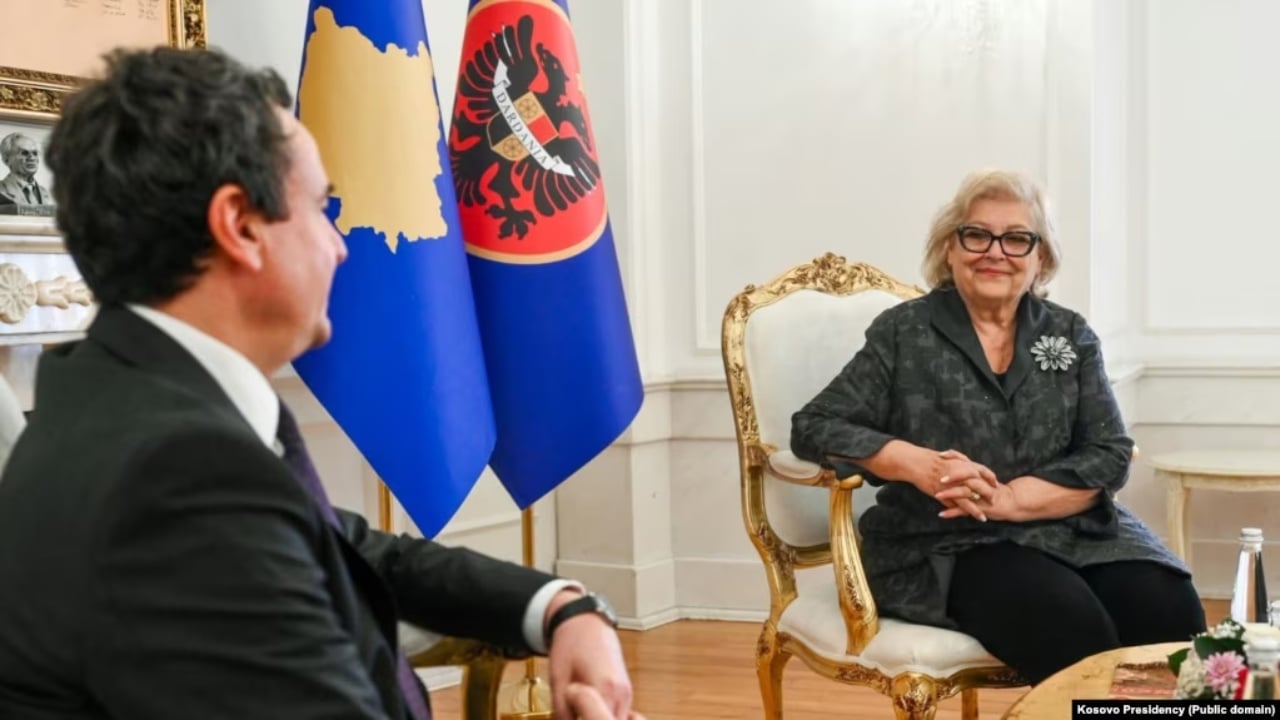
A name from PDK’s political past became the solution that ended Kosovo’s institutional deadlock. Justina Shiroka Pula was voted president after a last-minute agreement between Lëvizja Vetëvendosje and the Democratic Party of Kosovo, two forces that for years have presented themselves as irreconcilable opponents.
The compromise that avoided new elections
The agreement was reached in the final hours of the constitutional deadline, at a moment when failure to elect a president could have pushed the country toward new parliamentary elections, the fourth in less than two years.
In the end, Shiroka Pula received 81 votes for president, while the amendments to Kosovo’s Law on the Specialist Chambers were approved with 88 votes. Beyond the language of success used by the parties, the political balance is clear: LVV avoided the cost of another electoral process, while PDK secured the support it wanted for the legal amendments.
Outside the Assembly, the atmosphere was tense. Protesters were demanding changes to the law governing the functioning of the Special Court, while tensions had escalated after clashes with police, in which tear gas and water cannons were used, while protesters threw stones and pyrotechnic devices.
How the candidate’s name changed within just a few hours
The political clash did not disappear even during the negotiations. Albin Kurti accused PDK of refusing a meeting for an agreement, while Bedri Hamza offered a different version, suggesting that the problem was the constant shifting of positions.
In just over eight hours, Kurti appeared before the media three times with different formulas. He initially proposed Bekim Sejdiu, then Glauk Konjufca or Feride Rushiti, each time linking the presidency issue to the votes for the amendments to the Law on the Specialist Chambers.
Only in the third appearance did the name of Justina Shiroka Pula emerge. PDK immediately accepted her as an acceptable name and within minutes representatives of the two parties shook hands, closing a process that until just moments earlier had appeared blocked.
Why she was acceptable to both sides
Justina Shiroka Pula is not an unknown figure in Kosovar politics. She served as minister of Energy and Mining in Hashim Thaçi’s government from 2008 to 2011 and later as a PDK lawmaker until 2014.
However, for more than 12 years she had been away from active politics. After leaving the Assembly, she returned to academic engagement as a professor of economics and later took a leadership role at the Kosovo Academy of Sciences and Arts, where at the end of 2025 she became the first woman to head the institution.
This distance from active politics appears to have made it easier for her to be accepted as a compromise figure. According to voices commenting on the development, the weight of her academic profile, and not only her party past, influenced her acceptability as a consensus candidate.
A tactical deal, not necessarily political rapprochement
Although the agreement was presented by the parties as an institutional solution, developments point more to an alignment of interests than to a real rapprochement between LVV and PDK. Both sides had concrete needs and the tight deadline forced them to move.
According to LVV representatives, avoiding new elections was part of the political calculation. Likewise, from the same camp there was skepticism over whether the amendments to the Law on the Specialist Chambers would actually have an impact on cases involving former KLA leaders.
This makes the compromise more of a political transaction of the moment than a sign of normalized relations between the two camps. In public terms, the antagonism remains strong; in practical terms, the sides showed that they can cooperate when interests align.
What is expected from the new president’s term
After taking the oath in the first minutes of October 7, Shiroka Pula declared that she would be president of all citizens and that she would work for unity, justice, development and stronger institutions. This now remains the main test of her mandate: whether she will truly be able to stand above the parties that voted for her.
Her first visits after taking office, to Prekaz, to Ibrahim Rugova’s grave and to Adem Demaçi’s grave, carried a symbolic message of balance between Kosovo’s different political and state-building traditions.
But the real challenge will be less ceremonial and more institutional. The Constitution gives the president a representative role and responsibility for the constitutional functioning of institutions, while the polarized political climate is expected to quickly test the new president’s independence.
The election of Justina Shiroka Pula gave Kosovo a president and spared the system another electoral clash, but it also left open questions about the way this compromise was built.
For now, more than a rapprochement between rivals, this development looks like the product of a mutual political need at one of the most charged moments on Pristina’s institutional stage.