
The pesticide market in Albania is raising serious questions about how imports are controlled, the actual quality of products, and the burden passed on to farmers. The data show massive inflows of pesticides from countries outside the European Union, while the responsible institutions are offering no public clarification on standards, effectiveness, and the impact on food safety.
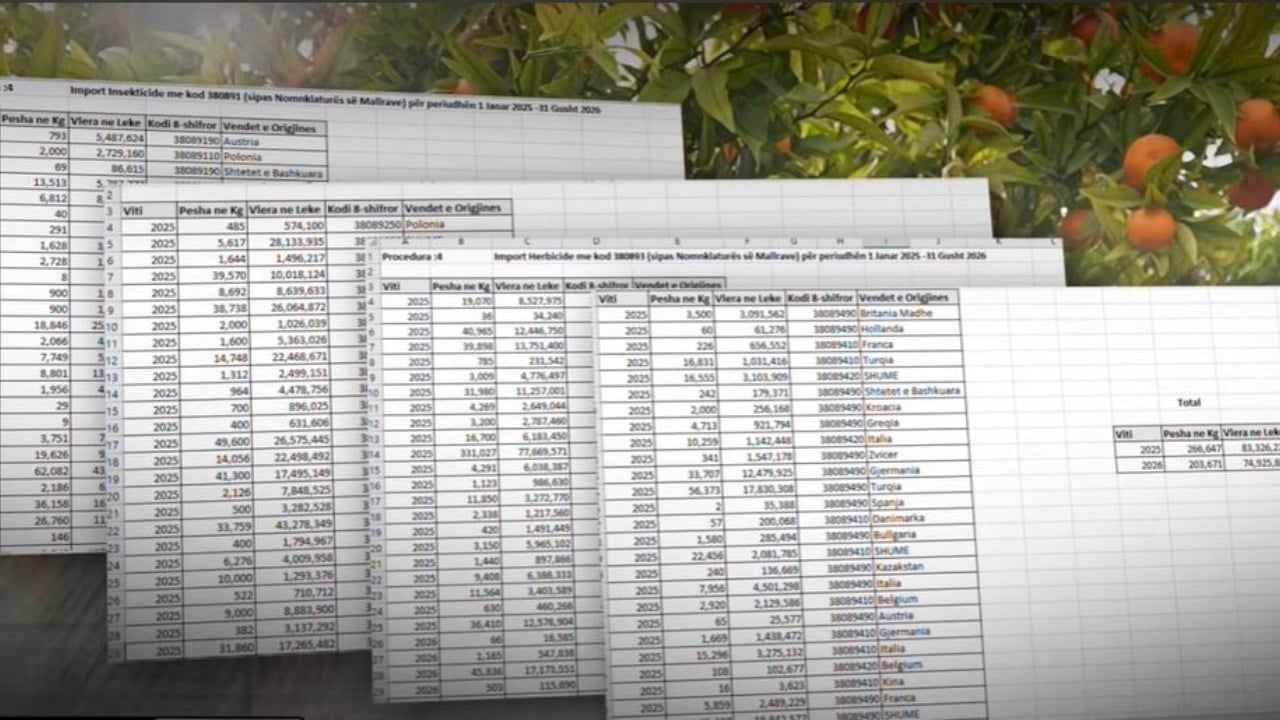
748 tons of pesticides from China and India
In 2025 and during the first eight months of 2026, 748 tons of pesticides from China and India entered Albanian customs, with a total value of 2.68 million euros. According to the published data, preparations from Jordan and Kazakhstan also enter the domestic market.
The claim raising concern is that these products enter at low cost for importers, but are sold to farmers as European preparations, at high prices and without full transparency about the true origin of production.
Farmers pay dearly while the effect is in doubt
When crops are affected by disease, farmers are forced to use pesticides to save production. But complaints about the poor quality of these preparations are repeated: for the same problem, many of them are forced to spray several times or try different products.
Agricultural soil expert Ilir Kristo says pesticides account for about 30% of production costs and that farmers usually do not cut spending on this item precisely because they consider it decisive in protecting output. That makes the financial burden even heavier when the product does not deliver the expected effect.
The law allows entry, but does not necessarily guarantee quality
According to the version presented in the reporting, the legal route for registering these products goes through the Plant Protection Products Registration Commission at the Ministry of Agriculture. The main criterion remains that the active substance be registered in Europe.
But this is precisely where the main allegation arises: that beyond the active substance, the physico-chemical properties of preparations produced outside the EU may be weaker than those produced in European countries. If that is the case, the consequence falls directly on the farmer, who is forced to spray more often and increase costs.
Seven companies dominate the market
Trade in agricultural medicines in Albania, according to the published data, is dominated by seven companies: Agro-Blend shpk, SHEGAJ-AGR, MELDI sh.p.k., ARLI INTERNACIONAL, AGROHELP SH.P.K, AGRO-ZANI and INTERLOGJISTIC.
It is precisely these imports and the mechanism of institutional control that require stronger verification. So far, the Ministry of Agriculture has not given a public response to concerns over the origin, quality and labeling of these pesticides, even though the issue directly affects food safety and consumer health.
The debate is not merely commercial. It is tied to how farmers are protected from inflated costs, how the quality of agricultural inputs is guaranteed, and how real state oversight is over a market that affects citizens’ daily food.
If the products enter legally, but reach farmers with questionable standards and with labeling that creates a European perception, responsibility does not rest only with importers. It falls directly on the Ministry of Agriculture and on the oversight system that should provide public accountability.