
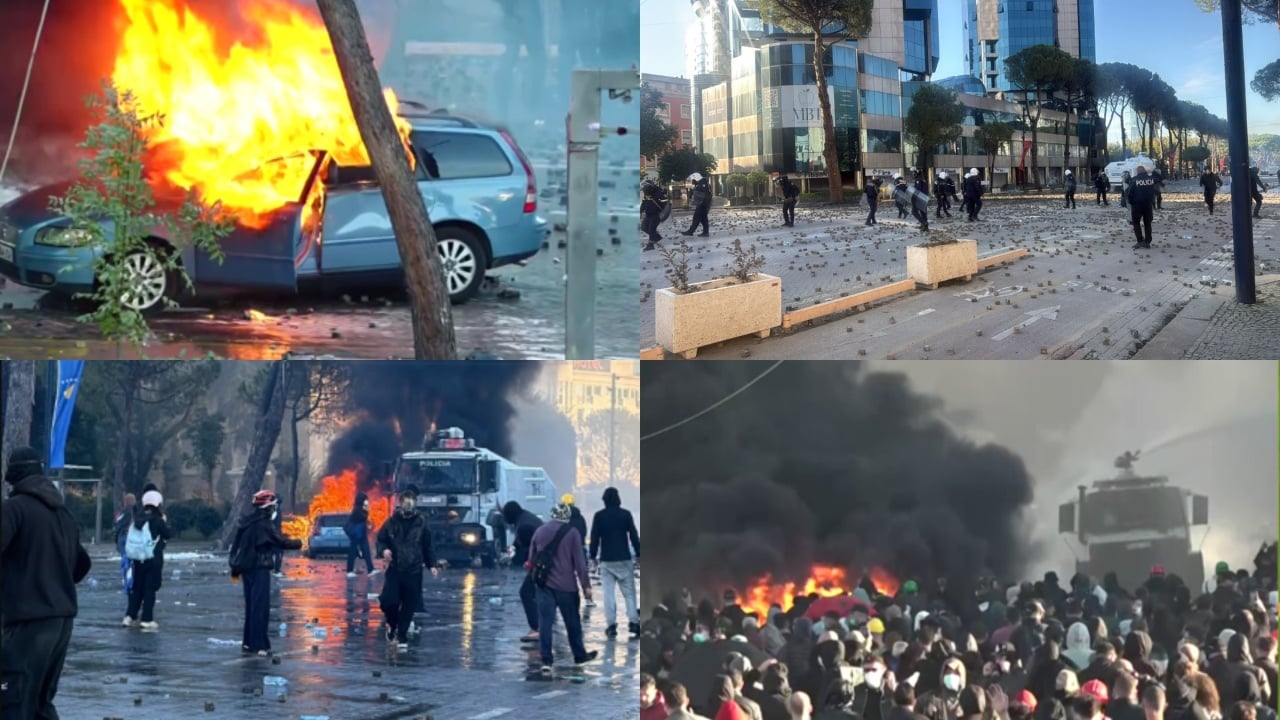
Tirana enters the fifth day of protests with another flashpoint at the Ministry of Education, as police forces and vehicles deployed for crowd control have been increased on the ground. After four days of clashes and damage in the capital, the protest is once again taking the form of an open challenge between citizens in revolt and the state law-enforcement apparatus.
Attention returns to the Ministry of Education
The gathering of protesters has again been announced near the Ministry of Education, which remains one of the most sensitive points of these days of unrest. According to the organization announced by the protesters, today’s mobilization is also expected to include participation from Albanians coming from the diaspora.
The ministry building appears damaged from the incidents of previous days, showing that the tension has not been episodic, but repeated and prolonged.
Police increase their presence on the ground
Large numbers of police officers have been positioned near the Ministry of Education, while water tanker trucks have also been deployed in the area as part of the measures taken by the authorities to manage the situation.
This increased police engagement comes after the previous four days were marked by strong clashes, while the official version has spoken of order and control measures on the ground.
After the class boycott, the protest escalated
The protests began on Tuesday with a boycott of classes by pupils and students, but subsequent developments showed a rapid widening of discontent. What began as a reaction in education later turned into a broader wave of protests in other cities of the country as well.
The escalation of the situation has brought not only clashes with police, but also damage to public institutions and businesses in the capital.
Political demand against the government
Protesters are expressing direct dissatisfaction with the government and are demanding the resignation of Prime Minister Edi Rama. At the center of the revolt are also accusations of corruption, as well as demands for changes in the education system.
In this climate, the protest no longer appears simply as a sectoral reaction, but as a broader crisis of confidence in institutions and in the way public discontent is being managed.
The fifth day of protest finds the capital in another test of strength between citizens seeking change and the state, which has lined up on the ground with strong security measures.
What remains visible is that the tension has not subsided, while the center of Tirana continues to be the space where social discontent, political demands and the response of institutions collide.