
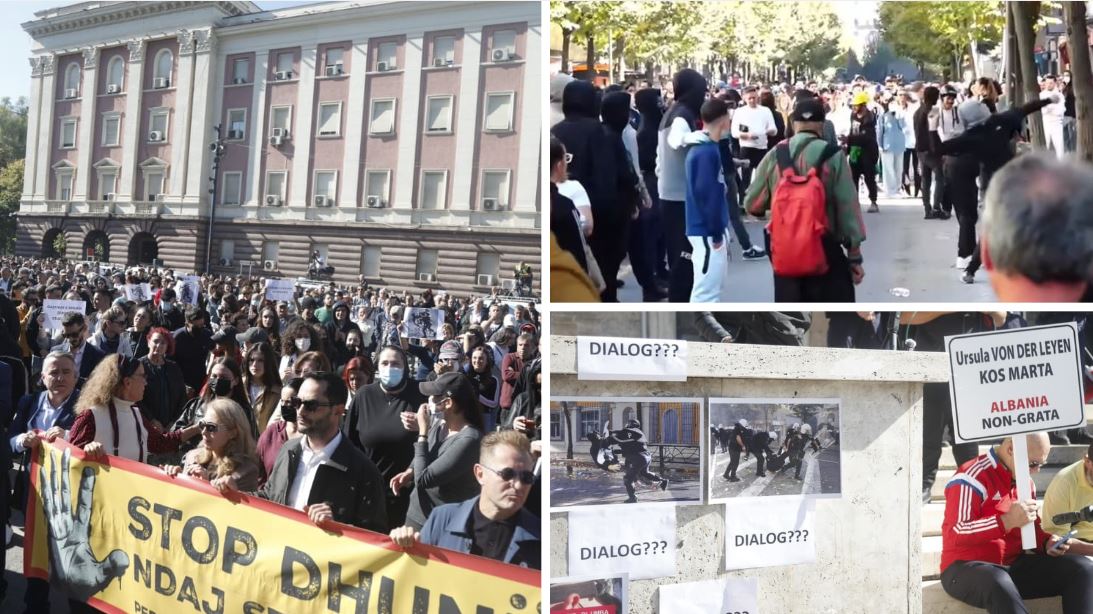
Students and lecturers on the ground rejected the call for “dialogue” placed by Edi Rama outside the Prime Minister’s Office, turning the government’s symbolism into an act of open opposition. The gathering began peacefully, but the protesters’ message was direct: without accountability for the violence and the lack of clarity in the handling of the protests, official calls for talks are not being accepted as a solution.
Chairs placed outside the Prime Minister’s Office became a sign of rejection
From the morning, several chairs were placed in front of the Prime Minister’s Office building, each with a paper left on it carrying the message “dialogue.” The initiative was presented by the government as an invitation to talks with students.
The protesters marched in front of the Prime Minister’s Office and tore up the papers placed on the chairs, before then knocking over the chairs themselves. The action was clearly read as a rejection of the scheme offered by the prime minister.
Confrontation with the government communications representative
During the protest there was also a verbal confrontation with Manjola Hasa, director of the Media and Information Agency. She said she was there to convey the request of any student who would like to speak with the prime minister.
According to the version presented by her, Edi Rama’s position remained unchanged and anyone who wanted dialogue was welcome. But the protesters’ reaction was rejecting and tense.
Protesters first demand accountability for the police intervention
One of the protesters addressed the government representative with the demand that accountability first be given for the violence against students and for the presence, according to him, of officers without identification during police interventions.
This reaction shows the gap between the official language of “dialogue” and the distrust on the ground toward institutions, especially when protesters raise accusations about the way police control has been exercised.
From peaceful gathering to political tensions around the protest
The gathering began peacefully, but the dynamic grew harsher as the minutes passed, while the symbolism put in place by the government did not produce calm. On the contrary, it was met with public opposition and strong tones toward the executive.
At the same time, the political climate around the protest has been further aggravated by official statements portraying the situation as a violent escalation. This makes the conflict between the government’s narrative and what protesters are articulating in the street even more visible.
The rejection of the chairs and the papers bearing the message “dialogue” turned the protest outside the Prime Minister’s Office into a direct challenge to the way the government is trying to manage the crisis.
Instead of rapprochement, the scene produced more distrust, verbal clashes and clear demands for institutional accountability.