
The situation outside the Prime Minister’s Office became tense from the very start of the protest, after the government’s gesture of placing chairs with the message “dialogue” was directly rejected by protesters. The chairs were knocked over, the papers were torn up, and the political clash immediately moved from symbolism to confrontation on the ground.
The chairs placed by Rama were knocked over as soon as the protest began
In the morning, several chairs were placed in front of the Prime Minister’s Office building, each with a sheet of paper that read “dialogue.” The initiative came from Prime Minister Edi Rama, at a time when the protest had signaled a direct confrontation with the government.
Shortly after the crowd arrived in front of the building, students and protesters tore up the papers and knocked over the chairs. The reaction showed that the message offered by the government was not seen as a genuine invitation, but as a symbolic act that did not address the accusations and grievances raised in the protest.
Confrontation with the director of MIA
There was also a verbal confrontation on the ground with Manjola Hasa, director of the Media and Information Agency, who appeared near the protest saying she was there to convey any request for a meeting with the prime minister.
According to the version she presented, the prime minister remained open to dialogue with students who wished to speak. But that message immediately met resistance from protesters at the scene.
Accusations against police and rejection of the official framing
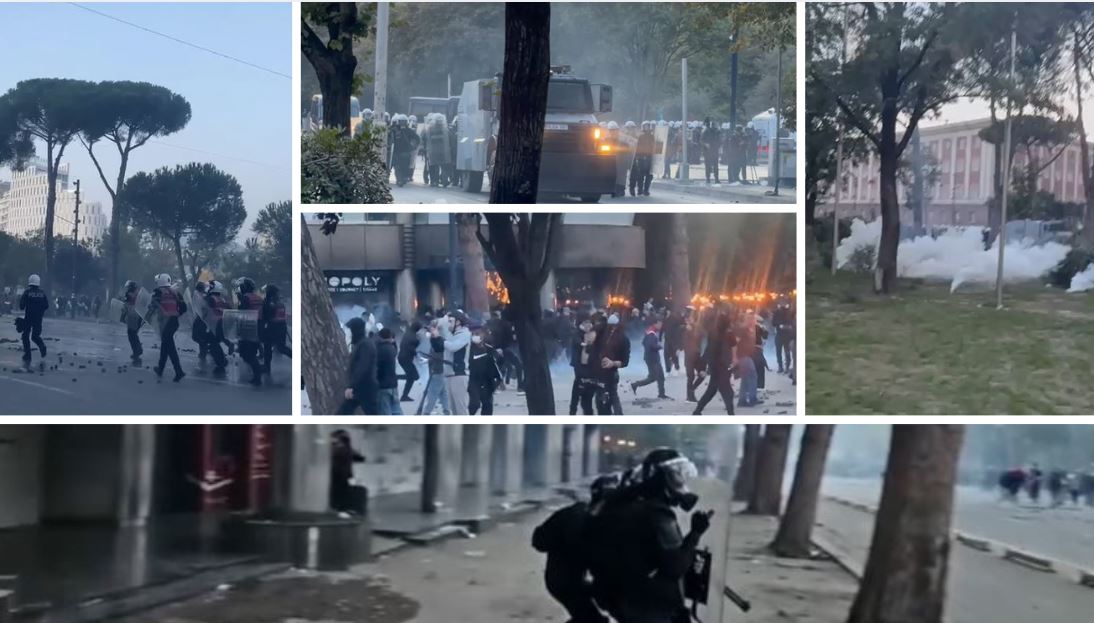
One of the protesters addressed the government representative with the demand that there first be accountability for the alleged violence against students by unidentified police officers. This shifted the debate from the call for dialogue to institutional responsibility for how the protest had been managed.
In this climate, the call for talks was not accepted as sufficient. On the ground, it was clear that some protesters considered the invitation to dialogue unsupported without clarifications and without accountability for police actions.
Rising political tension around the protest
Alongside developments on the boulevard, the protest has also generated other political and institutional reactions. At the center of the debate remains not only the clash between protesters and the government, but also the way the authorities are trying to manage the crisis in public.
The footage and incidents outside the Prime Minister’s Office show that the attempt to impose a stage-managed image of dialogue was not enough to ease tensions. On the contrary, it became another point of confrontation between protesters and the government.
Instead of bringing the sides closer, the moment outside the Prime Minister’s Office highlighted the deep mistrust between them. The “dialogue” chairs remained as a rejected gesture in the square, in a protest where the main demand did not appear to be symbolism, but accountability.