
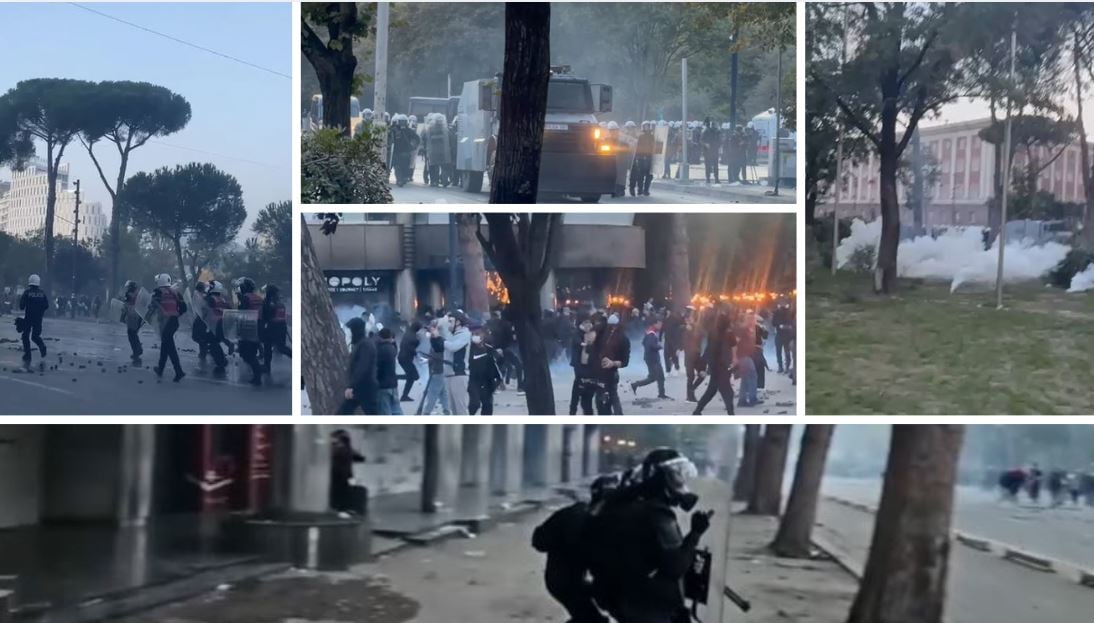
The seventh protest in Tirana was marked by strong tensions outside the Prime Minister’s Office, where clashes were reported between protesters and police. At the same time, the government tried to shift attention to the message of “dialogue,” but on the ground the situation showed a very different reality.
Chairs set out for “dialogue” were knocked over by protesters
This morning, several chairs were placed in front of the Prime Minister’s Office, each with a sheet of paper reading “dialogue,” in a gesture publicly displayed by Prime Minister Edi Rama.
As the protest began, students marched toward the Prime Minister’s Office, tore up the papers placed on the chairs and knocked the chairs over, directly rejecting this form of communication proposed by the government.
Confrontation with the government’s communications representative
During the protest there was also a verbal confrontation with Manjola Hasa, director of the Agency for Media and Information.
According to the version presented by her, she was there to convey the request of any student who wanted to speak with the prime minister and to reiterate that the head of government was open to dialogue.
On the other hand, one of the protesters first demanded accountability from the government for the violence used against students by unidentified police officers, rejecting the call for dialogue under conditions of tension in the streets.
There were clashes with police on the ground
The protest escalated near the Prime Minister’s Office, where according to reports police used gas and rubber bullets to disperse protesters.
The incident once again highlighted the contrast between the official language of calm and dialogue, and the way the protest was managed on the ground.
Official toll: arrests and criminal proceedings
For the seventh protest in Tirana, it was reported that 33 people were arrested and criminal proceedings were initiated against another 41.
Meanwhile, reactions from the government camp focused on violence against police officers. According to public statements by minister Taulant Balla after the meeting of the Socialist Party parliamentary group, it was stressed that “the blood of police officers is the blood of the state” and that minors should not be used as “cannon fodder.”
Amid calls for dialogue and clashes in the streets, the protest outside the Prime Minister’s Office showed once again that the gap between the government and the protesters remains open.
What was presented as an invitation to talk was met with rejection on the ground, in a climate where distrust toward institutions appears to be deepening.