
The debate over student protests has flared up again, this time around the use of masks and the way police intervention is justified. In a television face-off, jurist Ylli Manjani defended his reading of the law on public assemblies, while a student pushed back by drawing attention to international standards on tear gas and rubber bullets.
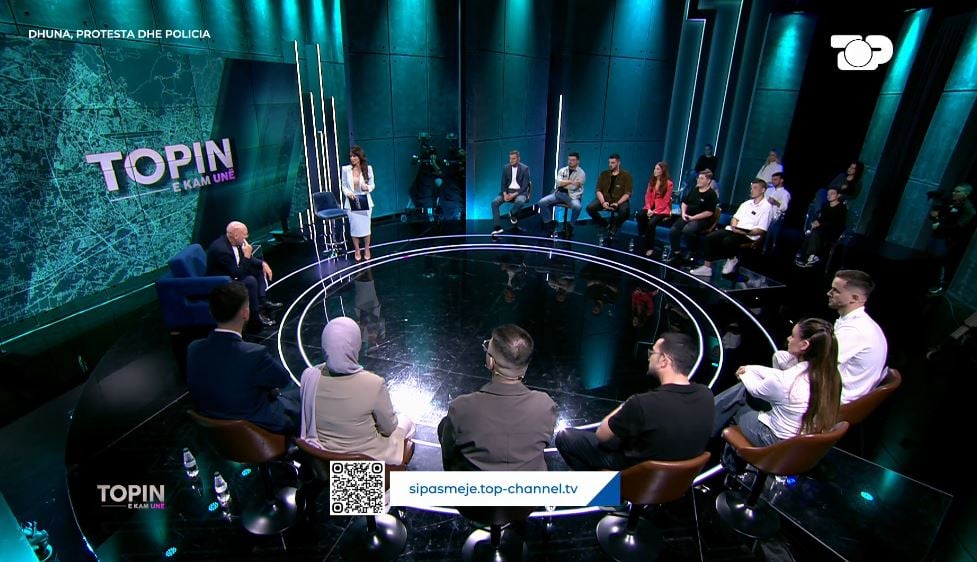
Manjani: in violent clashes, a forceful response is also to be expected
Ylli Manjani focused on cases where, according to him, protesters use violence, arguing that under such conditions there will be a forceful response. He said the assessment of proportionality cannot be made in a general way, but only by looking at specific cases and the facts of each situation.
Along the same lines, Manjani used harsh language toward those who take part in clashes and then complain about the consequences, presenting violence on the ground as a direct result of a violent confrontation.
The claim that masks are banned at assemblies
The strongest point of his statement was the claim that going to a protest wearing masks is not allowed by law. Manjani presented this interpretation as a clear rule for public assemblies, whether notified in advance or not.
The debate here is not only about the text of the law, but also about the way this argument is used in a climate of tension between protesters and the police. When the emphasis is placed on the mask, the more sensitive question is partly avoided: is police force being applied within the permitted limits?
The student’s objection: masks as protection from gas and blows
Manjani’s statements were challenged by the student Rei, who said masks and goggles are not worn without reason. According to him, they are linked to the need for protection, especially when there is a risk on the ground from tear gas and from the use of rubber bullets.
At this point, the debate shifts from a formal ban to a practical reason: if protesters claim they are protecting themselves from the means used by law enforcement, then the issue is not settled by a simple legal formula.
Reference to the UN on the use of force
The student referred to UN rules on the use of tear gas and rubber bullets, stressing that there are standards the police must respect. According to him, officers are aware of these rules and the use of such means cannot be treated as an issue without limits.
This places the discussion on a broader level than studio rhetoric: not only what is allowed for protesters, but also what the state is allowed when confronting them. That is precisely where the real core of the public debate lies.
The clash of arguments highlighted two different approaches: one that places the emphasis on bans and the responsibility of protesters, and another that seeks accountability for the limits of police force.
In the absence of full legal and factual clarification for each case, the debate over masks remains closely tied to a larger issue: the relationship between the right to protest and the way power is exercised in the streets.