
Prime Minister Edi Rama has publicly renewed his invitation for dialogue with students, but on the ground the situation remains unchanged: the protest continues, no meeting table has been set, and the political demand for his resignation continues to be voiced by students and high school pupils.
The invitation is repeated, but without a concrete result
According to the official version, Rama has once again called on students to sit down for talks about their demands and concerns.
However, so far the repeated calls for dialogue have not produced a meeting between the sides, leaving open the question of whether this invitation has any real effect beyond public symbolism.
The “stone table” remains in front of the Prime Minister’s Office
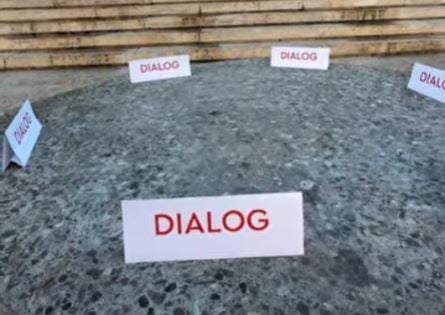
In front of the Prime Minister’s Office, the so-called “stone table” continues to stand, presented by Rama as a symbol of the invitation to dialogue.
Its presence at the entrance to the institution serves as a political message from the government, while on the other side the protest on the ground has not dissolved and the practical rejection of the table remains evident.
Students and high school pupils maintain the same position
Reports point to a continuation of the student protest, with no signs of retreat from the demands that have been raised.
Students and high school pupils continue to demand Rama’s resignation, shifting the confrontation beyond a technical debate over demands and placing it openly on a political plane as well.
Lecturers side with the protest
Lecturers have also lined up in support of the students, boycotting the teaching process.
This stance broadens the pressure on the government and shows that the confrontation is not remaining only between students and the executive, but is directly affecting the functioning of academic life.
For the moment, the picture remains frozen: the government insists on dialogue in public statements, while the protesters have not moved from their demand for the prime minister’s departure.
In the absence of a real meeting between the sides, the repeated invitation for talks remains more of a political signal than a tangible solution to the crisis.