
From the mention of Arbër Hajdari in Erion Veliaj’s letter to Florjan Binaj’s return as a candidate for Tirana Municipality. Two names linked on the board of the same foundation, two lease contracts at the symbolic rate of 1 euro, and nearly 60,000 square meters of state property made available through decisions by the Rama government. Who is determining the opposition’s candidate, and how independent is the alternative being offered to the citizens of the capital?
The race for Tirana Municipality is taking a direction that raises serious questions about how the candidate who will face the Socialist Party is being chosen.
At the center of the debate is actor Florjan Binaj, who on November 9 confirmed his ambition to run as an independent while at the same time seeking the support of opposition parties.
But beyond public statements and the image of a candidate coming from outside politics, documents published in the Open Corporates Albania register reveal an organizational link that deserves attention: Florjan Binaj is listed as a member of the governing board of the “Fundjavë Ndryshe” foundation, founded and led by Arbër Hajdari.
The same Arbër Hajdari whose name was mentioned only a few days earlier by Mayor Erion Veliaj in a letter from pretrial detention as the person to whom, it was claimed, the leadership of Tirana Municipality was supposed to be delegated.
Are we dealing with a coincidental overlap of names, or with a network of relationships that requires greater transparency?
And above all, is the opposition being asked to accept an imposed candidate without first clarifying his organizational, financial and institutional ties?
Arbër Hajdari and Florjan Binaj, together on the same governing board
Documentation published by Open Corporates Albania for the “Fundjavë Ndryshe” foundation, with NIPT L61315453U, identifies Arbër Hajdari as the foundation’s administrator.
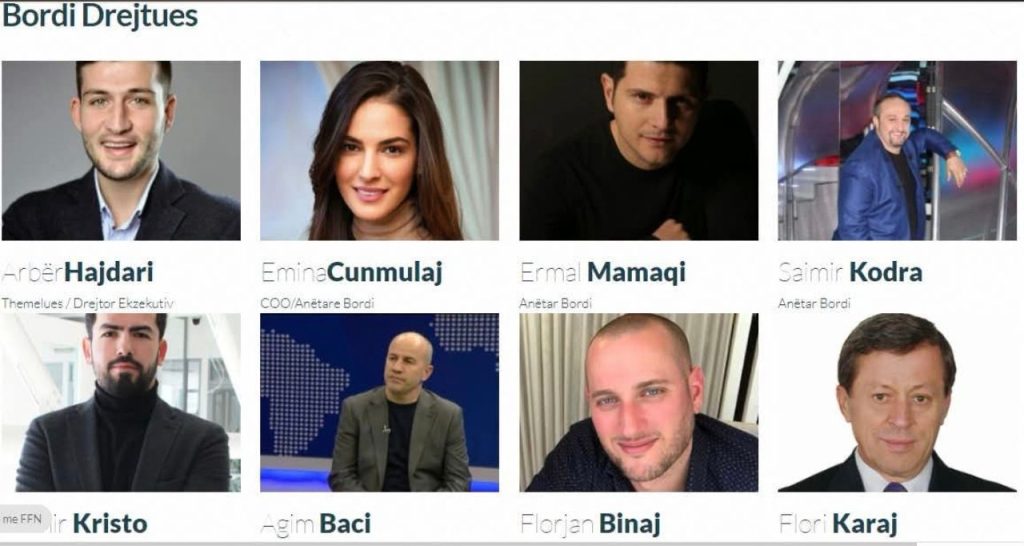
The list of governing board members includes Arbër Hajdari, Emina Cunmulaj, Ermal Mamaqi, Saimir Kodra, Saimir Kristo, Agim Baçi, Florjan Binaj and Flori Karaj.
So the link between Hajdari and Binaj is not based only on photographs or supposed personal acquaintance. It emerges from an organizational structure documented in public records.
How is it that Arbër Hajdari is mentioned in a claim about taking over the leadership of Tirana Municipality, while Florjan Binaj, documented as part of the same board, is seeking opposition support to become mayor?
Is there coordination between them, or are these two entirely separate ambitions?
This is an issue on which both figures can and should provide public clarification.
Nearly 60,000 square meters of state property under 1-euro contracts
But the link between Hajdari and Binaj is not the only element emerging from the documentation.
According to Open Corporates Albania, the “Fundjavë Ndryshe” foundation benefited from two lease contracts at the symbolic rate of 1 euro for state property, approved by decisions of the Council of Ministers during Edi Rama’s government.
Under Council of Ministers Decision No. 118, dated March 13, 2019, a 1-euro lease contract was approved for state property in Brar, Tirana, known as the former artillery repair facility, with a total area of 43,169 square meters and a 20-year term.
Five years later, under Council of Ministers Decision No. 240, dated April 17, 2024, the government approved another 1-euro lease contract, this time for a state property of 16,214 square meters, also in Brar, part of a former military unit.
The second decision was made on the basis of an unsolicited offer and includes 3,138.34 square meters of building area.
In total, this concerns 59,383 square meters of state property, included in two lease contracts with 20-year terms and a symbolic fee of 1 euro per contract.
These are not political rumors. They are documented facts through decisions of the Council of Ministers.
Because of the public interest, it remains important to verify how these properties have been used, what investments have been made, what contractual obligations have been fulfilled, and what the foundation’s institutional relations with the government have been.
Especially when a person documented on the foundation’s board aims to present himself as an opposition alternative for leading the capital.
Why did Erion Veliaj mention Arbër Hajdari specifically?
On November 2, 2026, Erion Veliaj published a letter from pretrial detention in which he claimed that Justice Minister Toni Gogu had conveyed several ultimatums to him on behalf of Prime Minister Edi Rama.
One of them, according to Veliaj’s version, was resignation from the leadership of Tirana Municipality and its delegation to Arbër Hajdari.
Why him in particular?
Why does the name of the head of a foundation that has received the use of state property through decisions of the Rama government appear in a conflict between the mayor and the prime minister?
And was this mention a revelation of some real discussion, Veliaj’s interpretation, or a deliberate political move to publicly damage Hajdari?
At the moment, none of these hypotheses has been proven.
But developments take on another dimension when, only a week later, Florjan Binaj once again confirms his intention to seek opposition support in the race for Tirana.
Two figures with a documented organizational link appear, in different circumstances, in discussions about the same institution.
A coincidence? Possibly.
But it is a coincidence that deserves clarification, not silence.
Independent candidate, but with whose support?
Florjan Binaj has every right to run for Tirana Municipality. Likewise, opposition parties have the right to support a candidate from outside their own structures.
However, political independence is not a quality gained automatically by declaring it.
It must be supported by transparency.
Who is organizing Binaj’s candidacy? Who are his political advisers? Who will finance the campaign? What relationship has he maintained with the “Fundjavë Ndryshe” foundation and with its head, Arbër Hajdari?
Has he ever discussed a candidacy for Tirana Municipality with representatives of the majority or with people who have economic interests linked to municipal decision-making?
These are questions that apply to every candidate, but they take on particular importance when one name seeks to represent the entire opposition.
Because it is one thing to run as an individual and quite another to ask a political force with structures, membership and an electorate to stand behind your candidacy.
Is the opposition being deprived of the right to choose its own candidate?
The reaffirmation of Binaj’s candidacy comes at a time when other alternatives are also being discussed within the Democratic Party.
PD Secretary-General Gazment Bardhi has publicly assessed Ilir Alimehmeti as a serious candidacy for Tirana, while at the same time emphasizing the importance of decision-making by the party’s structures.
This situation opens an essential debate.
Why should the opposition necessarily accept a self-declared candidate without first conducting a transparent selection process?
Who decides which individual is best suited to challenge the Socialist Party?
The membership? The leadership structures? A primary process? Or media promotion and agreements between political leaders?
If a candidacy manages to impose itself through public pressure without being measured against other alternatives, then the opposition risks giving up one of its most fundamental rights: the democratic selection of its representatives.
And if this process unfolds without transparency on candidates’ financing and ties, citizens have reason to demand more information.
Are there shared interests between the foundation, business and politics?
The “Fundjavë Ndryshe” foundation has built a well-known public profile through humanitarian activities and support for families in need.
This activity should not be prejudged.
But humanitarian work cannot serve as an exemption from demands for public transparency, especially when leaders or members of such organizations enter discussions about political posts.
Open Corporates Albania documentation shows the organizational link between Hajdari and Binaj, as well as the existence of the lease contracts for state property.
Who benefits politically from a divided opposition?
Ultimately, the issue is not limited only to Florjan Binaj and Arbër Hajdari.
The problem is broader.
If the opposition fails to develop a credible process for choosing its candidate, it risks entering the race for Tirana Municipality divided, without strategy and with a candidate who does not necessarily enjoy the consensus of its base.
From such a situation, the most direct political beneficiary could be the Socialist Party.
This does not prove that the majority is organizing the process from behind the scenes.
But it raises a question the opposition cannot ignore: is it controlling the selection of its own candidate, or is it reacting to names being served up in the public debate?
Tirana is the country’s most important political and economic center. Its municipality administers major interests linked to construction, urban development, public property, infrastructure investment and services.
For this reason, candidates’ relations with business, nonprofit organizations and state institutions are not private matters of no importance.
They are part of the information citizens have the right to demand before voting.
Questions that require answers
Arbër Hajdari should clarify whether there have been concrete discussions about taking over the leadership of Tirana Municipality, why his name was included in Erion Veliaj’s claims, and what his current position is regarding a possible candidacy.
Florjan Binaj should clarify his current relationship with the “Fundjavë Ndryshe” foundation, whether there has been coordination with Arbër Hajdari on political matters, and who is supporting his candidacy organizationally and financially.
The foundation, for its part, could make public documentation on the use of the state properties obtained under the 1-euro contracts, the implementation of the planned investments, and its financial relations with public and private donors.
Meanwhile, opposition leaders should explain on the basis of what criteria the candidate for the capital will be selected and whether there will be a process in which alternatives truly compete.
Tirana is nobody’s property
The documents show that Arbër Hajdari and Florjan Binaj have been part of the same governing structure. The documents also show that the foundation led by Hajdari benefited from two lease contracts at the symbolic rate of 1 euro for nearly 60,000 square meters of state property.
These are verifiable facts.
Whether these relationships have any influence on Florjan Binaj’s political candidacy.
When a figure seeks to win the opposition’s support to lead Tirana, while the name of his associate in a foundation is involved in a fierce political clash within the majority, the questions cannot be considered unimportant.
Is a genuine alternative being prepared for citizens, or is the opposition being asked to accept a candidacy without knowing enough about the people and interests behind it?
The answer cannot be given through insinuations, but through documents, financial disclosures and transparency.
Because Tirana does not need another mayor indebted to powerful people.
It needs a mayor accountable only to its citizens.