
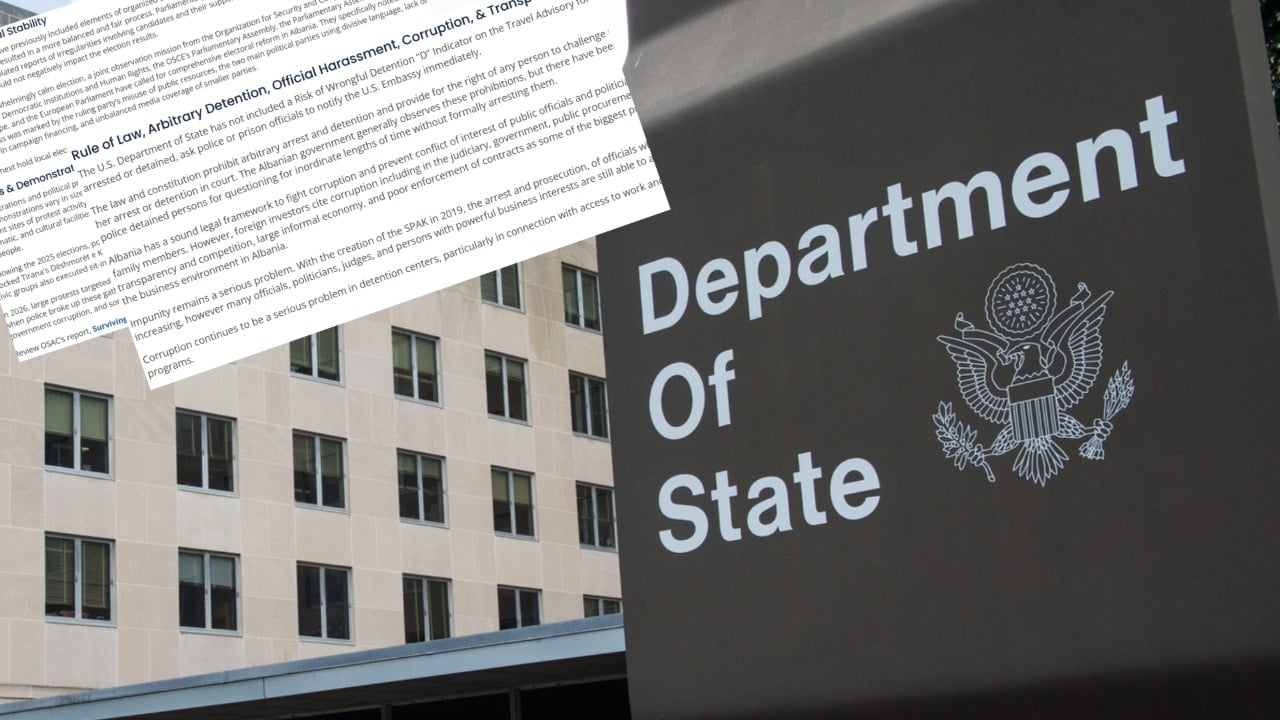
A recent OSAC report, a structure of the U.S. Department of State, offers a picture of Albania that is not as clean as official versions suggest. The document mentions calmer elections than before and the role of SPAK in striking at corruption, but at the same time lists old problems: the use of public resources in campaigns, a divisive political climate, allegations of government corruption, and weaknesses in the real enforcement of legal guarantees.
Calmer elections, but not without question marks
According to OSAC, Albania’s latest electoral cycles have taken place in a more balanced and calmer process compared with the past. However, the report does not present this as an unqualified success story, as it highlights problems related to campaign financing, the use of public resources, and the political climate.
The document recalls that in the past, elections in Albania were accompanied by elements of organized crime and corruption in the voting process. For the 2025 parliamentary elections, the assessment is that they were generally held in a calm atmosphere, although there were isolated reports of irregularities involving candidates and their supporters.
The Central Election Commission has stated that these cases did not affect the final result. But a joint observation mission of the OSCE, the OSCE Parliamentary Assembly, the Parliamentary Assembly of the Council of Europe, and the European Parliament has called for full electoral reform, signaling that the problems do not end with a formal balance sheet of voting day.
The report focuses on public resources and divisive language
In the assessment of the international missions cited in the report, the use of public resources by the ruling party during the campaign and the divisive language used by the two main political parties were highlighted. These are among the most sensitive points, as they directly affect real equality in the race and the standard of institutions during the electoral process.
Albania is expected to hold local elections in 2027 and the next parliamentary elections in 2029. Against this backdrop, the report suggests that familiar electoral tensions have not ended, but have simply shifted to a less noisy and, at first glance, more controlled terrain.
Protests in Tirana, from the environment to corruption allegations
The report describes protest as a common phenomenon in Albania, usually peaceful, but with episodes of violence recorded in the past. One of the spaces most often used for gatherings remains Dëshmorët e Kombit Boulevard in Tirana, where government institutions and diplomatic missions are concentrated.
According to this assessment, after the 2025 elections opposition groups held large protests against the government in the capital. Some of them led to the blocking of the main boulevard, while in certain cases Molotov cocktails and pyrotechnic devices were used.
The document also mentions the latest protests in Tirana, which according to OSAC began as environmental protests but later expanded to include allegations of government corruption and in some cases degenerated into clashes. The wording indicates that public discontent was not treated only as an environmental issue, but as a broader channel of distrust toward governance.
SPAK is credited, but the report raises alarms over impunity
In the section on the rule of law, the report attributes an important role to SPAK in the fight against corruption and organized crime. According to it, the structure is pursuing complex cases related to high-level corruption, organized crime groups, and other sensitive issues, in cooperation with international law enforcement institutions.
However, the document does not see this as proof that the system has solved the problem of impunity. Even though the creation of SPAK has brought an increase in investigations and prosecutions against officials accused of abuses, the report stresses that there are still cases in which people with political or economic influence manage to avoid legal responsibility.
It also mentions cases in which people were held for long periods for questioning without being formally arrested, even though the Constitution and Albanian laws prohibit arbitrary arrests and detention without legal basis. This places the test not only on the laws on paper, but on their implementation by institutions.
Security and prisons, formal control but unresolved problems
According to OSAC, the Ministry of Interior oversees the State Police and the Republican Guard, while the Armed Forces are under the direction of the Ministry of Defense. The report assesses that civilian authorities maintain effective control over the security structures.
But here too, the balance is not clean. The report mentions problems that continue to affect the work of law enforcement institutions, while in the prison system concerns are raised over corruption, especially regarding access to work and special easing programs for convicts.
In the economic section, the document underlines that foreign investors continue to identify obstacles, which is linked to the broader perception of institutional transparency and the functioning of the rule of law.
The report offers a two-level picture of Albania: on the one hand, it mentions relative progress in elections and in the investigation of corruption, while on the other hand, suspicions remain open over the use of the state in politics, clashes during protests, and the real ability of institutions to deal with the untouchables.
That is precisely where the core of the document lies: not in optimistic declarations, but in the gap between declared standards and the practice that citizens face on the ground.