
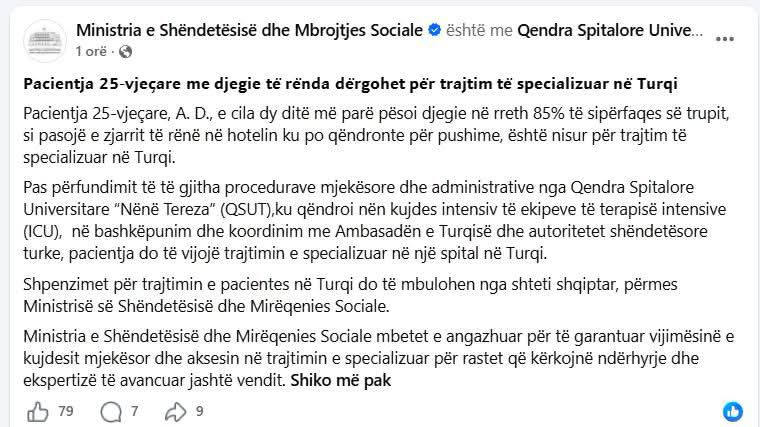
Yesterday, a girl just 25 years old, burned over about 85% of her body, was sent to Turkey for specialized treatment.
Sending her abroad is undoubtedly the right decision if greater opportunities exist there to save her life. In such a situation, every option, every financial resource and every institutional channel should be made available to the patient.
But what cannot be considered normal is the way the Ministry of Health is communicating this event: almost as if the fact that Albania is unable to treat such a patient inside the country amounts to a state success story.
It is not.
It is a major question about the real condition of our healthcare system.
While global medicine has advanced in robotic surgery, organ transplants, minimally invasive procedures and therapies that until just a few years ago seemed impossible, Albania continues to have cases where the only solution is: send the patient abroad.
The Ministry also emphasizes that the cost of treatment in Turkey will be covered by the Albanian state.
It is very good that it will be covered. That is the state’s duty, not charity.
But the question we should ask is not only how much the state will pay for this patient in Turkey. The far more important question is:
Why, after so many years of investment and millions of euros spent on healthcare, has Albania still not built the capacity to provide this treatment here?
In a country that talks about satellites, artificial intelligence, the production of cars, weapons and drones; in a country where millions of euros are found for artistic projects, concessions, tenders and initiatives of every kind; in a country where millions more are lost or wasted because of corruption, Albanians have the right to demand a very simple answer:
Why the hell can they not be treated in their own country?
And for this, the Health Minister should answer at least these 10 questions:
1. Why does Albania today not have full capacity to treat massive burns?
What, specifically, is the Albanian system lacking to treat a patient with burns over 85% of the body: infrastructure, equipment, specialized personnel, reconstructive surgery, specific intensive care, or all of them together?
2. Does Albania have a modern and fully equipped national center for severe burns?
If so, what are its real capacities and which categories of patients can it treat? If not, why has such a structure not been established to this day?
3. How many Albanian patients have been sent abroad for treatment during the past five years?
Not only for burns. How many citizens have been sent abroad for illnesses, interventions or procedures that Albanian hospitals have been unable to provide?
4. How much money has the Albanian state paid for the treatment of patients abroad?
What is the total bill for the past five years and in which countries or hospitals has this money been spent? How many of these treatments are repeated every year for the same categories of pathologies?
5. Would building the capacity to treat them in Albania have cost less?
If the state is constantly paying foreign hospitals for treatments that are lacking here, has an economic analysis ever been carried out to determine whether investment in equipment, infrastructure and the specialization of Albanian doctors would have been more advantageous?
6. How much money has been invested specifically in the treatment of severe burns over the past 10 years?
What equipment has been purchased? How many dedicated beds exist? How many specialists have been trained? How many of them continue to work in the public system?
7. Why has the state not created specialized teams meeting international standards for the most severe cases?
If the problem is a lack of expertise, what has the Ministry done throughout all these years for the overseas specialization of Albanian doctors and the creation of multidisciplinary teams that could treat these cases here?
8. What is the plan so that in five years we do not publish the same announcement again?
Does a concrete strategy exist, with a budget, deadlines and objectives, to build the capacities that are missing today? Or will the permanent solution continue to be the plane ticket and transfer to a foreign hospital?
9. Why is sending a patient abroad presented as an institutional success?
Success would be for an Albanian patient to receive in Tirana the same standard of treatment that she would receive in Istanbul, Rome, Berlin or Paris. The transfer may be a necessary and correct action, but at the same time it proves that a vital capacity is missing in Albania.
10. When will the day come when an Albanian does not need to leave Albania to save their life?
That is the question that sums up all the others.
Because a healthcare system is not measured only by hospital facades, conferences, promotional videos or budget figures. It is measured at the moment when a citizen is between life and death and the state must show what it is truly capable of doing for them.
We sincerely hope that the 25-year-old wins her battle and returns to Albania healthy.
But while she is being sent to Turkey to receive the treatment she needs, someone in the Ministry of Health should have the courage to ask the question that cannot be covered up by any propaganda statement:
Why is a state that claims to be modernizing at a dizzying pace still unable to offer its own citizens some of the treatments that could save their lives?
And above all:
How many more years must Albanians wait before they can be treated in their own country?