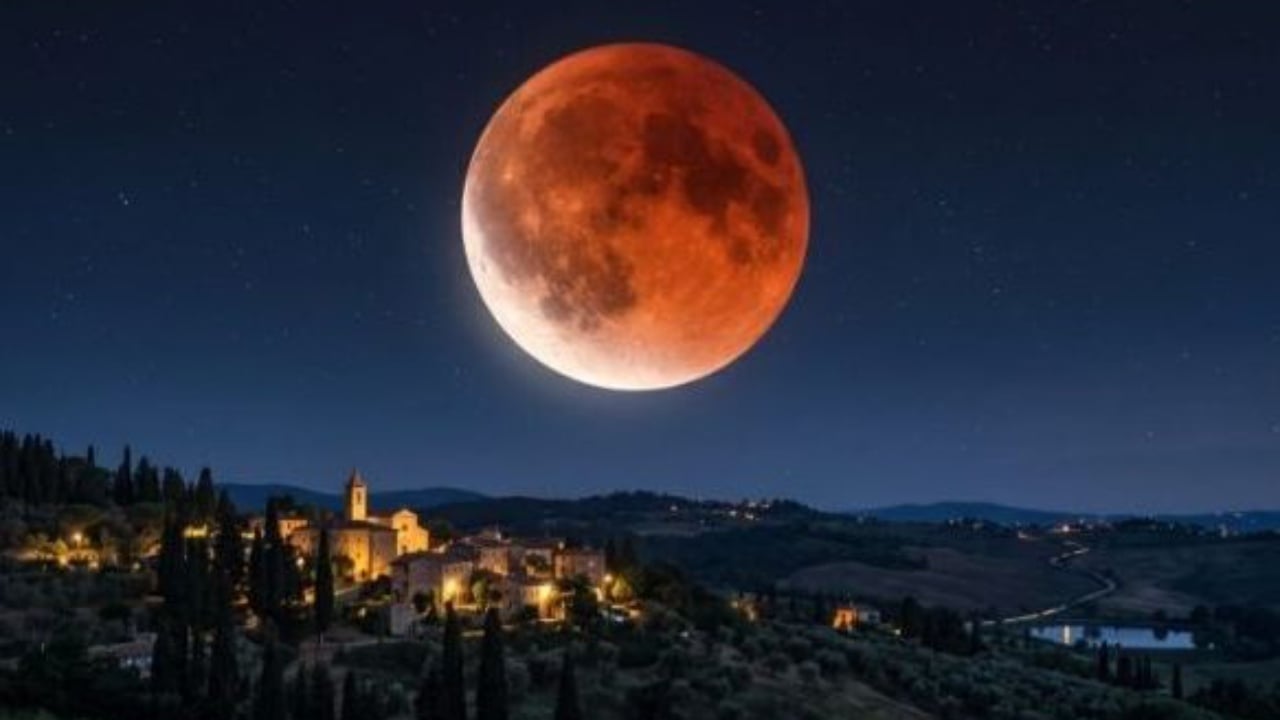
The final weekend of summer brings one of the year’s most notable astronomical events: in the early hours of August 28, the Full Moon is expected to be caught in a deep partial lunar eclipse, visible in several regions of the world, including Europe.
What will happen on August 28
The phenomenon occurs when Earth passes between the Sun and the Moon, casting its shadow over the planet’s natural satellite. This creates a play of light and shadow that, in this case, is expected to be especially visible.
The Moon will first pass through the penumbra and then enter almost entirely into Earth’s umbra. According to the published data, up to 96% of the lunar disk could be covered during the peak phase of the eclipse.
Why the Moon looks red during an eclipse
Even when Earth’s shadow covers most of the Moon, it does not disappear completely from view. Earth’s atmosphere filters sunlight and allows red and orange wavelengths to reach the lunar surface.
For this very reason, a reddish or rusty color often appears during lunar eclipses, a phenomenon widely known as the “Blood Moon.” In this case, the contrast between the illuminated part and the darkened part is expected to be strong.
When and where it can be seen
The most favorable view is expected in North and South America, during the night between August 27 and 28, when the Moon will be higher in the sky.
In Europe, including Italy, the eclipse is expected to be visible before dawn on August 28. This means observation will also depend on local conditions, as the Moon will be nearing the western horizon.
How to observe it safely
Unlike solar eclipses, this phenomenon can be seen with the naked eye and without protective equipment. No filters or special glasses are needed to follow it.
For those with binoculars or a small telescope, the details become even clearer, especially the gradual movement of Earth’s shadow across the Moon’s surface and its curved edge.
For skywatchers, the morning of August 28 is expected to offer one of those phenomena that do not appear often with this level of visual intensity.
If the weather allows and the horizon is clear, the eclipse could become one of the most special astronomical moments of this late August.