
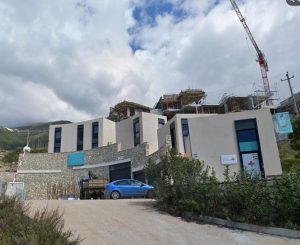
Five years after a 1.1 million euro public investment to build a police post and health center on the edge of the Green Coast resort in Palasë, the Investment Corporation plans to hand over the land for hotels in exchange for a new service center higher up the hill.
The Police Post and health center were built about five years ago in Palasë with a fund of 1.1 million euros.
Five years ago, the Albanian government spent 112 million lek through the Albanian Development Fund to build a police post, a medical emergency unit and other support services near the luxury resort “Green Coast” — christened the “Palasë Integrated Services Center.”
As part of the public investment, a helipad was also built inside the Palasa Stream, a protected natural monument, despite objections from the Protected Areas Agency.
Before five years have even passed since the investment, the Albanian Investment Corporation is seeking private partners to build hotels on the land of the Integrated Services Center in Palasë, as well as on the land where the Border Police post is located a few kilometers further south.
In return, the Corporation plans for private investors to build new facilities for the police post and emergency medical services higher up on the Palasë hill.
According to public documents, the buildings constructed in 2021 “are no longer sufficient” and through a public tender opened on July 16, 2026, the Corporation is seeking to have them built a second time.
But this time the payment is not planned to come from the state budget, but with 4,000 square meters of public land on the seafront in Palasë and Dhërmi.
Elira Kokona, head of the Albanian Investment Corporation, explained the overlap of the project with the investment made just five years ago by citing the need to expand space for public services. She stressed that the first project would be a masterplan, while adding that “we should not remain hostage to what was done earlier.”
“It is not something being done overnight. It takes into account the development of the area for another 10 years as well,” Kokona said in a telephone conversation with BIRN.
For urban planning experts, public structures should have a lifespan of several decades, and dismantling the investment within five years creates a double burden on taxpayers.
“Either this was done wrong from the start and was not planned at the time for the next 20 years, or we have an error in the second plan (for which the tender is being announced). One of the two is wrong,” urban planner Doriana Musai told BIRN.
Competition for a masterplan
The Albanian Investment Corporation (AIC) is a state mechanism set up with the aim of mobilizing private capital for projects of public interest, serving as an intermediary between public resources and major infrastructure developments.
However, AIC has also been criticized as a mechanism for transferring valuable public assets to private businesses.
The tender opened on July 16 by AIC comes at a time when thousands of Albanian citizens have been protesting for weeks, among other things against plans for the concrete overdevelopment of the country’s southern coastline. Palasë is considered one of the most meaningful examples of this transformation.
Through the tender, the Corporation is seeking private investors who will finance the international competition for the selection of the masterplan and three architectural concept proposals.
The process has been divided into two phases. In the first phase, the best candidates will be selected on the basis of the masterplan and architectural concept proposals, while in the second phase the technical and financial offers will be evaluated. The first phase closes on September 10, 2026 and envisages five finalists.
The winner will be selected on the basis of architectural quality and financial benefit for the Corporation.
To carry out the transfer of public properties on the seafront, the Corporation has used the legal instrument of entrepreneurship.
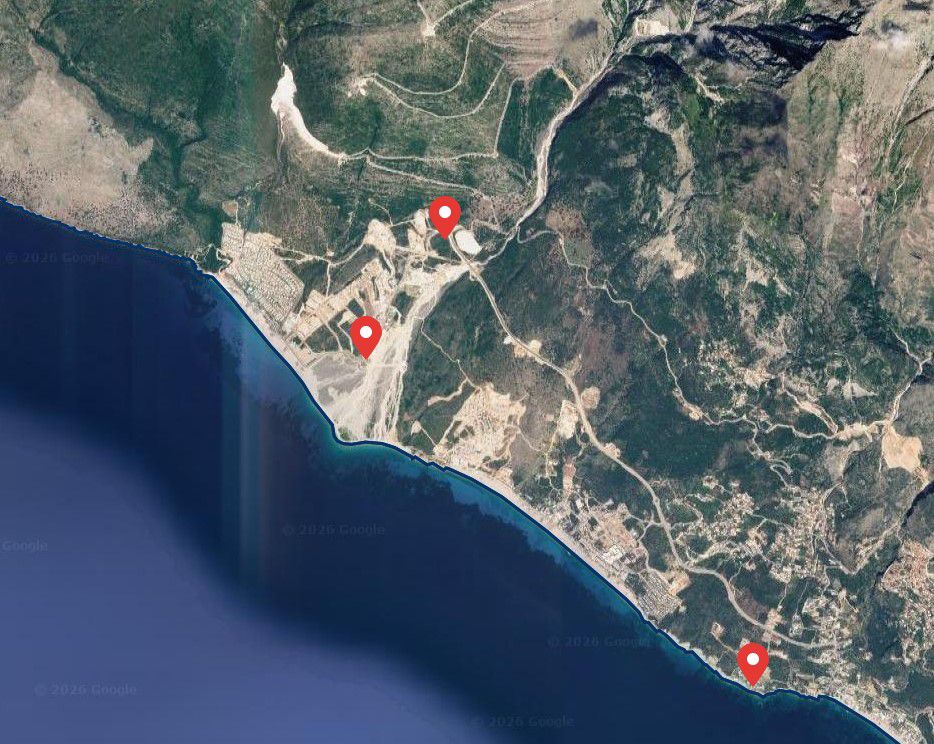
The scheme provides that a private company will finance and build the new Public Services Center in Palasë, designated as Zone 1 of the project, on an area of about 35,000 square meters of forest near the exit of the Llogara tunnel.
In return, the private investor will gain the right to develop luxury hotels and accommodation structures on two state properties transferred to the Corporation by a decision of the Council of Ministers in May of this year.
These are an area of 2,555 square meters near the Green Coast resort and the Palasa Stream, as well as another area of 1,500 square meters by the sea in Dhërmi, where the existing border point is located.
In total, the private investor will have access to more than 4,055 square meters of public land in one of the areas with the highest real estate market value in Albania, where hotel construction is planned.
As a condition of the contract, the bidder must transfer to the Corporation no less than 35 percent of the construction area.
The tender documents justify the construction of the new public services center with the increase in tourist flows.
“The main beneficiaries are the residents of the area and visitors, who will benefit from the closer and more organized presence of public structures, as well as from a safer and more functional environment throughout the year, especially during periods of high tourist flow,” the tender documentation states.
Another projected benefit is the possibility for the private sector to develop hotel activities and related services.
The project envisages around 900 square meters for the police and border station, 170 square meters for the fire station, 217 square meters for the health center, as well as 730 square meters for workspaces and accommodation for the Republic Guard.
The reason for the inclusion of the Republic Guard in this project has not been made clear.
Elira Kokona defended the project as a “strategic necessity,” arguing that the current police post does not have enough space for parking vehicles seized or blocked in the area.
Asked about the public investment made only five years earlier, she insisted that this was a matter of long-term planning.
“The first project will be a masterplan and it may turn out that there is no need for new spaces for the police,” she said.
Urban planner Doriana Musai believes these plans do not appear justified and that building new service centers would make sense only in the event of unplanned population growth beyond existing capacities.
“Territorial development has not undergone any substantial transformation in the last five years. It has developed gradually, because investments and permits in that area were granted much earlier,” Musai said.
“The risk is that this new center, too, will become non-functional in a short time,” she concluded.
Source: Reporter.al