
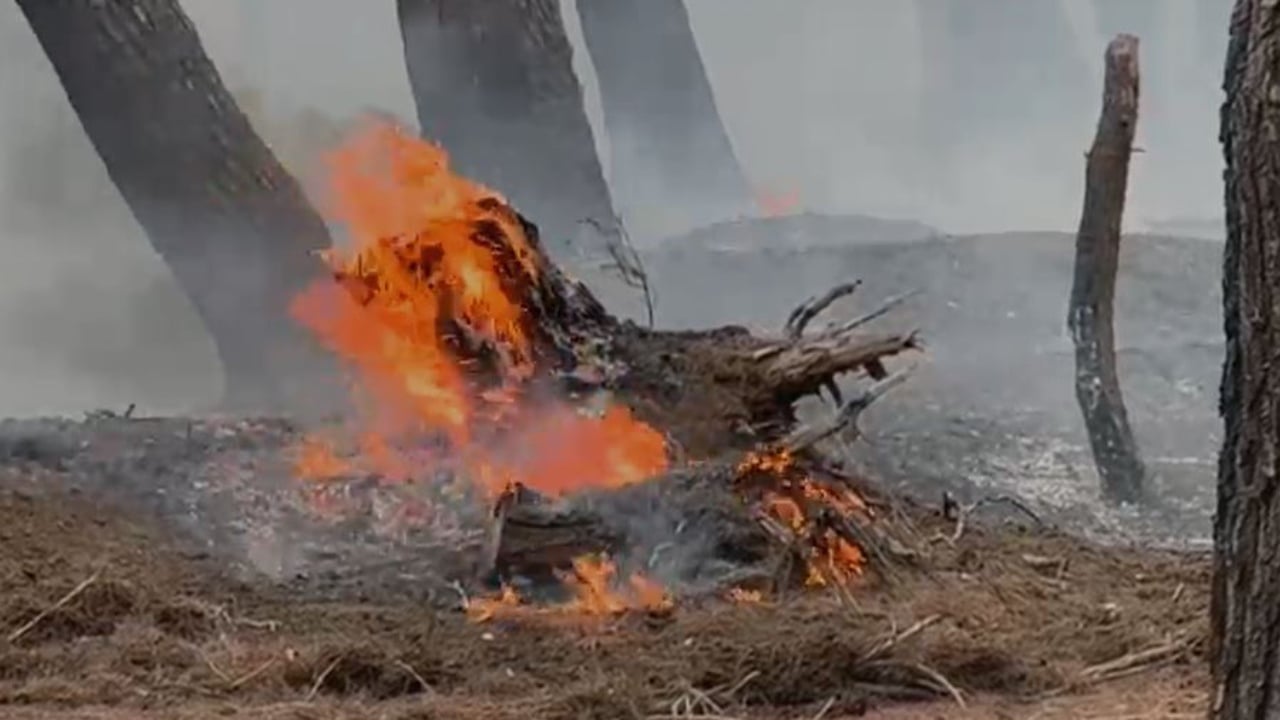
Figures published by the National Environment Agency for 2025 present an alarming toll from wildfires in the country. According to the official report, the flames affected around 34,000 hectares, while about 16,000 hectares burned in forest and pastureland. The document ranks 2025 as one of the most problematic years of the decade, with damage translating into a heavy cost for the environment and the economy.
2025, one of the worst years of the decade
The NEA report ranks 2025 as the second most problematic year after 2017 in terms of the scale of wildfires. According to official data, burned areas almost doubled compared with the 2021–2024 period.
In total, of the 34,000 hectares affected by the flames, about 16,000 hectares belonged to the forest and pastureland fund. These figures alone raise serious questions about prevention, field management and the effectiveness of institutional mechanisms during the fire season.
Financial damage exceeds 7.1 billion lek
According to the calculations included in the report, the total damage to the National Forest and Pastureland Fund reached 7,186,335,000 lek. This is a very high public and environmental bill, in a situation where the consequences are not measured only by the burned area.
During the season, 128,597.8 cubic meters of timber were also destroyed. Of this quantity, only 25,634 m³ is reported to have remained usable for exploitation, showing the real scale of the blow to forest assets.
The south bore the main burden of the fires
The fires spread across 47 municipalities, but according to the report the greatest damage was recorded in the south of the country. Delvina was the municipality with the largest burned area, at 5,845 hectares, followed by Finiq with 1,828 hectares, Tepelena with 1,512, Konispol with 1,400 and Himara with 1,081 hectares.
The list of the worst-affected areas also includes Gramsh with 982 hectares and Berat with 690 hectares. At county level, Vlora and Gjirokastra lead by a significant margin over the rest of the country.
Causes: many claims, but most cases unanswered
The official version speaks of a combination of human activity and extreme climate conditions: high temperatures, prolonged drought and strong winds, especially in areas with pine forests where the spread of flames is favored by resin and dry ground cover.
The report mentions as factors the burning of agricultural waste without safety measures, fires set to open pastureland, the throwing of lit cigarettes, faults in power lines, sparks from motor vehicles, as well as deliberate arson linked to property disputes, illegal land clearing or urban speculation.
However, despite this catalog of causes, the institutions themselves acknowledge that 150 fire cases remain of unknown origin. Only 20 cases were classified as unintentional human-caused fires and 3 as intentional, a ratio that leaves strong doubts about the actual ability to investigate and clarify the incidents.
The 2025 toll once again puts at the center the failure to contain fires before they reach uncontrollable proportions. When the damage is measured in thousands of hectares and billions of lek, responsibility cannot remain only with the climate or with a general formulation about the “human factor.”
The report’s figures show a crisis that has severely hit forests, pastureland and public finances, while a large share of cases continue without perpetrators and without clear causes.