Diesel and gasoline placed on the market are expected to come under a new control regime after the government approved the mandatory marking of fuels. According to the official version, the measure aims to ensure traceability throughout the supply chain and crack down on evasion, but it also brings a new direct cost for companies in the sector.
What the decision provides
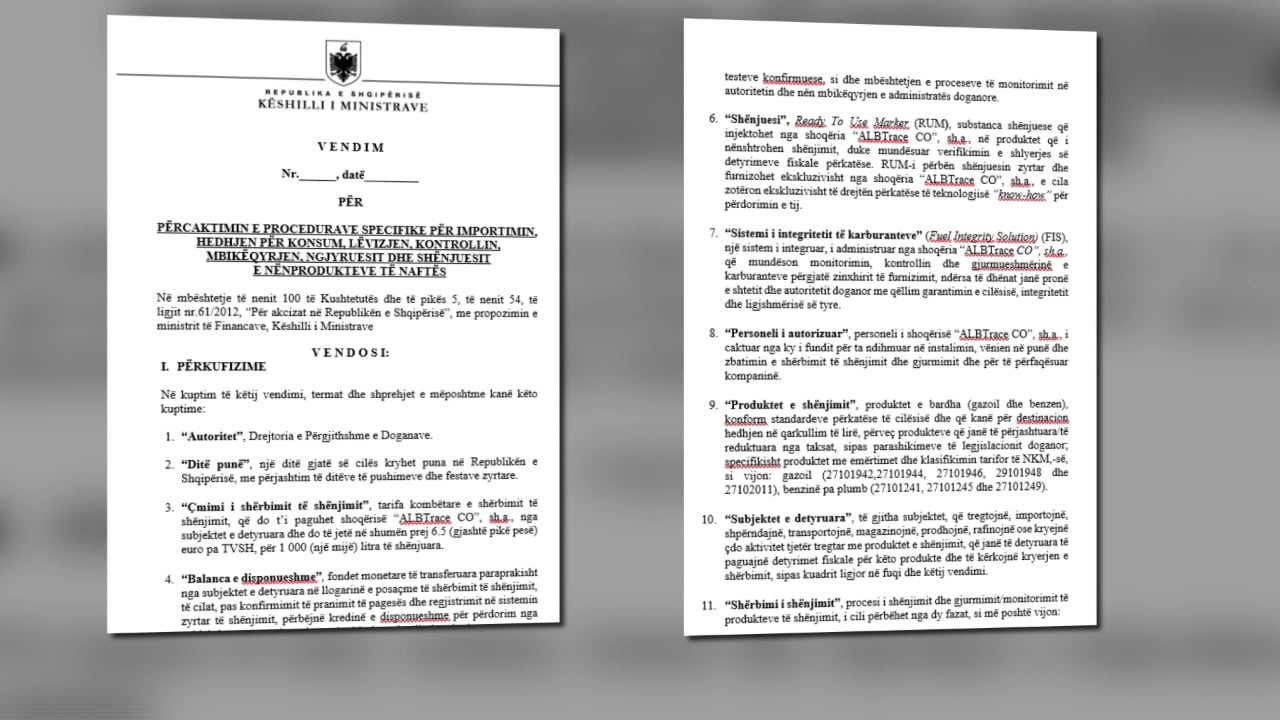
The decision approved by the government stipulates that every liter of diesel and gasoline must carry an invisible trace, which will serve to identify and track the product on the market.
According to the Finance Ministry, the system called “Fuel Integrity Solution” will make it possible to monitor, control and trace fuels at every stage of supply. The institution says the data will be the property of the state and the customs authority.
New fee for companies
Implementation of the service will not be without cost for operators. The document provides for a fee of 6.5 euros excluding VAT for every 1,000 liters of marked fuel.
This will be paid by entities that import or trade fuels, adding a new financial element in a market that directly affects prices and the supply chain.
Who will provide the service
The technical and operational component of the system will be carried out by ALBTrace CO sh.a., engaged by the government for this process.
According to the official provisions, the company will handle the relevant equipment and instruments, field tests, confirmatory tests, and support for monitoring processes, under the supervision of the customs administration.
Prohibitions and implementation deadlines
The draft decision prohibits the import, trade, transport or storage of fuels that have not been marked under the new procedures. Each shipment, after the marking process, will be issued a certificate.
The customs administration will have a role in on-the-ground monitoring and inspections to verify implementation. The new regime is expected to enter into force after an implementation period of up to six months. After this phase, fuels included in the scheme will not be allowed onto the market without going through the mandatory marking and monitoring process.
The government presents the intervention as a tool against informality and for tighter control of the fuel market. It remains to be seen how the new scheme will work in practice, what impact it will have on operators’ costs, and how much transparency there will be over its administration.